
Ever watched a tiny ring change from blue to green and wondered what happened? Learning mood ring color meanings can turn an ordinary accessory into a fascinating little window into temperature, feelings, and self-awareness.
These rings do not actually read emotions from your mind. Instead, their heat-sensitive material reacts to temperature around your finger. Still, mood ring color meanings make the experience fun, personal, and surprisingly interesting to explore.
Mood ring color meanings are fascinating. They are captivating. Society has been enthralled by them since the birth of mood rings about fifty years ago.
Mood rings became a famous novelty in the 1970s because their stones appeared to reveal the wearer’s emotional state. Their appeal came from a simple surprise: the same ring could display noticeably different colors.
Today, people still enjoy them as jewelry, gifts, conversation starters, and playful self-awareness tools. The colors may suggest a feeling, but temperature, circulation, surroundings, and the ring’s material also influence what you see.
How Do Mood Rings Work?
🌡️ A mood ring contains thermochromic material that changes color as temperature changes. In many designs, liquid crystals alter their molecular arrangement when warmed or cooled, changing how they interact with and reflect light.
💡 That means the ring measures a physical change, not an emotion itself. Your finger may become warmer or cooler because of circulation, weather, activity, stress, or excitement. The color chart simply gives that physical change an emotional interpretation.
🔬 The Simple Science Behind the Color Change
Think of the crystal layer as a tiny temperature-sensitive display. As its temperature shifts, the crystals change orientation and reflect different wavelengths of light, making the stone appear blue, green, purple, amber, or another shade.
🌡️ Why Finger Temperature Matters
Your fingers constantly exchange heat with the surrounding environment. Blood flow also changes with physical and emotional states. Because the ring sits against your skin, these temperature changes can influence its appearance without proving exactly what you feel.
Mood Ring Color Meanings
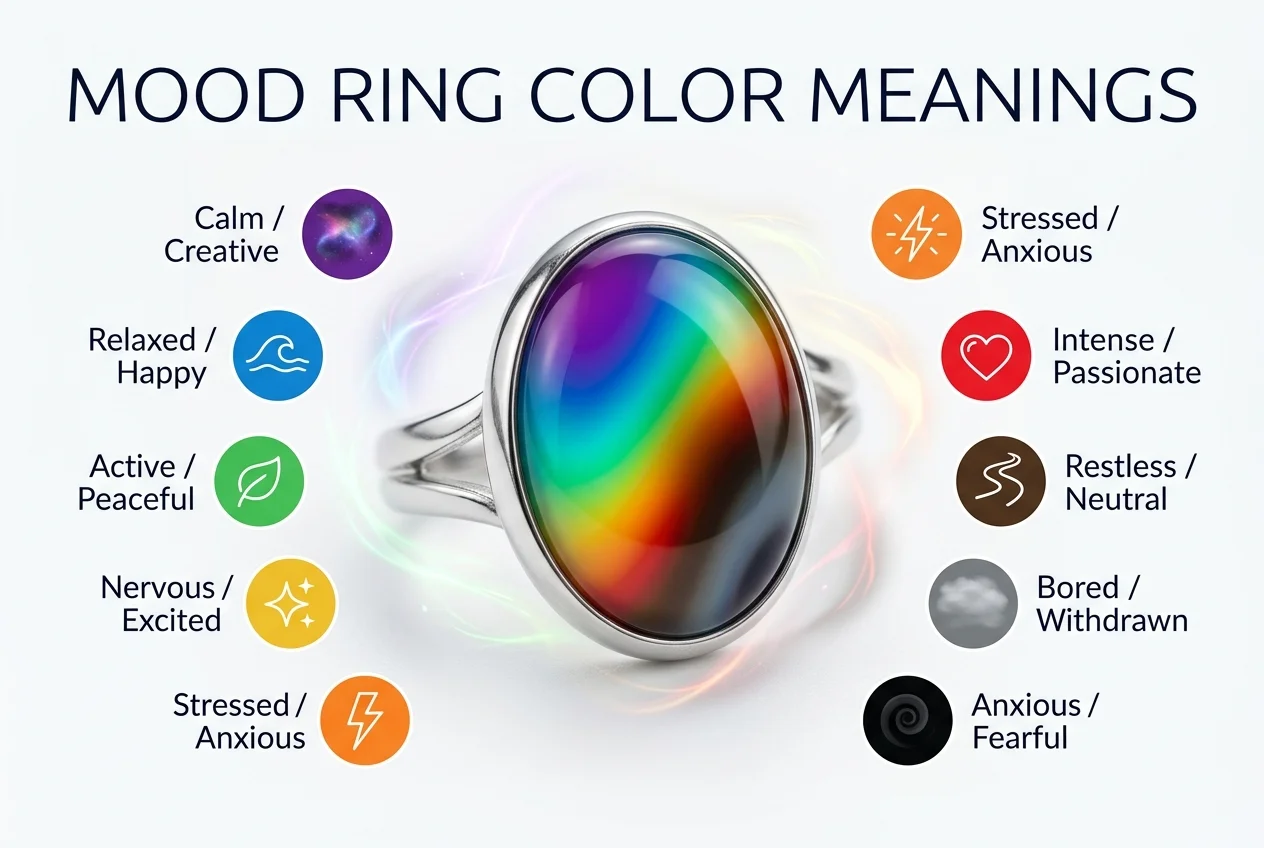
🎨 Traditional mood ring color meanings connect different shades with emotional states such as calmness, excitement, nervousness, passion, or tension. These associations are best understood as a fun interpretation system rather than a psychological test.
⚠️ There is no single universal chart for every modern ring. Manufacturers can use different thermochromic materials and temperature ranges, so the same shade may not represent exactly the same thing on every product.
💜 Purple Violet
Purple or violet is traditionally linked with strong emotional warmth. It may suggest passion, romance, excitement, affection, or happiness. Because different rings use different materials, treat this interpretation as symbolic rather than scientifically diagnostic.
❤️ Bright Red
Bright red often represents intense energy in traditional charts. It may be associated with excitement, passion, fear, or anger. A warm finger can also produce stronger colors, so the surrounding temperature should always be considered.
🧡 Orange Red
Orange-red is commonly connected with tension, nervous energy, worry, or heightened emotion. If this shade appears suddenly, consider what is happening around you before assuming it reflects your emotional state.
🟠 Orange
Orange is traditionally associated with active thoughts, stress, excitement, or restlessness. It can also appear when your finger becomes warmer. Look at the circumstances around the color change instead of relying on one interpretation.
💛 Yellow
Yellow is often linked with uncertainty, nervousness, or mixed thoughts. It can represent a middle stage between cooler and warmer readings, although the exact temperature range depends on the thermochromic material inside the ring.
🟨 Amber
Amber commonly appears in traditional charts as a sign of nervousness, excitement, or emotional uncertainty. It may simply indicate a particular temperature, so its meaning should not be treated as a definite statement about your mood.
🩵 Blue Green
Blue-green is generally viewed as a pleasant shade. Traditional interpretations connect it with confidence, optimism, comfort, and emotional balance. It can be an enjoyable color to notice, but it does not confirm that you feel any particular emotion.
💙 Blue
Blue is one of the classic mood ring shades and is usually associated with calmness, relaxation, peace, or comfort. The ring is responding to temperature, however, so a blue reading should not be treated as proof of happiness.
💚 Green
Green is traditionally considered a balanced or ordinary reading. It may symbolize calmness, stability, or a relaxed state. Because skin temperature naturally changes throughout the day, green can appear without any major emotional shift.
🤎 Brown
Brown is commonly associated with restlessness, tension, frustration, or nervousness in traditional charts. It can also indicate cooling around the finger, especially when environmental temperature changes or circulation affects the skin.
🩶 Gray
Gray is often connected with anxiety, nervousness, uncertainty, or strain. However, a cooler finger can produce a gray reading without emotional distress. Always consider temperature and surroundings before assigning an emotional explanation.
🖤 Black
Black is traditionally associated with tension, fear, anxiety, or strong negative feelings. Yet an unworn or very cold ring can also become dark, and older thermochromic jewelry could become permanently dark after moisture damage.
Read More: Cat Tail Meanings: What Your Cat Tail Says
Mood Ring Color Meanings: Ring Color Chart
📊 A quick chart makes the traditional color system easier to scan. Remember that these are common interpretations, not universal scientific rules. Modern rings can use different pigments, temperature ranges, and color sequences, so your manufacturer’s guide may differ.
| 🌈 Ring Color | 💭 Traditional Interpretation | 🌡️ Other Possible Explanation |
|---|---|---|
| 💜 Purple/Violet | Passion, romance, excitement | Warmer skin |
| ❤️ Red | Strong emotion, excitement, anger | Higher temperature |
| 🧡 Orange-Red | Tension, worry, intense energy | Temperature increase |
| 🟠 Orange | Stress, excitement, restless energy | Warm surroundings |
| 💛 Yellow | Nervousness, uncertainty | Transitional temperature |
| 🟨 Amber | Excitement, nervousness | Temperature variation |
| 🩵 Blue-Green | Confidence, optimism, comfort | Normal warm reading |
| 💙 Blue | Calmness, relaxation | Warm skin |
| 💚 Green | Balance, calmness | Typical temperature range |
| 🤎 Brown | Restlessness, frustration | Cooler temperature |
| 🩶 Gray | Anxiety, uncertainty | Cooler skin |
| 🖤 Black | Tension or fear | Cold, unworn, or damaged ring |
🔎 The key takeaway: color charts are guides, not diagnoses. A ring cannot distinguish whether your finger became warmer because you were excited, exercising, sitting in a warm room, or simply wearing the jewelry for longer.
🎨 Which Mood Ring Color Meanings Is the Happiest?
There is no scientifically established “happiest” color. Traditional charts often associate blue or violet with pleasant emotional states, but different rings use different materials and color sequences, so interpretations vary between products.
🌡️ Why Can One Ring Show Different Colors?
A ring can change because the temperature of the thermochromic material changes. Your skin, weather, activity, circulation, and contact with warm or cool objects can all influence that temperature and therefore alter the visible shade.
🌈 Can a Mood Ring Show More Than One Color?
Yes. Some mood jewelry can display multiple shades across the same piece because different areas may experience slightly different temperatures. Modern thermochromic materials can also cycle through several colors instead of following older charts.
💧 Can Water Affect a Mood Ring Color Meanings?
Moisture can damage some thermochromic mood jewelry, especially older designs. Water or high humidity may interfere with the sensitive material. Modern products vary, so follow the care instructions supplied with your particular ring.
Should I Believe My Mood Ring Color Meanings?
You can enjoy the traditional interpretations, but do not use them as a reliable measurement of your emotions. A mood ring reacts to temperature, while many things besides feelings can change the temperature of your fingers.
❄️ Cold air can make your fingers cooler.
🔥 Warm surroundings can raise their temperature.
🏃 Exercise can increase circulation.
😰 Stress can alter blood flow.
🖐️ Holding a warm or cold object can change the reading.
The best approach is to treat your ring as a prompt for self-reflection. If it turns a surprising color, pause and ask yourself how you actually feel. Your personal experience is more meaningful than any printed color chart.
🧠 Can Mood Rings Really Detect Emotions?
Not directly. Mood rings detect temperature changes and then display colors. Emotional reactions can sometimes influence circulation and skin temperature, creating an indirect connection, but the ring cannot identify a specific feeling with reliable accuracy.
❄️ Why Does My Mood Ring Turn Black?
A black reading does not automatically mean you are angry or upset. The ring may be cold, inactive, damaged, or responding to its particular thermochromic range. Older rings could also darken permanently after moisture damage.
💙 Why Does My Mood Ring Turn Blue?
Blue is traditionally associated with calmness and relaxation, but the physical explanation is temperature. Your ring may reach its blue range because of your finger temperature rather than because the jewelry has detected a particular emotion.
💚 Why Does My Mood Ring Turn Green?
Green is commonly interpreted as a balanced or calm state. Scientifically, though, the shade simply means the thermochromic material is within a particular temperature range established by the ring’s design.
Does Mood Jewelry Actually Work?
Yes, if “work” means changing color when its temperature changes. Thermochromic liquid crystals are specifically designed to produce visible color changes as temperature shifts. The part that does not work reliably is using those colors as a direct emotional diagnosis.
💍 Mood jewelry can still be enjoyable for several reasons:
- 🎨 Visual appeal: Watching a ring shift colors is naturally engaging.
- 💬 Conversation starter: Unusual color changes can invite questions.
- 🧠 Self-reflection: The color can encourage you to check how you feel.
- 👗 Fashion: Many modern designs work simply as colorful accessories.
- 🎁 Gift appeal: Their changing appearance gives them a playful quality.
The important distinction is simple: the technology behind the color change is real, but the emotional label attached to each color is largely a traditional interpretation.
🔬 Is There Real Science Behind Mood Rings?
Yes. Thermochromic liquid crystals change their optical behavior when temperature changes. Their molecular arrangement affects which wavelengths of light are reflected, producing different visible colors. That explains the color-changing effect without requiring the ring to detect thoughts.
❤️ Can Emotions Change Finger Temperature?
Emotions can produce physical responses, including changes in circulation. Stress and excitement may alter blood flow, which can affect peripheral temperature. However, those same temperature changes can have many other causes, so they cannot identify one specific emotion.
Read More:
So Did Jewelry Address the Mood Market?
Mood rings became a major novelty trend in the 1970s. Current reference material credits New York inventors Josh Reynolds and Maris Ambats with producing the first mood ring in 1975, while the broader history includes other contributors and earlier temperature-sensitive ideas.
The concept was clever because it combined science with fashion. Instead of wearing an ordinary gemstone, people could wear something that appeared to react to them.
✨ That made mood jewelry especially memorable:
- 💍 Fashion: The changing stone made ordinary jewelry more unusual.
- 🔮 Mystery: Color charts gave the ring an almost magical personality.
- 🗣️ Social appeal: People could compare their colors with friends.
- 🧪 Science: Thermochromic materials created a genuine physical effect.
- ❤️ Personal meaning: Wearers could connect the colors with their own experiences.
The trend eventually faded from the mainstream, but mood jewelry never completely disappeared. Modern versions continue to combine colorful design with the same temperature-responsive idea that made the original concept so appealing.
🕰️ When Did Mood Rings Become Popular?
Mood rings became a major fashion novelty in the 1970s after their introduction in 1975. Their unusual combination of jewelry, color-changing technology, and supposed emotional interpretation helped them attract widespread public attention.
👤 Who Invented the Mood Ring?
Josh Reynolds and Maris Ambats are widely credited with producing the first mood ring in 1975. The invention story is more nuanced, however, because other temperature-sensitive jewelry concepts and inventors are also part of the broader history.
🔮 Why Are Mood Rings Still Popular?
Their appeal is easy to understand: they combine fashion, curiosity, science, and self-expression in one small object. Even when people know the colors are not precise emotional measurements, watching the ring change remains entertaining.
Conclusion
Mood ring color meanings make these colorful accessories more than ordinary jewelry. They offer a playful way to notice temperature changes, explore traditional symbolism, start conversations, and reflect on your feelings.
Most importantly, mood ring color meanings should remain a fun guide rather than a scientific diagnosis. Enjoy the colors, notice your surroundings, and let your own emotions—not the ring—tell you how you feel.

MeaningShelf shares meaningful quotes, thoughtful messages, and helpful word meanings, managed by Lily Anderson, an SEO content writer with 2 years of experience, creating engaging content that inspires readers and helps them find the right words for every moment.
2 thoughts on “Mood Rings Colors and Meanings: A Great Way of Self-Discovery”