
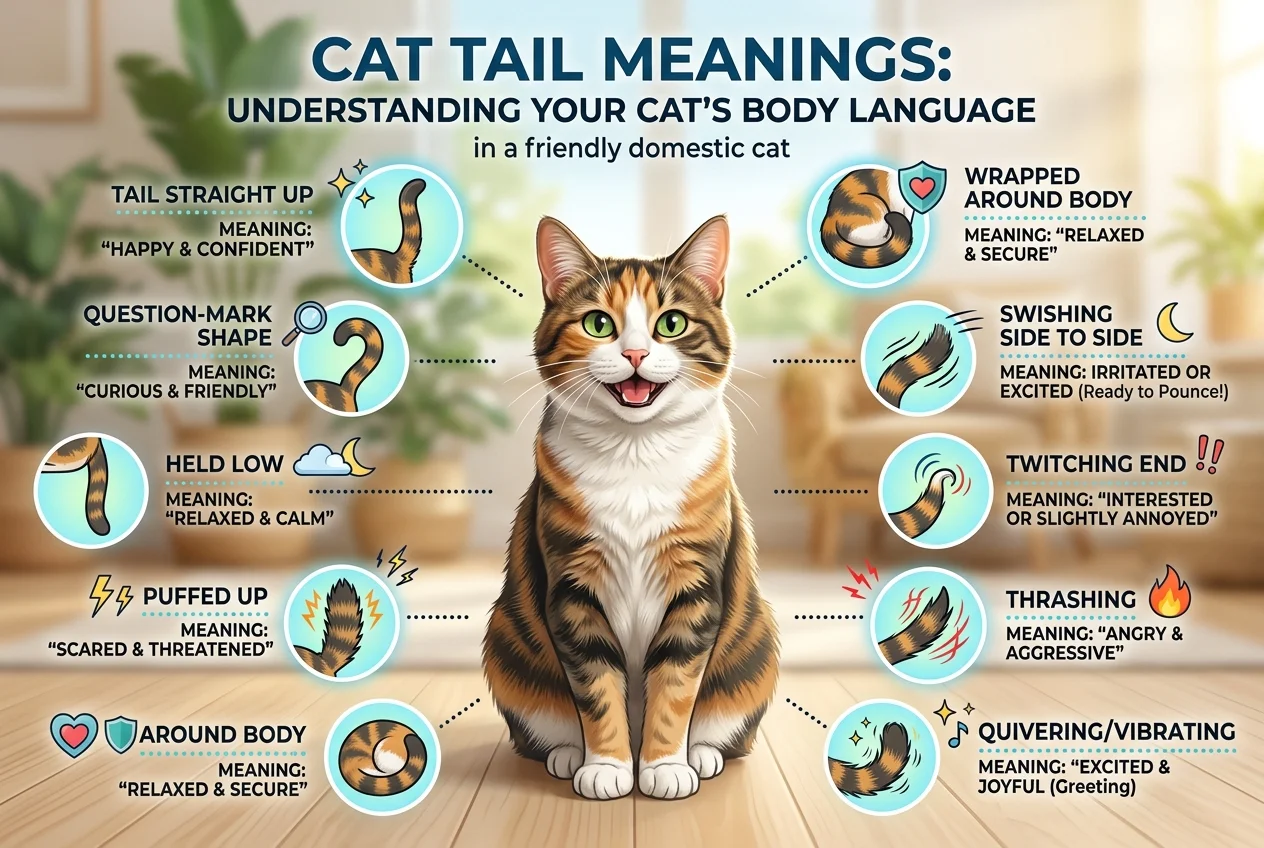
Your cat may not speak with words, but their tail is constantly sending little messages. Learning these signals can reveal whether your feline feels relaxed, curious, playful, worried, or uncomfortable.
Learning cat tail meanings becomes easier when you watch the entire cat, not just the tail. Ears, eyes, whiskers, posture, sounds, and surroundings add important clues to the message.
Why It’s Important To Decode a Cat Tail Meaning
A cat’s tail can provide useful clues about their emotional state. An upright tail may suggest confidence, while a tucked or rapidly moving tail can signal fear, stress, irritation, or discomfort.
Reading these signals helps you respond appropriately. Instead of forcing interaction, you can give a worried cat space or recognize when unusual behavior deserves veterinary attention.
Understanding Cat Tail Language
Cats communicate through a combination of tail movements, facial expressions, ear positions, and body posture. The same movement can mean different things depending on what is happening around your cat.
Think of the tail as one part of a larger conversation. A relaxed cat approaching you with an upright tail is very different from a frightened cat whose tail is puffed and whose ears are flattened.
Your Cat’s Tail Is Straight Up
A tail held straight up usually indicates confidence, friendliness, and an openness to interaction. Cats often approach people or other cats this way during a positive greeting.
Your Cat’s Tail Is a Question Mark or Hook
An upright tail with a curved tip resembling a question mark commonly signals a friendly mood. Your cat may be inviting interaction, greeting you, or showing comfortable social behavior.
Your Cat’s Tail Is Held Low to the Ground
A tail held low can indicate fear, anxiety, or discomfort. Look for crouching, flattened ears, hiding, or other unusual behavior before deciding what your cat feels.
Your Cat’s Tail Is Puffed Up
A dramatically puffed tail usually appears when a cat feels startled or threatened. Raised fur makes the animal appear larger, while an arched back can reinforce this defensive warning.
Your Cat’s Tail Is Wrapped Around Their Body
A cat sitting with its tail tightly wrapped around the body may feel frightened, defensive, cold, painful, or unwell. Repeated unusual posture should be discussed with a veterinarian.
Why Do Cats Wag Their Tails?
Cats move their tails for many reasons, so a wag does not automatically mean happiness. Speed, direction, intensity, body posture, and the surrounding situation all help reveal the message.
A slow swish during play can show intense concentration, while rapid thrashing may signal irritation. This is why interpreting cat tail meanings requires looking at the whole situation rather than one movement alone.
Thrashing Tail Movements
A forceful, rapidly moving or thumping tail often means your cat is irritated, angry, or overstimulated. During petting, this can be a clear signal that they want the interaction to stop.
Twitching the End of the Tail
A twitching tail tip can appear during hunting, play, or mild frustration. Watch what your cat is focused on. A toy or moving object may explain the behavior.
Swishing Tails
Slow side-to-side swishing often happens when a cat is intensely focused on something. They may be watching prey, another animal, or a toy and preparing to pounce.
Tail Quivers
A quivering upright tail can occur when a cat is excited to see someone. Similar movements can also occur during urine marking, so the surrounding behavior provides an important clue.
Read More:
Why Do Cats Wrap Their Tails Around You?
When a cat curls its tail around your legs or another cat, it can be a friendly social gesture. Tail wrapping may accompany greetings and demonstrates a willingness to interact.
It is often compared with a human hug, but every cat has individual preferences. Let your cat decide whether they want further contact rather than assuming every tail position means the same thing.
Why do cats have tails? | Cat tail meanings
A cat’s tail is more than decoration. It helps with balance, environmental awareness, and communication. Cats can adjust its position while moving, climbing, jumping, or interacting with others.
Understanding cat tail meanings therefore involves both behavior and anatomy. The tail is connected to the spine and contains vertebrae, muscles, ligaments, tendons, and nerves that allow flexible movement.
How to read cat tail meanings
Start by observing the tail’s position, movement, and speed. Then check the ears, eyes, whiskers, body posture, sounds, and what is happening nearby before interpreting the signal.
| Tail behavior | Common clue |
|---|---|
| Straight up | Friendly or confident |
| Question-mark shape | Happy and social |
| Low or tucked | Fear, anxiety, or discomfort |
| Puffed | Threatened or frightened |
| Rapid thrashing | Irritation or agitation |
| Slow swishing | Focus or hunting |
| Quivering upright tail | Excitement or possible marking |
| Wrapped around you | Friendly social behavior |
These are useful guidelines, not rigid rules. Cats have individual personalities, and context matters greatly when reading feline body language.
Why cats have tails
Cats use their tails for several important jobs. A major function is balance: the tail acts as a counterweight when cats climb, jump, turn, or move along narrow surfaces.
The tail also contributes to environmental awareness and communication. Cats cannot directly see everything behind them, so sensory information from the tail can help them detect nearby changes.
Cat tail meanings
Different positions and movements can communicate different emotional states. The most useful clues include:
- Upright: confidence and friendly greeting.
- Curved tip: social, positive interaction.
- Low: fear, anxiety, or discomfort.
- Tucked: insecurity, fear, or possible pain.
- Puffed: feeling threatened.
- Rapidly moving: agitation or high arousal.
- Slowly swishing: concentration or hunting.
- Wrapped around a person: friendly social contact.
Remember that tail behavior should be combined with facial expressions and body posture. A single signal rarely tells the complete story.
Do cats have full control of their tails?
Yes. Cats can voluntarily control their tails from the base toward the tip. A typical cat tail contains about 19–23 vertebrae supported by muscles, ligaments, and tendons, giving it considerable flexibility.
This control helps cats communicate and adjust their bodies during movement. However, tail injuries can affect nerves and function, so sudden changes in tail movement should not be ignored.
Why do cats chase their tails?
Kittens commonly chase their tails during play as they develop hunting and coordination skills. A moving tail can resemble prey, triggering the instinct to chase, grab, or bite.
Occasional tail chasing is usually harmless, but repetitive chasing or biting can signal boredom, irritation, or another problem. Provide appropriate interactive play and seek veterinary advice if the behavior becomes persistent.
Why do some cats have no tail?
Some cats are naturally born with very short tails or no visible tail. The Manx is a well-known example, while Bobtail-type cats may have naturally shortened tails because of genetic variations.
Tailless cats can adapt surprisingly well and use other body-language signals for communication. They can also compensate for reduced tail function during movement, although certain inherited traits can be associated with health concerns.
Why does my cat have a crooked tail?
A crooked or kinked tail can result from an old injury, developmental variation, or genetics. Some cats naturally have a curved or kinked tail without experiencing any problem.
If the tail suddenly changes shape, becomes painful, stops moving normally, or follows an injury, contact your veterinarian. A professional examination can help determine whether the change is harmless or needs treatment.
5 facts about cat tails
- A cat’s tail contains numerous vertebrae that allow flexible movement.
- The tail helps cats maintain balance while climbing and jumping.
- Tail position is an important part of feline body language.
- Some cats naturally have extremely short tails or no tail.
- Cats can use their tails to communicate both positive and negative emotional states.
Read More:
Conclusion
Learning cat tail meanings can make everyday interactions easier and more respectful. Watch the tail alongside the ears, eyes, posture, sounds, and surrounding situation for better clues.
The more carefully you observe cat tail meanings, the easier it becomes to recognize greetings, play, fear, irritation, and discomfort. Give your cat space whenever their signals suggest stress or pain.

MeaningShelf shares meaningful quotes, thoughtful messages, and helpful word meanings, managed by Lily Anderson, an SEO content writer with 2 years of experience, creating engaging content that inspires readers and helps them find the right words for every moment.
1 thought on “Cat Tail Meanings: What Your Cat Tail Says”