
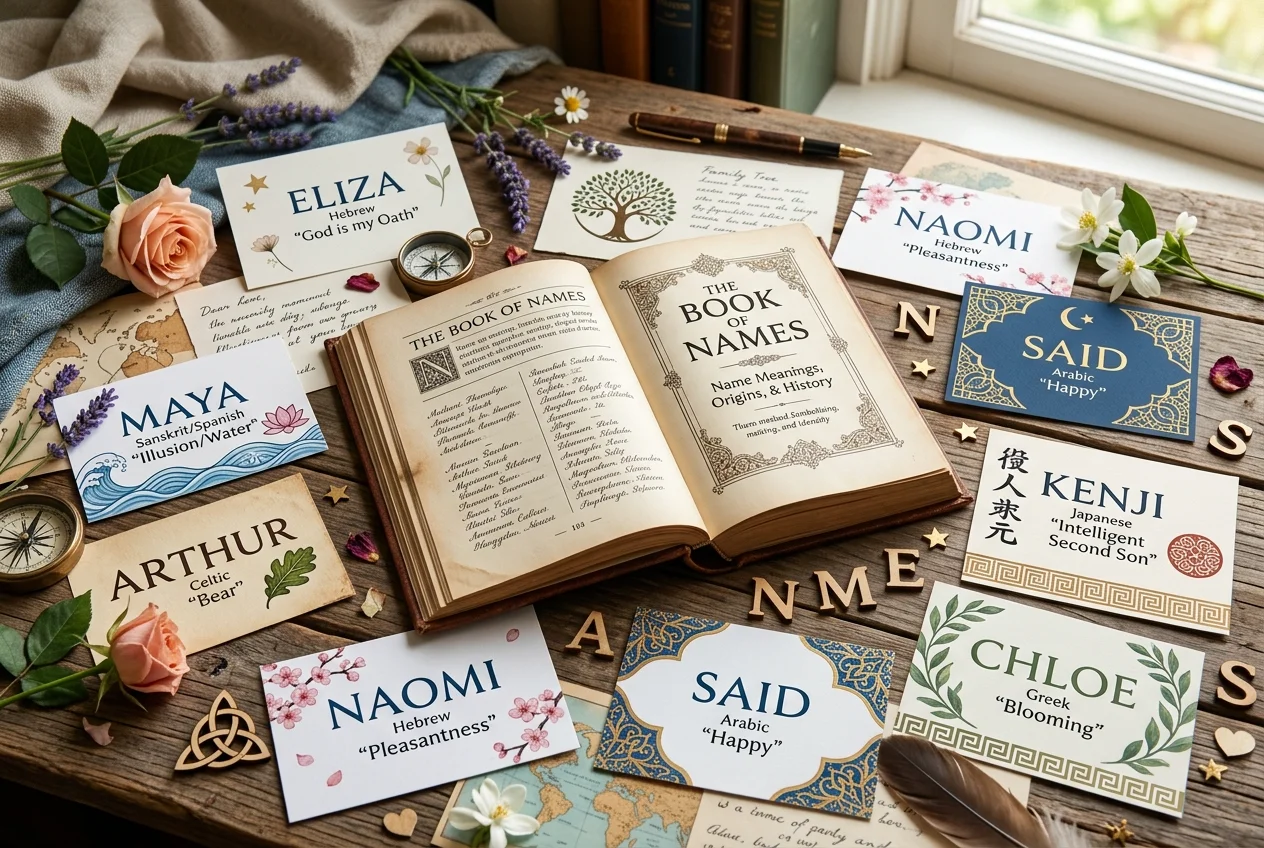
Choosing a name can feel surprisingly personal. A name may carry history, culture, family traditions, or a simple idea that parents hope their child will embody throughout life.
Understanding name meanings can reveal fascinating connections between languages, religions, places, and generations. From timeless classics to modern choices, every name can have a story worth exploring.
What Is a Name Meaning?
A name meaning describes the word, idea, quality, object, or concept traditionally connected with a personal name. Some names come from ordinary words, while others developed from ancient languages, family traditions, occupations, or religious expressions.
🔹 A name may represent:
- ❤️ Love or affection
- 💪 Strength or courage
- ✨ Light or brightness
- 🌿 Nature or flowers
- 🕊️ Peace or grace
- 📖 Faith or wisdom
The meaning can sometimes be literal and sometimes symbolic. That difference is important when researching a name because popular websites may simplify complicated historical origins.
Why Do Names Have Meanings?
Names developed for practical, cultural, and personal reasons. In older societies, a name could describe someone’s appearance, occupation, birthplace, family connection, personality, or an important event surrounding birth.
🌟 Common reasons names developed include:
- 👨👩👧 Family: honoring relatives or ancestors
- 🛡️ Character: expressing courage or strength
- 🌸 Nature: using flowers, animals, places, or seasons
- 🙏 Religion: reflecting faith or spiritual beliefs
- 🗺️ Location: connecting someone with a place
- 💝 Hope: expressing a parent’s wishes
As languages changed, original words sometimes became difficult to recognize.
Name Meaning vs. Name Origin
A name’s meaning and origin are closely related, but they answer different questions. Meaning explains what the name or its root traditionally represents, while origin identifies the language, culture, or historical tradition where it developed.
🔵 Think of them this way:
| Term | What it tells you |
|---|---|
| Meaning | What the name represents |
| Origin | Where the name developed |
| Etymology | How the word or name evolved |
| History | How people used the name |
| Pronunciation | How the name is traditionally spoken |
Looking at all these details provides a fuller picture.
How Are Name Meanings Determined?
Researchers examine old languages, written records, historical spellings, pronunciation changes, and related words when studying personal names. They may compare a name with older forms from the same language family.
🔎 Reliable research often considers:
- 📜 Historical records
- 🗣️ Ancient pronunciation
- ✍️ Earlier spellings
- 🌍 Language and culture
- 📚 Historical dictionaries
- ⏳ Changes across centuries
- 🔤 Related linguistic roots
This matters because attractive definitions online are not always historically proven. A trustworthy explanation should separate documented evidence from modern interpretations.
Popular Baby Name Meanings
Parents often look for names connected with positive qualities. A meaningful name can reflect family hopes without needing to be unusual or difficult to pronounce.
💖 Popular themes include:
- ❤️ Love and affection
- ✨ Light and brightness
- 🌱 Growth and life
- 🕊️ Peace and harmony
- 💪 Strength and courage
- 🌈 Hope and happiness
- 👑 Leadership and nobility
- 🌸 Beauty and grace
A familiar name can have an ancient history, while an uncommon name may have a newer origin. Meaning is only one part of choosing a suitable baby name.
Boy Names and Their Meanings
Boy names are frequently explored through qualities such as courage, strength, leadership, wisdom, protection, and bravery. Traditional choices may have centuries of history, while newer names can reflect changing cultural preferences.
💙 When comparing boy names, consider:
- 💪 Meaning and symbolism
- 🌍 Cultural origin
- 🗣️ Pronunciation
- ✍️ Spelling
- 👨👩👦 Family connections
- ⭐ Popularity
- 🧸 Possible nicknames
A powerful meaning is appealing, but the name should also sound natural with the child’s surname.
Girl Names and Their Meanings
Girl names are commonly associated with beauty, grace, love, light, flowers, nature, happiness, and strength. Many popular choices have histories that cross several countries and languages.
🌷 Useful factors to compare include:
- 🌸 Traditional meaning
- 💕 Emotional association
- 🌍 Cultural background
- 🗣️ Pronunciation
- ✨ Spelling variations
- 📈 Current popularity
- 👧 Possible nicknames
A beautiful online definition should still be checked against the name’s actual linguistic history before being treated as its original meaning.
Read More: Nissan Dashboard Symbols and Meanings: Complete Guide
Unisex Names and Meanings
Unisex names can suit people of different genders and often appeal to parents seeking flexible, modern choices. Many come from nature, occupations, places, surnames, or qualities rather than traditionally gendered meanings.
🟢 Examples of useful categories include:
- 🌿 Nature-inspired names
- 🏙️ Place names
- 🧑🎨 Occupational names
- 💫 Virtue names
- 👨👩👧 Family surnames
- 🌈 Modern gender-neutral choices
Gender usage can change over time. A name that was once strongly associated with one gender may later become more evenly used.
Names That Mean Love
Names associated with love can represent affection, devotion, beloved relationships, or emotional connection. Some have a direct linguistic connection with the word “love,” while others became associated with affection through tradition or culture.
❤️ Love-related themes include:
- 💕 Love
- 💗 Beloved
- 💞 Affection
- 💝 Devotion
- 🌹 Romance
- 🫶 Friendship
- 💖 Cherished
Always check the original language. A name described as “love” may actually mean beloved, dear, or another related concept.
Names That Mean Strength
Strength-related names can represent physical power, courage, resilience, firmness, protection, or strong character. These names appeal to parents who want a choice connected with confidence and determination.
💪 Strength can appear through different ideas:
- 🛡️ Protector
- ⚔️ Warrior
- 🦁 Brave
- 👑 Leader
- 💪 Strong
- 🔥 Powerful
- 🏔️ Enduring
Different cultures express strength differently. One name may refer directly to physical power, while another may symbolize courage or protection.
Names That Mean Light
Light has been an important naming theme across many cultures. It can represent brightness, knowledge, hope, guidance, purity, or a fresh beginning.
✨ Light-related ideas include:
- ☀️ Sun
- 🌙 Dawn
- ⭐ Star
- 💡 Brightness
- 🌅 New beginning
- 🕯️ Guidance
- 🌟 Radiance
Some names literally come from words meaning light. Others are connected with light through religion, mythology, poetry, or cultural symbolism.
Names That Mean Hope
Hope-related names express optimism, expectation, trust, or the belief that something positive lies ahead. Families may choose them to represent a new beginning or an especially meaningful moment.
🌈 Common ideas connected with hope include:
- 🌱 New beginnings
- 💚 Optimism
- 🌅 A fresh start
- 🕊️ Peace
- 🙏 Faith
- ☀️ Bright future
- 💫 Positive expectation
The exact definition depends on the language. A name may literally mean hope or carry a related idea such as trust or expectation.
Names That Mean Wisdom
Wisdom represents knowledge, understanding, judgment, experience, and thoughtful decision-making. Names connected with wisdom can be found in ancient languages, religious traditions, mythology, and historical naming systems.
🧠 Wisdom-related concepts include:
- 📚 Knowledge
- 🧠 Understanding
- 👁️ Insight
- 🎓 Learning
- ⚖️ Good judgment
- 🌟 Intelligence
- 📖 Experience
Some names literally translate to wisdom, while others became associated with wise historical or fictional figures.
Names Inspired by Nature
Nature-inspired names can come from flowers, trees, animals, rivers, oceans, mountains, seasons, weather, or celestial objects. They are attractive because they can feel both familiar and distinctive.
🌿 Popular nature categories include:
- 🌸 Flowers
- 🌳 Trees
- 🦊 Animals
- 🌊 Water
- 🏔️ Mountains
- 🌙 Celestial objects
- 🌧️ Weather
- 🍂 Seasons
Nature can also have different symbolism in different cultures, so cultural context adds valuable meaning.
Names Connected With Flowers
Flower names can symbolize beauty, growth, affection, renewal, femininity, or particular cultural traditions. Many have become established personal names rather than simply botanical references.
🌺 Well-known flower-related names include:
- 🌹 Rose
- 🌸 Lily
- 💜 Violet
- 🌼 Daisy
- 🌺 Jasmine
- 🌷 Iris
A flower’s symbolism should not automatically be confused with its name’s original linguistic meaning. Historical origin and cultural symbolism may tell different stories.
Names Connected With the Moon and Stars
Celestial names often evoke the moon, stars, sky, dawn, or other elements of the heavens. They can create a sense of wonder and are especially appealing to families seeking nature-inspired choices.
🌙 Celestial themes include:
- 🌙 Moon
- ⭐ Star
- ☀️ Sun
- 🌅 Dawn
- 🌌 Sky
- ✨ Brightness
- 🌠 Heavenly imagery
Ancient civilizations closely observed the sky, so celestial references appear in many traditional naming systems and mythologies.
Names With Religious Meanings
Religious traditions have influenced personal names for thousands of years. Biblical, Islamic, Hindu, Buddhist, and other traditions include names connected with faith, blessings, virtues, prophets, spiritual concepts, and sacred stories.
🙏 Religious name themes may include:
- ✝️ Faith
- ☪️ Devotion
- 🕊️ Peace
- 🙏 Blessing
- ❤️ Mercy
- 🌟 Divine ideas
- 📖 Sacred history
A name’s literal translation may differ from the cultural or religious significance it carries within a community.
Names by Language and Origin
Names can originate in almost every language and cultural tradition. English, Hebrew, Arabic, Greek, Latin, Irish, Celtic, Japanese, Sanskrit, Germanic, French, Spanish, and Norse traditions have all contributed widely used names.
🌍 Popular origin categories include:
| Origin | Common associations |
|---|---|
| Hebrew | Biblical and religious traditions |
| Arabic | Virtues, qualities, faith |
| Greek | Mythology, virtues, history |
| Latin | Roman and European traditions |
| Japanese | Kanji, nature, cultural meaning |
| Irish | Gaelic history and folklore |
| Celtic | Mythology and nature |
| Sanskrit | Ancient Indian languages and traditions |
Names can travel between cultures and develop new forms.
Hebrew Name Meanings
Hebrew names are strongly represented in biblical history and Jewish naming traditions. Many connect with faith, God, blessings, peace, life, gratitude, or personal qualities.
📜 Important considerations include:
- ✡️ Biblical history
- 📖 Hebrew language
- 🕊️ Religious significance
- 🔤 Transliteration
- 🗣️ Pronunciation
- 🌍 International variations
Some Hebrew names entered English and other languages through religious texts. Their modern spelling may therefore differ substantially from the earliest form.
Arabic Name Meanings
Arabic names often connect with virtues, qualities, nature, religion, beauty, generosity, nobility, strength, or positive characteristics. Their exact interpretation depends on Arabic linguistic roots and cultural usage.
🕌 When researching an Arabic name, check:
- 🔤 Arabic root
- 🗣️ Original pronunciation
- ✍️ English transliteration
- 🌍 Regional usage
- 🙏 Religious associations
- 📜 Historical context
Different English spellings can represent the same Arabic name, making careful comparison particularly important.
Greek Name Meanings
Greek names have influenced European naming traditions for centuries. They may connect with mythology, virtues, nature, occupations, physical characteristics, victory, strength, or ancient historical figures.
🏛️ Greek naming traditions are connected with:
- 🏺 Ancient Greece
- ⚡ Mythology
- 🏆 Victory
- 💪 Strength
- 🌿 Nature
- 📜 Classical literature
- ✝️ Early Christianity
Many ancient Greek names later entered other European languages, creating modern forms that may look quite different from their original versions.
Latin Name Meanings
Latin contributed many names to European languages. Some developed from ordinary Latin words, while others came from Roman family names, titles, descriptive terms, or historical figures.
🏛️ Latin-origin names can be found in:
- 🇮🇹 Roman history
- ⛪ Christian traditions
- 📚 Classical literature
- 🌍 European languages
- 👑 Historical families
- 🏺 Ancient Roman culture
Because Latin influenced several later languages, a Latin-origin name may have different modern pronunciations and spellings.
Japanese Name Meanings
Japanese names require special care because meaning can depend heavily on the written characters. Different kanji can produce different meanings even when names have the same or similar pronunciation.
🇯🇵 Important factors include:
- 漢字 Kanji selection
- 🗣️ Reading and pronunciation
- ✍️ Written form
- 🌸 Nature references
- 👨👩👧 Family traditions
- 🎎 Cultural context
Therefore, a Japanese name should not always be assigned one universal meaning without knowing how it is written.
Irish and Celtic Name Meanings
Irish and Celtic naming traditions include names connected with mythology, nature, warriors, royalty, places, and personal qualities. Many survive through folklore, literature, and family traditions.
☘️ Their history can involve:
- 🏰 Ancient kingdoms
- ⚔️ Warriors
- 🌿 Nature
- 🧚 Folklore
- 👑 Royal traditions
- 📜 Gaelic languages
English spelling often differs from historical Gaelic forms. Pronunciation can change too, which explains why some familiar Celtic names sound unexpected.
Names by Meaning and Theme
Searching by theme can make choosing a name much easier. Instead of scanning thousands of alphabetical entries, parents can begin with one idea that feels personally meaningful.
🎯 Popular themes include:
- ❤️ Love
- 💪 Strength
- ✨ Light
- 🌈 Hope
- 🧠 Wisdom
- 🕊️ Peace
- 🌸 Beauty
- 👑 Leadership
- 🌿 Nature
- 🎁 Gift
- 😊 Joy
- 🛡️ Protection
This method narrows a broad search into a more personal and manageable shortlist.
| Theme | What it may represent |
|---|---|
| ❤️ Love | Affection, devotion, beloved |
| 💪 Strength | Power, courage, resilience |
| ✨ Light | Hope, brightness, guidance |
| 🧠 Wisdom | Knowledge, insight, judgment |
| 🌈 Hope | Optimism, expectation |
| 🕊️ Peace | Calm, harmony |
| 🌸 Grace | Beauty, kindness, blessing |
| 🌿 Nature | Flowers, animals, earth |
| 😊 Joy | Happiness, delight |
| 🛡️ Protection | Safety, guardianship |
How Name Meanings Change Over Time
Languages constantly evolve. Sounds disappear, words change, spelling becomes standardized, and expressions that once had obvious meanings can eventually become unfamiliar.
⏳ A name can change because of:
- 🔤 Spelling changes
- 🗣️ Pronunciation shifts
- 🌍 Migration
- 📚 Religious influence
- 👨👩👧 Family traditions
- 🏛️ Historical events
- 🌐 Language mixing
This explains why the modern form of a name may look very different from its earliest recorded version.
Why One Name Can Have Multiple Meanings
A name can have multiple interpretations because it may exist in several languages or have different historical spellings. Similar pronunciations can also develop independently in different cultures.
🔍 Multiple meanings may result from:
- 🌍 Different languages
- ✍️ Spelling variations
- 🗣️ Pronunciation changes
- 📜 Separate historical roots
- 🔤 Transliteration
- 💫 Later symbolic associations
A careful explanation should distinguish the documented origin from newer interpretations rather than presenting every definition as equally certain.
Read More: Mood Rings Colors and Meanings: A Great Way of Self-Discovery
How to Research a Name Properly
Good research begins with the exact spelling and pronunciation. Next, examine the language of origin, earliest known form, historical usage, and established translation.
📚 A useful research checklist:
- ✅ Identify the original language
- ✅ Check historical spellings
- ✅ Compare reliable references
- ✅ Examine the linguistic root
- ✅ Check cultural context
- ✅ Separate literal meaning from symbolism
- ✅ Verify popularity using official data when relevant
This process helps avoid repeating attractive but unsupported claims.
Are Popular Names More Meaningful?
Popularity has no connection with the depth of a name’s history. A widely used name can have ancient roots, while an uncommon name may have a very recent origin.
⭐ Parents may prefer:
- 👨👩👧 Familiar names
- 🌟 Rare names
- 🏛️ Traditional names
- 🆕 Modern names
- 🌍 International names
- ❤️ Family names
The best choice depends on personal preference, cultural connection, pronunciation, family history, and the meaning the parents value.
Most Popular Baby Names in the United States
The U.S. Social Security Administration publishes annual baby-name statistics. The latest available 2025 national data ranks Liam first for boys and Olivia first for girls. Social Security Administration Baby Names
📊 The 2025 top five were:
| Rank | Boys | Girls |
|---|---|---|
| 🥇 1 | Liam | Olivia |
| 🥈 2 | Noah | Charlotte |
| 🥉 3 | Oliver | Emma |
| 4 | Theodore | Amelia |
| 5 | Henry | Sophia |
| 6 | James | Mia |
| 7 | Elijah | Isabella |
| 8 | Mateo | Evelyn |
| 9 | William | Sofia |
| 10 | Lucas | Eliana |
These rankings measure frequency, not whether one name is more meaningful than another.
How U.S. Name Popularity Is Measured
The Social Security Administration uses Social Security card application data to produce U.S. baby-name statistics. Its database allows users to explore national and state-level naming patterns across many years.
📈 The data can help you understand:
- 🇺🇸 U.S. name popularity
- 📅 Year-to-year changes
- 👶 Birth-name frequency
- 🗺️ State-level patterns
- 👦 Boys’ rankings
- 👧 Girls’ rankings
- 📊 Historical trends
The SSA’s historical baby-name data extends back to 1880, making it useful for comparing modern choices with earlier generations. SSA Popular Baby Names
Popular Names Can Change Quickly
A name’s ranking can rise or fall because of cultural trends, public figures, entertainment, migration, regional preferences, or changing attitudes toward older names.
🔄 Popularity can be influenced by:
- 🎬 Movies and television
- 🎵 Music and celebrities
- 👑 Public figures
- 🌍 Immigration and culture
- 👨👩👧 Family traditions
- 📱 Modern trends
- 🕰️ Revival of older names
That is why a name’s current popularity should always be separated from its historical meaning.
Name Popularity by State
National rankings provide a broad picture, but regional preferences can look very different. The SSA publishes state-level statistics showing the most frequently given names within individual states.
🗺️ State comparisons can reveal:
- 🌎 Regional preferences
- 📈 Local trends
- 👶 Popular choices
- 👦 Boys’ rankings
- 👧 Girls’ rankings
A name that ranks highly nationally may not have the same position in every state. Regional data can therefore add useful context when researching American naming trends.
How to Choose a Meaningful Name
Start with the idea you want the name to represent. Then create a shortlist and compare meaning, origin, pronunciation, spelling, cultural connection, and current popularity.
💡 A practical process is:
- ❤️ Choose a meaningful theme.
- 🌍 Select possible cultural origins.
- 📖 Research the historical meaning.
- 🗣️ Say each name aloud.
- ✍️ Check spelling and pronunciation.
- 👨👩👧 Try it with the surname.
- ⭐ Consider popularity.
- 💝 Choose the one that feels right.
A meaningful choice should also be comfortable for everyday use.
Check the Meaning Before Choosing
An attractive definition on a naming website is not automatically historically accurate. Before choosing a name, determine whether its definition is literal, traditional, symbolic, or a modern interpretation.
🔎 Before deciding, ask:
- ❓ Is the origin documented?
- ❓ What language does it come from?
- ❓ Does the translation match the original word?
- ❓ Are there alternate spellings?
- ❓ Does the culture use the same interpretation?
- ❓ Is the source reliable?
A few minutes of verification can prevent years of repeating inaccurate information.
Common Mistakes When Researching Names
Name research can become confusing when websites copy information from one another. A definition may appear on dozens of pages without any clear historical evidence behind it.
⚠️ Watch for these common mistakes:
- ❌ Treating symbolism as literal meaning
- ❌ Confusing similar names
- ❌ Ignoring spelling variations
- ❌ Assuming one culture owns a name
- ❌ Trusting unsourced lists
- ❌ Confusing popularity with origin
- ❌ Assuming every online definition is proven
Reliable research should clearly explain what is known and what remains uncertain.
Do Name Meanings Predict Personality?
No. A traditional name definition does not scientifically determine someone’s personality, behavior, intelligence, abilities, or future.
🧠 A name may symbolize:
- 💪 Courage
- ❤️ Love
- 🧠 Wisdom
- 🌟 Brightness
- 🕊️ Peace
But these are associations rather than predictions. A person’s character develops through experiences, relationships, environment, decisions, and individual personality.
Why Name Meanings Matter
Names can connect people with parents, grandparents, ancestors, languages, religions, communities, and historical traditions. For many families, the meaning provides an emotional reason for choosing one name over another.
💝 A name may represent:
- 👨👩👧 Family heritage
- 🌍 Cultural identity
- 🙏 Faith
- 🌱 Hope for the future
- 🕰️ Connection with history
- ❤️ Personal memories
- 🎁 A meaningful blessing
Over time, the person carrying the name can give it an entirely new and personal story.
Name Meanings in Different Cultures
There is no single universal naming system. Cultures differ in how they use given names, family names, inherited names, religious names, birth-order names, and symbolic names.
🌎 Naming traditions may emphasize:
- 👵 Ancestors
- 🙏 Religion
- 🌿 Nature
- 👶 Birth circumstances
- 💝 Family hopes
- 🏛️ Historical figures
- 🗣️ Language
- 👨👩👧 Community traditions
Understanding these differences creates more accurate research and helps avoid applying one culture’s interpretation to another.
Frequently Asked Questions
What are name meanings?
They describe the traditional linguistic, cultural, historical, or symbolic ideas associated with personal names. A name may relate to a quality, object, place, occupation, religious idea, or nature.
How can I find a name’s origin?
Check reliable references for its language, earliest recorded form, historical spelling, pronunciation, and documented usage. Comparing several trustworthy sources can reveal differences or uncertainty.
Can one name have different meanings?
Yes. Different languages, spellings, pronunciations, and cultural traditions can create multiple interpretations. Some names also develop symbolic associations after becoming established personal names.
What names mean love?
Many cultures have names associated with love, affection, devotion, or beloved relationships. The exact interpretation depends on the original language and historical context.
What names mean strength?
Strength-related names can represent courage, power, resilience, bravery, protection, or leadership. Their exact definitions vary according to language and cultural tradition.
What names mean light?
Names connected with light may literally describe brightness or symbolically represent hope, guidance, knowledge, purity, or a new beginning.
Are name meanings historically accurate?
Some are strongly documented, while others are uncertain or modern interpretations. Good research distinguishes established linguistic evidence from later cultural associations.
Does a name’s meaning affect personality?
No. There is no scientific basis for saying that a traditional name meaning determines someone’s personality, behavior, abilities, or future.
Where can I check U.S. baby-name popularity?
The Social Security Administration publishes national and state baby-name statistics. Its latest available national rankings cover babies born in 2025. U.S. Social Security Administration Baby Names Database
Should I choose a rare or popular name?
Neither is automatically better. Popular names can be familiar and easy to recognize, while rare choices may feel distinctive. Meaning, pronunciation, family connection, and personal preference matter most.
Final Thoughts
Name meanings can turn a simple naming choice into a fascinating journey through language, history, culture, and family traditions. Careful research helps reveal each name’s story.
Whether you prefer a classic, modern, rare, or culturally significant choice, look beyond attractive definitions. Compare origins, evidence, pronunciation, and popularity before making your final decision.

MeaningShelf shares meaningful quotes, thoughtful messages, and helpful word meanings, managed by Lily Anderson, an SEO content writer with 2 years of experience, creating engaging content that inspires readers and helps them find the right words for every moment.
1 thought on “Name Meanings: Origins, History & Hidden Stories”