
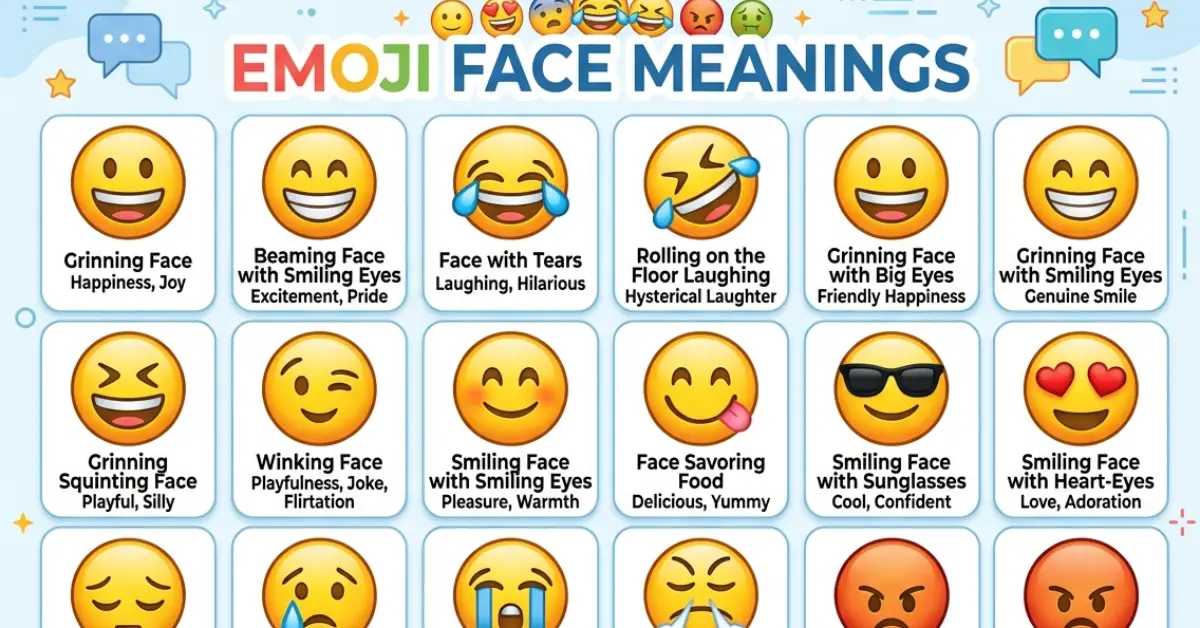
Emoji faces can turn a short message into something warmer, funnier, or more expressive. Understanding emoji face meanings helps you read the emotion behind a text without relying only on words or punctuation.
From a cheerful smile to a nervous grimace, each face can communicate a different feeling depending on context. Learning emoji face meanings makes everyday texting easier and helps you choose expressions that match your message.
Emoji faces meanings by category
Understanding emoji face meanings becomes easier when faces are grouped by the emotion or idea they commonly communicate. Smiling, crying, anger, surprise, fear, confusion, and affection each have recognizable visual patterns.
These categories are useful guides rather than strict rules. A face can take on another meaning when used sarcastically, humorously, affectionately, or in response to a particular conversation.
Smiling, happy, and affectionate emoji faces
Smiling faces commonly express happiness, friendliness, amusement, warmth, affection, or satisfaction. Examples include 😀, 😄, 😊, 😉, 😍, and 🥰.
Their emotional intensity varies. A simple smile may feel polite, while heart eyes can show stronger admiration or affection. Context determines whether the expression feels romantic, friendly, playful, or simply positive.
| Emoji | Common interpretation |
|---|---|
| 😀 | Happiness or friendliness |
| 😄 | Cheerful excitement |
| 😊 | Warmth, pleasure, or gratitude |
| 😉 | Wink, teasing, or playfulness |
| 😍 | Strong admiration or affection |
| 🥰 | Loving or affectionate feelings |
Neutral and skeptical emoji faces
Neutral and skeptical expressions often communicate uncertainty, hesitation, disbelief, awkwardness, or limited emotional reaction. Common examples include 😐, 😑, 🤔, 🙄, and 🧐.
These are especially dependent on context. A thinking face may show curiosity, while rolling eyes can suggest annoyance, disbelief, sarcasm, or frustration.
| Emoji | Common interpretation |
|---|---|
| 😐 | Neutral reaction |
| 😑 | Unimpressed or expressionless |
| 🤔 | Thinking or questioning |
| 🙄 | Annoyance or disbelief |
| 🧐 | Close examination or suspicion |
Negative and concerned emoji faces
Negative expressions can communicate sadness, worry, disappointment, frustration, fear, or emotional discomfort. Examples include 😟, 😕, 😞, 😣, 😢, and 😠.
Not every negative-looking face means the same thing. Concern, disappointment, irritation, and sadness can overlap, so the surrounding words are important when interpreting emoji face meanings.
| Emoji | Common interpretation |
|---|---|
| 😟 | Worry |
| 😕 | Confusion |
| 😞 | Disappointment |
| 😣 | Distress or frustration |
| 😢 | Sadness |
| 😠 | Anger |
Sleepy or unwell emoji faces
Sleepy and unwell expressions communicate tiredness, exhaustion, illness, discomfort, or physical strain. 😴 usually indicates sleepiness, while 🤒 and 🤢 are associated with feeling sick.
A tired face can also be exaggerated for humor. Someone may use 😴 after a long day even when they are simply exhausted rather than literally falling asleep.
| Emoji | Common interpretation |
|---|---|
| 😴 | Sleepy or sleeping |
| 😪 | Tired or drowsy |
| 🤒 | Feeling ill |
| 🤢 | Nausea or disgust |
| 🤧 | Sneezing or feeling unwell |
Read More: Emoji Heart Meanings: What Every Heart Really Means
Tongues, hands, and accessories emoji faces
Some faces become playful because of tongues, hands, glasses, or other visual details. 😋, 😛, 😜, 🤪, 😎, and 🤓 can add humor or personality.
These expressions are common in casual conversations. Their meaning may range from joking and silliness to confidence, teasing, food enjoyment, or exaggerated reactions.
| Emoji | Common interpretation |
|---|---|
| 😋 | Enjoying something |
| 😛 | Playful teasing |
| 😜 | Joking or cheekiness |
| 🤪 | Wild or silly behavior |
| 😎 | Coolness or confidence |
| 🤓 | Nerdy or intellectual humor |
Costume, creature, and animal emoji faces
Some face-style emojis add costumes, fantasy themes, creatures, or animals to digital conversations. Examples include 🤠, 🥳, 🥸, 🤡, 😈, 👿, and animal faces such as 🐶.
Their meaning comes from both expression and character. A clown may suggest silliness, while a cowboy face can create a playful western mood rather than one specific emotion.
| Emoji | Common interpretation |
|---|---|
| 🤠 | Playful cowboy theme |
| 🥳 | Celebration |
| 🥸 | Disguise or pretending |
| 🤡 | Clowning or foolishness |
| 😈 | Mischief |
| 👿 | Anger or hostility |
Common face emoji meanings
People often search emoji face meanings because similar-looking expressions can feel surprisingly different in messages. Small changes in eyes, mouth, tears, sweat, or accessories can alter the emotional tone.
The following examples explain commonly used faces and their everyday interpretations. These are practical communication guides, not rigid definitions, because people can use the same emoji differently.
Smiley face emoji
🙂 is officially called the slightly smiling face. It generally communicates a mild smile, friendliness, or simple positivity. Depending on context, some people also use it for restrained or awkward reactions.
It is less enthusiastic than 😄 or 😁, so the surrounding message matters. “That sounds good 🙂” may feel calm and polite rather than highly excited.
Sad face emoji
Sad-looking faces can communicate disappointment, regret, loneliness, emotional pain, or quiet reflection. 😔 and 😞 are common choices for softer sadness, while 😢 usually makes the emotion clearer.
When interpreting emoji face meanings, remember that emotional intensity matters. A mildly disappointed person may choose 😔, while someone describing intense sadness may use 😭.
| Emoji | Typical feeling |
|---|---|
| 😔 | Quiet sadness |
| 😞 | Disappointment |
| 😢 | Sadness or crying |
| 😭 | Intense emotion |
Straight face emoji
😐 is the neutral face and commonly communicates little emotional reaction. It can suggest indifference, awkwardness, uncertainty, boredom, or a deliberately flat response.
Its tone depends heavily on the words around it. “Okay 😐” can sound much less enthusiastic than “Okay!” The emoji adds an important emotional cue to an otherwise simple sentence.
Melting face emoji
🫠 is officially called the melting face. It can describe extreme heat, but people also use it for embarrassment, awkwardness, sarcasm, emotional overwhelm, or feeling unable to cope.
This is a good example of why emoji face meanings cannot always be understood literally. The same melting expression can describe hot weather or an awkward social moment.
| Situation | Possible meaning |
|---|---|
| Hot weather | Feeling overheated |
| Embarrassment | Feeling awkward |
| Stress | Feeling overwhelmed |
| Sarcasm | Pretending everything is fine |
Angry face emoji
😠 represents anger or displeasure, while 😡 generally gives the reaction a stronger appearance. These faces can communicate frustration, irritation, disagreement, or genuine anger.
The intensity should be judged from the conversation. Friends sometimes use angry faces jokingly, while a serious complaint can make the same symbols feel much stronger.
Shocked face emoji
😲 is the astonished face and commonly communicates strong surprise. It can appear when someone receives unexpected news, sees something impressive, or discovers information they did not anticipate.
Similar expressions such as 😮 and 😯 also communicate surprise. The difference is mainly visual and contextual, so readers should consider the complete message rather than relying on one character.
Scared face emoji
😨 generally expresses fear or apprehension. It may appear when someone describes something frightening, stressful, risky, or unexpectedly alarming.
😱 is more dramatic and commonly represents intense fear, screaming, or shock. These faces can also be used humorously when someone exaggerates a relatively minor problem.
Crying face emoji
😢 is the crying face and usually represents sadness, hurt, disappointment, or emotional pain. 😭 is officially the loudly crying face and generally appears more intense.
However, emoji face meanings are not always literal. People frequently use crying emojis to show extreme laughter, excitement, frustration, disbelief, or an overwhelming emotional response.
Heart face emoji
😍 is officially called the smiling face with heart-eyes. It commonly communicates strong admiration, attraction, love, excitement, or enthusiastic appreciation.
🥰, the smiling face with hearts, can feel softer and more affectionate. These faces do not automatically mean romantic love because friends and family can also use them to show warmth.
Blue face emoji
🥶 is officially the cold face. It generally represents feeling extremely cold, freezing weather, or being chilled.
In casual communication, users may also employ it figuratively for an intense reaction or an uncomfortable situation. Its most direct interpretation remains feeling cold or exposed to extreme chill.
Money face emoji
🤑 is the money-mouth face. It commonly relates to wealth, money, financial success, making money, or feeling rich.
It can be used seriously or humorously, such as discussing earnings, a profitable opportunity, shopping, or an unexpectedly valuable deal. The visual currency symbols make its financial association especially clear.
| Context | Possible meaning |
|---|---|
| Business | Financial success |
| Shopping | Excitement about money |
| Work | Making money |
| Humor | Feeling rich |
Hot face emoji
🥵 is the hot face, showing a red face, sweat, and an extended tongue. Its direct use is describing intense heat or feeling overheated.
It can also be used figuratively for physical attractiveness or an intense reaction. Because this second usage may be suggestive, context is especially important when interpreting emoji face meanings.
Kissy face emoji
😘 is officially called the face blowing a kiss. It can communicate affection, friendliness, gratitude, romance, or a playful goodbye.
Its meaning depends heavily on the relationship between people. Romantic partners may use it affectionately, while friends or family members can use it casually to add warmth to a message.
Read More: Angel Numbers and Their Meanings: 000 to 999
Clown face emoji
🤡 represents a clown face and can be used for humor, silliness, foolish behavior, irony, or situations where someone feels they have made themselves look foolish.
Online, people sometimes use it for humorous self-criticism. Its tone can range from harmless joking to sarcasm, so the surrounding conversation provides important clues.
Frequently asked questions about emoji face meanings
Understanding emoji face meanings is easier when you remember that emoji characters provide visual cues rather than complete sentences. Unicode supplies standardized names and annotations, while everyday users develop additional meanings through culture and online communication.
The questions below cover some of the most common issues people encounter when interpreting faces in texting, messaging apps, social media, and everyday digital conversations.
What do emoji faces mean?
They represent emotions, reactions, expressions, or ideas. A single face can have several interpretations depending on context, including happiness, sadness, affection, confusion, humor, frustration, surprise, or fear.
What is the difference between 😀 and 😊?
😀 is the grinning face, while 😊 is the smiling face with smiling eyes. Both communicate positive feelings, but 😊 often feels warmer, gentler, or more content.
What does 😂 mean?
😂 is officially called the face with tears of joy. It commonly expresses strong laughter or amusement and is frequently used when something is extremely funny.
What does 😭 mean in texting?
😭 is the loudly crying face. It can express intense sadness, but texting culture also uses it for overwhelming laughter, excitement, frustration, or dramatic reactions.
What does 🥺 mean?
🥺 is the pleading face. It can suggest pleading, vulnerability, affection, sadness, or an emotional request depending on the surrounding conversation.
What does 🤔 mean?
🤔 is the thinking face. It commonly suggests thinking, questioning, considering an idea, uncertainty, or curiosity. It can also indicate that someone is not completely convinced.
What does 🙄 mean?
🙄 is the face with rolling eyes. It commonly expresses annoyance, disbelief, impatience, sarcasm, or frustration with something someone has said or done.
Can one emoji have multiple meanings?
Yes. Context strongly affects emoji face meanings. The words surrounding an emoji, the relationship between speakers, and the situation can all change how a face is understood.
Why can the same emoji look different on different phones?
Different platforms create their own artwork for standardized Unicode characters. The underlying character remains standardized, but its visual design can vary between operating systems and applications.
Are emoji meanings officially fixed?
Not completely. Unicode standardizes characters and provides names and annotations, but everyday users develop additional meanings through language, culture, humor, slang, and online communication.
What is a common happy face emoji?
Several smiling emojis are widely recognized, including 😀, 😃, 😄, 😊, and 🙂. Their emotional tone varies from broad happiness and excitement to gentle friendliness.
What is the difference between 😢 and 😭?
😢 is the crying face and usually indicates sadness or emotional pain. 😭 is the loudly crying face and generally presents a stronger emotional reaction.
Does 😍 always mean romantic love?
No. 😍 can show romantic attraction, but people also use it for admiration, excitement, appreciation, food, pets, fashion, celebrities, or anything they find wonderful.
Does 🙂 always mean happiness?
No. 🙂 officially represents a slightly smiling face, but conversational use varies. Depending on context, it may feel friendly, restrained, awkward, polite, or emotionally neutral.
What does 🫠 mean in messages?
🫠 can describe literal heat, embarrassment, awkwardness, sarcasm, dread, or feeling overwhelmed. Its flexible use makes the surrounding text particularly important.
What does 🤑 mean?
🤑 is the money-mouth face and relates to money, wealth, financial success, or making money. It may be used seriously or playfully.
What does 🥵 mean?
🥵 is the hot face. It commonly means being overheated or experiencing intense heat, although it can also describe attraction or another figurative “hot” reaction.
How should I choose an emoji for a text?
Think about the emotion you want to add, then consider your relationship with the recipient. A simple smile works for friendly messages, while stronger expressions can add humor, affection, surprise, or emphasis.
Do emojis replace words?
Sometimes an emoji can communicate a complete reaction, but emojis usually work alongside words. They add emotional cues that plain text may not communicate clearly.
Are emojis the same as emoticons?
No. Emojis are standardized pictographic characters and sequences, while emoticons are combinations of ordinary text characters used to represent expressions, such as 🙂 or :-(.
How many emojis exist?
Unicode’s emoji system contains thousands of emoji characters and sequences. Counts can vary depending on whether a source counts individual characters, sequences, skin-tone variations, or other combinations.
Who decides which emojis become standardized?
The Unicode Consortium maintains the Unicode Standard and its emoji system. Emoji proposals go through a defined review process involving the Unicode Emoji Subcommittee.
Do emoji meanings change over time?
Yes. Unicode provides standardized names and annotations, but social usage evolves. Internet communities can give familiar faces additional meanings through slang, humor, memes, and changing communication habits.
Can emoji meaning differ by culture?
Yes. Cultural habits influence how people interpret gestures, symbols, colors, and expressions. When communicating internationally, it is safer to consider the recipient’s cultural background and the surrounding text.
Why is context important when interpreting emojis?
An emoji adds emotional information but does not tell the entire story. “Great 😍” and “You actually did that 😍” may both be positive while carrying different shades of admiration.
Why do people use emojis in texting?
Emojis help add emotional tone to short digital messages. They can make a statement feel friendlier, funnier, warmer, more excited, or more expressive without requiring a long explanation.
Can an emoji sound sarcastic?
Yes. Some emojis, especially 🙂, 🙄, 😏, and 🫠, can take on sarcastic meanings depending on the words around them. Sarcasm is usually easier to recognize from the complete conversation.
Are emoji interpretations always universal?
No. Many faces have widely recognized meanings, but individual interpretation can differ. Age, culture, online communities, personal habits, and relationships can all influence how a person reads an emoji.
Conclusion
Understanding emoji face meanings makes everyday digital conversations easier because expressions can add humor, warmth, concern, excitement, or subtle emotional cues that plain words sometimes miss.
The best way to understand emoji face meanings is to consider the symbol, surrounding words, relationship, and situation together. That approach keeps interpretations natural rather than overly literal.

MeaningShelf shares meaningful quotes, thoughtful messages, and helpful word meanings, managed by Lily Anderson, an SEO content writer with 2 years of experience, creating engaging content that inspires readers and helps them find the right words for every moment.
3 thoughts on “☺️ 😔 😲 🤡 Emoji Face Meanings | Guide & Examples”