
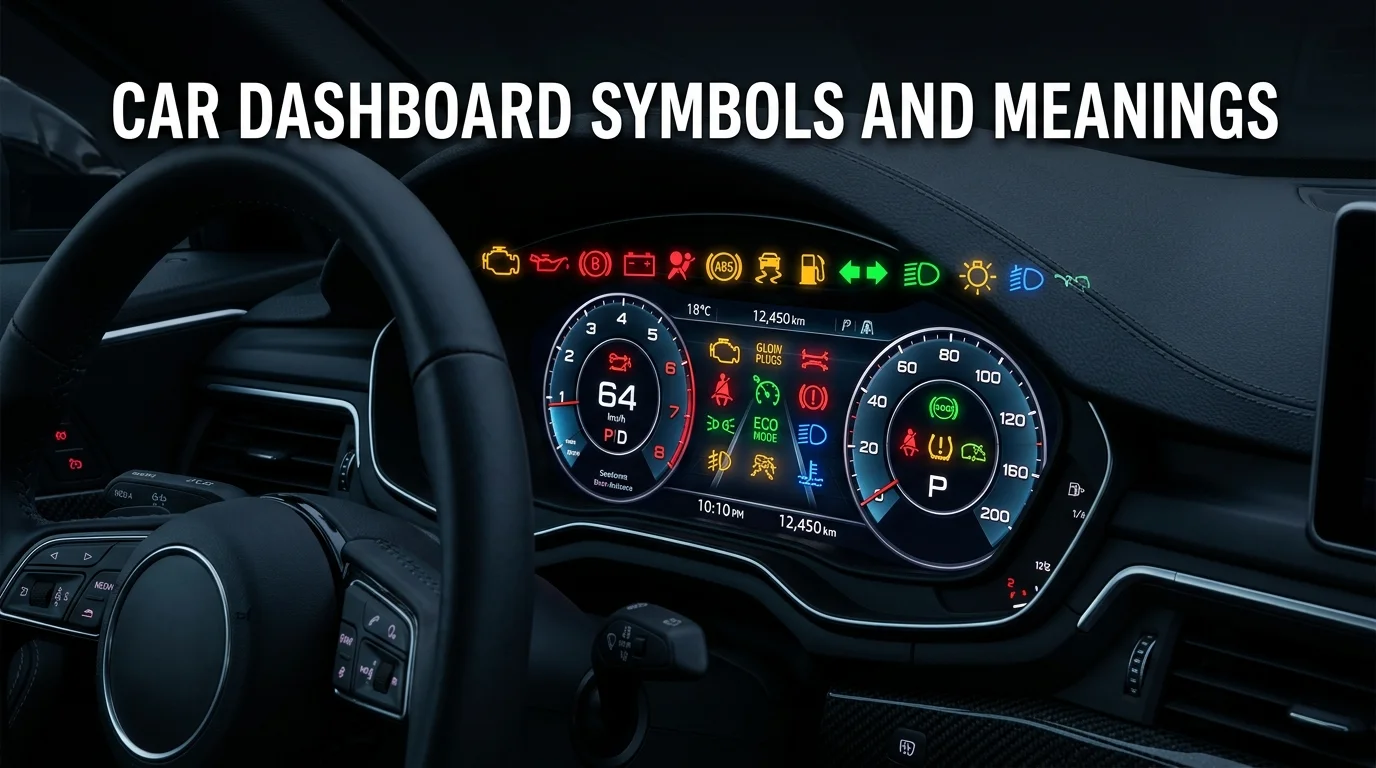
Your dashboard is your car’s communication system, using colors and symbols to tell you what is happening. Learning car dashboard symbols and meanings helps you recognize warnings early and respond safely.
From a flashing oil symbol to a simple blue high-beam indicator, car dashboard symbols and meanings can seem confusing at first. This guide explains common lights clearly, including which ones require immediate action.
Car Dashboard Symbols and Meanings: The Language of Light: Understanding the Colour System
Dashboard lights use colors to communicate urgency. 🔴 Red usually signals a serious problem, 🟡 amber means something needs checking, while 🟢 green, ⚪ white, and 🔵 blue commonly show an active or available feature.
Always remember that symbols and colors can vary between manufacturers and models. Your owner’s manual is the final authority, but this simple guide makes unfamiliar dashboard indicators much easier to understand.
| Symbol color | General meaning | What you should do |
|---|---|---|
| 🔴 Red | Serious warning | 🛑 Stop safely and investigate |
| 🟡 Yellow/Amber | Warning or fault | ⚠️ Check soon |
| 🟢 Green | System active | ✅ Usually informational |
| ⚪ White | System status | ℹ️ Usually informational |
| 🔵 Blue | Feature active | 💡 Usually informational |
Driver Information: Control and Warning Lamps
Control and warning lamps monitor important vehicle systems, including the engine, brakes, battery, tyres, stability systems, and lighting. Some lights appear briefly after starting while the vehicle performs its normal system checks.
Pay attention when a light remains on, flashes, or appears with a message. 🚨 A warning can indicate anything from normal operation to a serious fault requiring professional diagnosis, so never ignore unfamiliar indicators.
Red Warning Lights: Stop and Investigate Immediately
🔴 Red warning lights deserve immediate attention. Depending on the symbol, continuing to drive may create a safety risk or cause expensive mechanical damage. Safely pull over whenever the warning requires stopping.
Common red warnings involve brakes, oil pressure, coolant temperature, charging systems, or other critical functions. If the warning remains after following the manufacturer’s instructions, contact roadside assistance or a qualified technician.
1. STOP! (General Stop Warning)
🛑 STOP warning: This critical symbol tells you to stop driving and investigate the related problem.
- Pull over somewhere safe.
- Switch off the engine when instructed.
- Check the accompanying warning message.
- Seek professional help if the cause is unclear.
2. Fasten Your Seat Belt
🔴 Seat-belt warning: This symbol reminds occupants to fasten their restraints and may be accompanied by an audible alert.
- Fasten every occupied seat belt.
- Check passenger seating if the warning remains.
- Never drive with an occupant unrestrained.
- Investigate persistent sensor warnings professionally.
3. Brake System Fault, OR Brake Fluid Level Low
🛑 Brake warning: A red brake symbol may indicate low brake fluid or a brake-system fault.
- Stop safely when appropriate.
- Do not ignore unusual brake-pedal behavior.
- Check the owner’s manual.
- Seek professional inspection before continuing if the warning remains.
4. Engine Oil Pressure Low
🔴 Low oil pressure: This warning can mean the engine is not receiving adequate lubrication, making continued operation potentially damaging.
- Stop safely.
- Switch off the engine.
- Check the oil according to the manual.
- Do not continue driving if the warning remains.
- Arrange professional assistance when necessary.
5. Fault in the Motor Coolant System
🌡️ Coolant warning: This symbol may indicate overheating, low coolant, or a cooling-system fault.
- Stop safely if the engine is overheating.
- Allow the engine to cool.
- Never open a hot pressurized coolant system.
- Check coolant only when safe.
- Arrange professional assistance for persistent warnings.
6. 12V Battery / Alternator Fault
🔋 Battery warning: A battery-shaped symbol can indicate an alternator or charging-system problem rather than simply a weak battery.
- Reduce unnecessary electrical loads where appropriate.
- Stop safely when practical.
- Avoid unnecessary driving.
- Arrange an inspection.
- Remember that electrical power may eventually be lost.
Read More:
Car Dashboard Symbols and Meanings: Yellow/Orange (Amber) Warning Lights: Monitor and Get Checked Soon
🟡 Amber warning lights usually indicate a problem, limitation, or condition requiring attention. They do not always require an immediate stop, but ignoring them can allow a minor issue to become more serious.
Your response depends on the particular symbol, whether it flashes, and whether the vehicle behaves differently. Reduce speed when necessary and arrange professional inspection when the warning persists.
1. Low Tyre Pressure
🛞 Tyre-pressure warning: This indicates that one or more tyres may be below the recommended pressure or that the monitoring system has detected an issue.
- Check all tyre pressures.
- Inspect for visible damage.
- Use the manufacturer’s recommended pressure.
- Do not ignore a rapidly deflating tyre.
- Repair or replace damaged tyres promptly.
2. ABS Fault
⚠️ ABS warning: A fault may mean the anti-lock braking function is unavailable, although conventional braking can still operate on some vehicles.
- Drive cautiously.
- Avoid unnecessary hard braking.
- Have the system inspected promptly.
- Treat combined ABS and red brake warnings more seriously.
- Stop if braking performance changes significantly.
3. Engine Management and Emissions System Fault
🟡 Engine warning: This broad warning can involve sensors, ignition, fuel delivery, emissions equipment, or other monitored systems.
- Watch for rough running.
- Notice any power loss.
- Monitor unusual fuel consumption.
- Seek diagnosis if the light remains.
- Treat a flashing warning as potentially more urgent.
4. AdBlue® Level Low, OR Fault in the SCR System
💧 AdBlue warning: Diesel vehicles using Selective Catalytic Reduction may warn when the fluid is low or the SCR system detects a fault.
- Check the displayed remaining range.
- Refill with the correct AdBlue® product.
- Follow the manufacturer’s refill instructions.
- Do not ignore repeated warnings.
- Seek professional help for system faults.
5. Exterior Temperature Below +4 °C (+39 °F)
❄️ Ice warning: A low-temperature indicator alerts you to conditions where icy roads may become possible.
- Reduce speed when appropriate.
- Increase following distance.
- Be careful on bridges and shaded roads.
- Avoid sudden steering or braking.
- Remember that the symbol does not confirm ice everywhere.
6. TCS Manually Deactivated, ESC in “Sport” Mode or ECS Manually Deactivated
⚠️ Traction/stability warning: This indicator can show that TCS or ESC has been switched off or limited.
- Understand why the system was disabled.
- Restore normal operation when appropriate.
- Drive cautiously with reduced stability assistance.
- Avoid unnecessary aggressive acceleration.
- Follow the vehicle’s operating instructions.
7. Electronic Stability Control (ESC), Traction Control Regulating or ESC Fault
🚗 ESC/TCS symbol: A flashing light can mean the system is actively controlling wheel slip or vehicle stability.
- A flashing light may indicate normal intervention.
- A continuously illuminated light can indicate a fault.
- Drive carefully on slippery roads.
- Check the owner’s manual.
- Arrange inspection if the warning remains.
8. Fuel Tank Almost Empty
⛽ Low-fuel warning: This symbol means the fuel level has reached the vehicle’s reserve threshold.
- Refuel as soon as practical.
- Do not rely completely on the displayed range.
- Remember that traffic and driving style affect range.
- Avoid repeatedly driving with very little fuel.
- Plan refueling before the tank becomes empty.
9. Engine Oil Level
🛢️ Oil-level warning: This warning can indicate that the engine oil level is too low or that the monitoring system has detected a problem.
- Park safely.
- Check the oil using the manufacturer’s procedure.
- Add the specified oil if required.
- Avoid overfilling.
- Arrange an inspection if the warning persists.
Green/White/Blue: Informational Indicators
🟢 Green, white, and blue lights generally provide information rather than signal a fault. They tell you that a system is active, selected, available, or operating in a particular mode.
Understanding these indicators prevents unnecessary worry. A blue high-beam symbol, for example, normally confirms an active lighting function rather than warning of a mechanical problem.
1. Turn Signals
🟢 Turn-signal arrows: These indicators flash when the corresponding direction signal is activated.
- Left arrow = left signal.
- Right arrow = right signal.
- Both may flash with hazard lights.
- A faster-than-normal flash can indicate a lighting fault.
- Check exterior bulbs when safe.
2. Main Beam On
🔵 Main-beam indicator: This blue symbol confirms that the high-beam headlights are switched on.
- Use high beams when appropriate.
- Dip headlights for approaching traffic.
- Avoid causing glare.
- Check the indicator before entering busy areas.
- Follow local lighting rules.
3. Cruise Control (GRA) Active
🟢 Cruise-control indicator: This symbol shows that cruise control is available, selected, or actively maintaining a programmed speed.
- Monitor traffic continuously.
- Watch changing speed limits.
- Keep your hands and attention ready.
- Cancel cruise control when conditions require.
- Never treat automation as a replacement for driving attention.
4. Speed Limiter Active
⚪🟢 Speed-limiter indicator: This symbol shows that the limiter is selected or actively restricting the vehicle from exceeding its programmed speed.
- Confirm the selected speed.
- Continue watching road signs.
- Adjust the setting when legal limits change.
- Remember that the limiter does not replace driver attention.
- Follow local speed regulations.
5. Auto Hold Active (Green)
🟢 Auto Hold: This feature can keep the vehicle stationary after you stop, reducing the need to continuously hold the brake pedal.
- Useful in traffic and at stops.
- Green commonly indicates active holding.
- Understand how it releases.
- Check your vehicle’s instructions.
- Stay prepared to control the vehicle manually.
6. Start-Stop System Activated
⚪ Start-Stop indicator: This system can automatically stop the engine when the vehicle is stationary and restart it when driving conditions require.
- The system may temporarily become unavailable.
- Battery condition can affect operation.
- Engine temperature can influence availability.
- Climate-control demands can affect activation.
- A temporary change does not automatically indicate a fault.
7. Vehicle Chargin
🔋⚡ Charging indicator: Electric and plug-in hybrid vehicles use charging symbols to show connection or charging status.
- Check whether charging has started.
- Watch for charging-fault messages.
- Confirm the connector is properly connected.
- Follow the vehicle’s charging instructions.
- Check the display if charging stops unexpectedly.
8. Main Beam Assist Active
🔵💡 Main Beam Assist: This indicator shows that automatic high-beam assistance is available or active.
- The system may switch between high and dipped beams.
- Continue monitoring traffic.
- Automatic systems have limitations.
- Take control when conditions require.
- Keep the windshield and relevant sensors clean.
Read More:
Car Dashboard Symbols and Meanings: Warning Light Prevention: Keeping The Lights Off
🔧 Good maintenance can reduce avoidable dashboard warnings. Regular checks help identify problems before they develop into larger repairs, especially when the vehicle is used frequently or under demanding conditions.
Use these simple habits:
- 🛞 Check tyre pressure regularly.
- 🛢️ Monitor engine oil.
- 🌡️ Check coolant as recommended.
- 🔋 Pay attention to battery condition.
- 💡 Inspect exterior lighting.
- 🧰 Follow scheduled servicing.
- ⚠️ Investigate unusual noises or leaks.
- 🚗 Do not ignore recurring warning messages.
Vehicle Maintenance Schedule: Staying Ahead of Issues
📅 Maintenance intervals vary by manufacturer, model, engine, mileage, age, and driving conditions. Instead of following a generic schedule, use the service information supplied specifically for your vehicle.
A good maintenance routine can include:
- 🛢️ Engine oil and filter checks.
- 🛞 Tyre pressure and tread inspection.
- 🛑 Brake inspection.
- 🔋 Battery and charging-system checks.
- 💧 Fluid-level inspections.
- 💡 Lighting checks.
- 🔧 Diagnostic checks when required.
- 📖 Following the manufacturer’s service interval.
Keeping service records also helps technicians identify repeated faults and gives you a clearer picture of your vehicle’s maintenance history.
What to Do When a Warning Light Appears
🚨 The first step is to stay calm. Identify the symbol, its color, whether it is flashing, and any message shown on the instrument display.
Use this quick guide:
- 🔴 Red: Safely stop when the warning requires immediate attention.
- 🟡 Amber: Investigate the problem and arrange inspection.
- 🟢 Green: Usually confirms an active feature.
- ⚪ White: Usually communicates system status.
- 🔵 Blue: Commonly identifies a lighting or operating function.
If the vehicle also feels different, makes an unusual noise, loses power, overheats, or develops braking problems, prioritize safety over reaching your destination.
Car Dashboard Symbols and Meanings: Warning Light Troubleshooting: Digging Deeper
🔍 A dashboard warning identifies a monitored condition, but it does not always identify the exact failed component. Modern vehicles use sensors and diagnostic systems to store information about detected faults.
Professional troubleshooting may involve:
- 🧰 Reading diagnostic trouble codes.
- 🔌 Testing electrical connections.
- 🔎 Checking sensors.
- 🛠️ Inspecting mechanical components.
- 📊 Reviewing vehicle data.
- 🧪 Testing affected systems.
- ✅ Confirming the repair before clearing the warning.
Avoid repeatedly clearing a warning simply to make it disappear. If the underlying problem remains, the light can return and the vehicle may continue operating with an unresolved fault.
Driving Safety Tips: Staying Safe When Warning Lights Appear
🚗 Safety should always come first when a warning appears while driving. Do not stare at the dashboard, make sudden steering movements, or brake harshly simply because an unfamiliar symbol illuminates.
Remember these safety rules:
- 👀 Keep your attention on traffic.
- 🛑 Pull over safely when necessary.
- 🔴 Treat critical warnings seriously.
- ⚠️ Reduce speed when appropriate.
- 🛠️ Seek professional help when uncertain.
- 🌡️ Never open a hot cooling system.
- 🛞 Stop if a tyre appears dangerously damaged.
- 🛑 Do not continue if braking performance becomes unsafe.
Service Plan Options
For owners, scheduled maintenance and professional diagnostics can help identify developing faults before they become larger problems. Service plans, warranty coverage, and maintenance intervals can vary by country and vehicle.
Good ownership habits include:
- 📅 Follow the recommended service schedule.
- 🧾 Keep maintenance records.
- 🛢️ Use approved fluids.
- 🔧 Use suitable replacement parts.
- ⚠️ Investigate recurring dashboard warnings.
- 👨🔧 Use qualified technicians.
- 📖 Check model-specific manufacturer information.
- 🛡️ Review available warranty or service coverage.
The most reliable source for vehicle-specific servicing, warning messages, and equipment information is the owner’s manual and the manufacturer’s official service information.
Conclusion
Understanding car dashboard symbols and meanings helps turn confusing lights into useful information. Learn the colors, recognize serious warnings, and follow your vehicle’s instructions before continuing any journey.
Once you understand car dashboard symbols and meanings, you can react confidently instead of guessing. Regular maintenance, careful driving, and timely professional checks help keep your vehicle safer and more reliable.

MeaningShelf shares meaningful quotes, thoughtful messages, and helpful word meanings, managed by Lily Anderson, an SEO content writer with 2 years of experience, creating engaging content that inspires readers and helps them find the right words for every moment.