
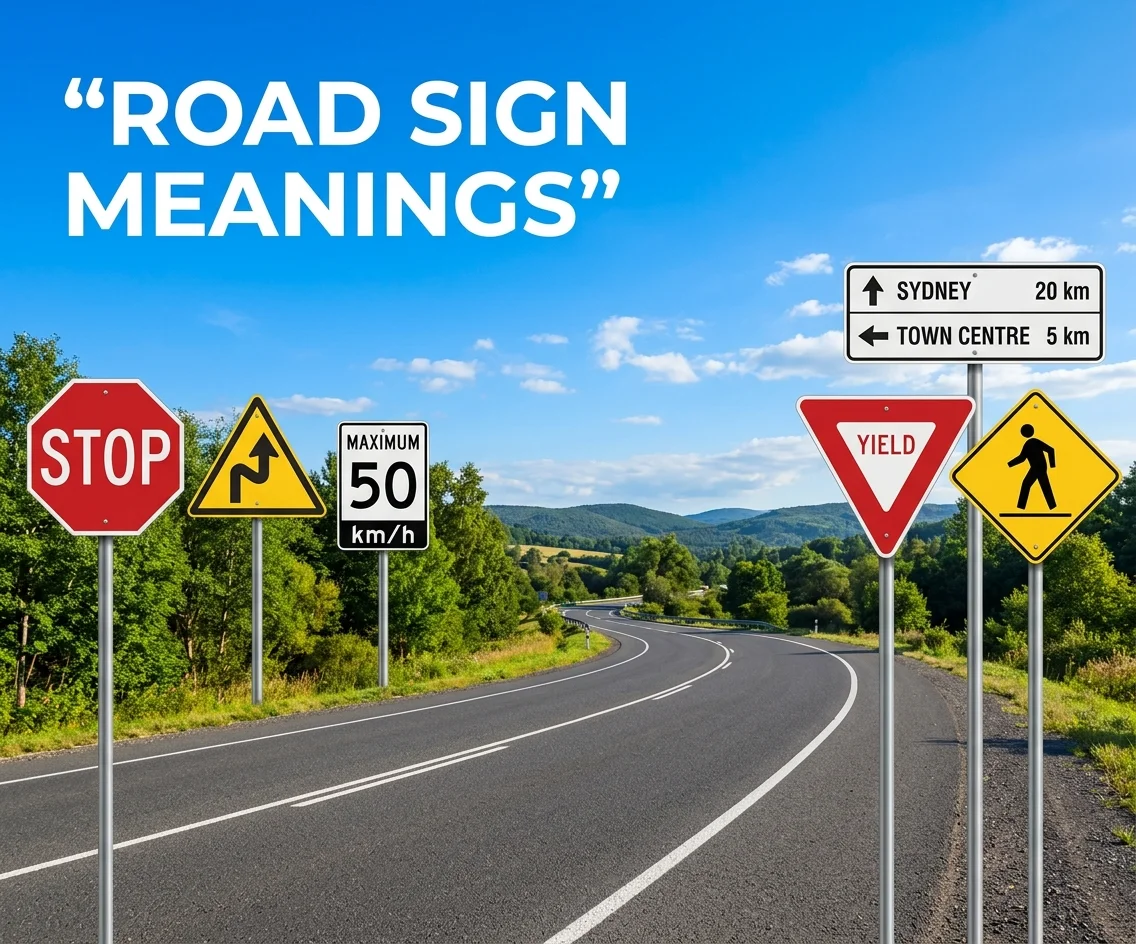
Road signs quietly guide almost every journey, telling drivers when to stop, slow down, turn, watch for hazards, or follow a particular route without lengthy explanations.
Once you understand the colors, shapes, symbols, and categories, road sign meanings become much easier to recognize. This guide explains them clearly so driving feels safer and less confusing.
Road Sign Meanings: Understanding Colors and Shapes of Road Signs
Road signs communicate important instructions, warnings, directions, services, and temporary conditions to drivers, pedestrians, cyclists, and other road users. Their colors, shapes, symbols, and words work together to deliver information quickly. Understanding road sign meanings starts with recognizing these visual patterns.
Instead of memorizing hundreds of individual signs, learn the patterns behind them. When you understand road sign meanings through color, shape, and purpose, you can often recognize what type of message you are seeing before reading every word.
The Meaning of Road Signs
Road signs are traffic control devices that communicate regulations, warnings, directions, services, and special road conditions. They help road users understand what is expected and what may be ahead. Learning road sign meanings can make unfamiliar signs easier to interpret.
The exact sign used depends on the road situation and applicable standards. In the United States, the Manual on Uniform Traffic Control Devices provides national standards for traffic signs, pavement markings, signals, and other traffic control devices.
The Introduction of Symbols, Colors, and Shapes
Symbols make information easier to recognize quickly, especially when drivers have limited time to read a message. Colors and shapes add another visual layer, helping road users identify a sign’s general purpose. These features are central to understanding road sign meanings.
A useful way to read a sign is to check these elements together:
- Color: gives an important clue about function.
- Shape: often identifies the sign category.
- Symbol: communicates a specific condition or instruction.
- Words: provide the exact message.
- Location: adds context to what the sign means.
What Do Road Sign Colors Mean?
Colors provide useful visual clues about the function of many signs. Under the current MUTCD, colors are assigned specific meanings, including regulation, warning, direction guidance, services, temporary traffic control, and incident management. Recognizing these colors is an important part of learning road sign meanings.
| Color | Common meaning or use |
|---|---|
| Red | Stop, prohibition, or certain regulatory messages |
| Yellow | Warning |
| Orange | Temporary traffic control |
| Green | Permitted movements and directional guidance |
| Blue | Road-user services and certain information |
| Brown | Recreational or cultural-interest guidance |
| Fluorescent yellow-green | Pedestrian, bicycle, school, playground, and school-bus warnings |
| Fluorescent pink | Incident management |
| White | Regulatory information |
| Black | Regulatory information or legend elements |
Color gives you an early clue, but it should not be interpreted alone. For example, yellow commonly indicates a warning, while orange is associated with temporary traffic control. Always read the complete sign when possible.
What Do Road Sign Shapes Mean?
Shapes provide another fast recognition tool. In the U.S. system, the octagon is reserved for STOP signs, while an inverted triangle identifies YIELD. Diamond-shaped signs are generally used for warnings. Learning these associations makes road sign meanings easier to remember.
Other shapes also have specific functions. Pentagons are associated with school advance warnings, circles with railroad advance warnings, and pennant-shaped signs with no-passing-zone warnings.
| Shape | Common purpose |
|---|---|
| Octagon | STOP |
| Inverted triangle | YIELD |
| Diamond | Warning |
| Circle | Railroad advance warning |
| Pentagon | School advance warning |
| Pennant | No-passing-zone warning |
| Rectangle | Regulatory or guide information |
| Crossbuck | Railroad grade crossing |
Shape recognition becomes particularly useful when a sign is visible from a distance. However, drivers should consider the complete sign, including its words, symbols, color, and surrounding road conditions.
Read More: 100 Idioms: Meanings & Examples
5 Examples of Road Signs and Their Meanings
Common signs show how different visual elements work together. A STOP sign combines a red background, white legend, and octagonal shape, making its regulatory message highly recognizable. These examples also make road sign meanings easier to understand in practical situations.
Here are five useful examples:
- STOP sign: requires drivers to come to a complete stop.
- YIELD sign: tells drivers to yield the right-of-way as required.
- School warning sign: alerts drivers to school-related activity.
- Road work sign: warns about temporary work-zone conditions.
- Railroad warning sign: alerts drivers that a railroad crossing may be ahead.
| Sign | Main purpose | Key visual clue |
|---|---|---|
| STOP | Complete stop | Red octagon |
| YIELD | Yield right-of-way | Inverted triangle |
| School warning | School-related warning | Fluorescent yellow-green |
| Road work | Temporary conditions | Orange |
| Railroad warning | Railroad crossing warning | Standardized railroad warning shape/device |
These examples show why learning road sign meanings is easier when you connect a sign’s appearance with its purpose rather than memorizing its image separately.
What this guide covers
This guide covers major traffic sign categories, colors, shapes, common signs, and traffic signals. It also explains how these elements work together to communicate information efficiently and improve understanding of road sign meanings.
You will learn about:
- Regulatory signs
- Warning signs
- Guide signs
- Service and informational signs
- School and pedestrian signs
- Construction and work-zone signs
- Railroad signs
- Traffic signal indications
- Common road symbols
The goal is to build practical recognition rather than encourage blind memorization. Once the basic system becomes familiar, many signs become easier to understand.
Different Categories of Traffic Signs
Traffic signs serve different purposes. Regulatory signs communicate legal requirements or restrictions, warning signs alert road users to conditions that may require caution, and guide signs help drivers navigate. Knowing these categories provides a foundation for understanding road sign meanings.
Other signs provide services or information, while temporary traffic control signs manage changing conditions around work zones. Knowing the category gives drivers a useful clue about what kind of action or information to expect.
| Category | Purpose | Examples |
|---|---|---|
| Regulatory | Communicate regulations or restrictions | STOP, speed limit, no turn |
| Warning | Alert users to conditions ahead | Curve, pedestrian, railroad |
| Guide | Provide route and directional information | Destination, route, distance |
| Service | Identify services or facilities | Rest area, hospital |
| Temporary traffic control | Manage temporary conditions | Road work, lane closure |
Regulatory signs are particularly important because they communicate requirements or restrictions. Warning signs prepare drivers for possible hazards, while guide signs help them find destinations, routes, and locations.
Traffic signs can also appear alongside traffic signals, pavement markings, and other control devices. Drivers should understand these devices together rather than treating every sign as an isolated message.
Understanding the Most Common Traffic Signs
Some signs appear so frequently that recognizing them should become automatic. STOP signs require a complete stop, while YIELD signs require drivers to slow or stop when necessary and yield the right-of-way. Knowing these signs is essential to understanding road sign meanings.
Speed-limit signs communicate the posted speed limit. One-way signs identify the permitted direction of travel, while pedestrian, school, railroad, and construction signs alert drivers to specific conditions.
| Common sign | What it tells drivers |
|---|---|
| STOP | Come to a complete stop |
| YIELD | Yield the right-of-way as required |
| Speed limit | Shows the posted speed limit |
| ONE WAY | Traffic travels in the indicated direction |
| School warning | School-related activity may be ahead |
| Pedestrian crossing | Watch for pedestrians |
| Road work | Temporary work-zone conditions may be ahead |
| Railroad warning | A railroad crossing may be ahead |
Traffic signal indications are another essential part of road communication. Unlike signs, signals use changing light indications to control movement at intersections and other locations.
Common signal indications include:
- Red: stop and remain stopped as required by the applicable traffic rule.
- Yellow: warns that the related green movement is ending and a red indication is about to appear.
- Green: permits movement when the intersection or roadway is otherwise clear and no other restriction applies.
- Flashing red: generally requires drivers to stop and proceed only when allowed and safe.
- Flashing yellow: generally requires drivers to proceed with caution.
- Yellow arrow: warns that the related protected movement is ending.
- Green arrow: indicates a permitted movement in the arrow’s direction, subject to applicable conditions.
- Red arrow: prohibits the movement indicated by the arrow while the red indication is displayed.
Drivers should always follow the actual signal displayed and obey applicable local traffic laws. A green signal does not mean drivers can enter an intersection without considering pedestrians, vehicles already in the intersection, or other hazards.
Read More: Rune Meanings: The 24 Elder Futhark Runes Explained
How to Learn and Retain Traffic Sign Meanings
Learning signs becomes easier when you group them by purpose instead of memorizing isolated pictures. Start with important regulatory signs, then learn warning shapes, colors, guide signs, service symbols, and traffic signals. This approach makes road sign meanings easier to retain.
Useful learning methods include:
- Read the driver manual: learn the official signs and rules used in your area.
- Use practice tests: test your recognition of unfamiliar signs.
- Group by color: connect colors with broad functions.
- Group by shape: remember distinctive shapes such as octagons and diamonds.
- Observe safely: notice signs during normal driving without taking your attention away from traffic.
- Review mistakes: revisit signs you frequently confuse.
- Learn signal indications: understand steady and flashing traffic-light meanings.
Practice helps turn visual recognition into a quick response. When color, shape, symbol, wording, and road context become connected in your memory, road sign meanings are easier to understand in real driving situations.
It is also important not to rely on a single visual clue. A color may tell you the general purpose, but the complete sign provides the specific instruction. Local regulations can also affect how certain signs and signals are applied.
Conclusion
Understanding road sign meanings helps drivers interpret warnings, regulations, directions, services, and traffic signals before making important decisions. Learning colors and shapes provides a practical foundation for safer, more confident road awareness.
The best way to master road sign meanings is through consistent practice and careful observation. Learn major categories first, then connect familiar colors, shapes, symbols, signals, and messages.
Frequently Asked Questions:
What are road sign meanings?
Road sign meanings explain what different traffic signs communicate, including warnings, regulations, directions, services, and road conditions.
Why are road sign meanings important for drivers?
Understanding road sign meanings helps drivers recognize warnings, follow traffic rules, navigate roads, and respond safely to changing conditions.
What do road sign meanings tell you about sign colors?
Road sign meanings can often be understood partly through colors, such as red for stopping or prohibition, yellow for warnings, and green for guidance.
What do road sign meanings tell you about sign shapes?
Road sign meanings are often connected to shapes, such as octagons for STOP and inverted triangles for YIELD.
What are the most common road sign meanings?
Common road sign meanings include STOP, YIELD, speed limits, one-way traffic, pedestrian crossings, school warnings, road work, and railroad crossings.
How can I learn road sign meanings quickly?
You can learn road sign meanings by grouping signs according to their colors, shapes, categories, symbols, and purposes, then practicing recognition regularly.
What do road sign meanings say about red traffic signs?
Road sign meanings associated with red commonly indicate STOP, prohibition, or certain regulatory requirements, depending on the complete sign.
What do road sign meanings say about yellow traffic signs?
Road sign meanings associated with yellow generally warn drivers about potential hazards, changing road conditions, or situations requiring extra attention.
What do road sign meanings say about traffic signals?
Road sign meanings work alongside traffic signals, where red generally means stop, yellow provides a transition warning, and green generally permits movement when safe.
Where can I find official road sign meanings?
Official road sign meanings in the United States are documented in the Federal Highway Administration’s Manual on Uniform Traffic Control Devices, commonly called the MUTCD.

MeaningShelf shares meaningful quotes, thoughtful messages, and helpful word meanings, managed by Lily Anderson, an SEO content writer with 2 years of experience, creating engaging content that inspires readers and helps them find the right words for every moment.
2 thoughts on “5 Road Sign Meanings: Understanding Colors and Shapes of Road Signs”