
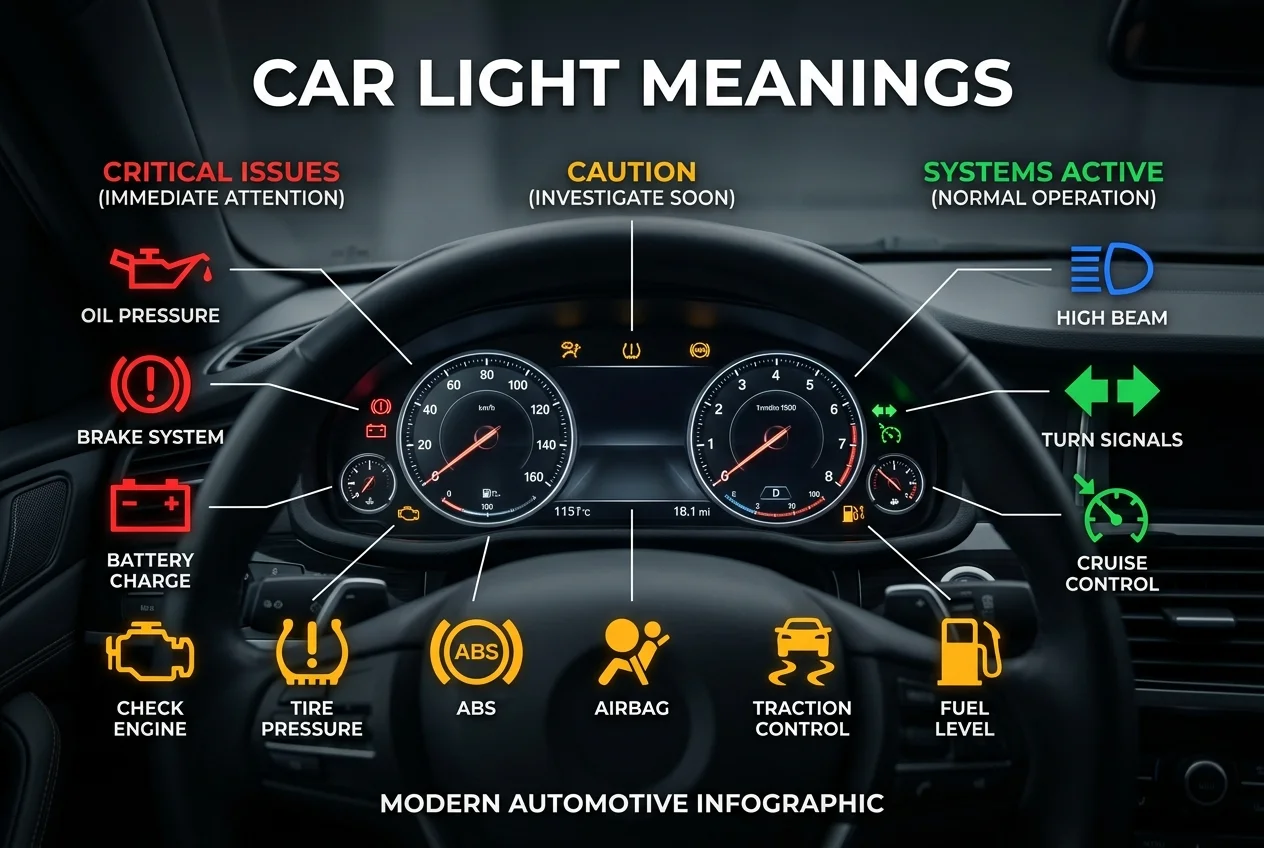
When a strange symbol suddenly glows on your dashboard, knowing the car light meanings can help you decide whether to keep driving, check something simple, or stop safely.
Modern vehicles use dashboard lights to communicate problems, system activity, and maintenance needs. This guide explains common car light meanings in simple language, so you can understand what your vehicle is telling you.
Understanding Dashboard Light Colors & Car Light Meanings
Dashboard colors give you a quick clue about what your vehicle is communicating. However, color is only a starting point. The symbol itself, accompanying message, and vehicle behavior also matter when deciding what to do.
🔴 Red: Often indicates a condition requiring prompt attention.
🟡 Yellow/Amber: Usually signals a problem or condition that needs attention.
🟢 Green: Commonly shows that a feature is operating.
🔵 Blue: Often indicates an active lighting or vehicle function.
These colors are not universal rules. Manufacturers can use different warning strategies, so always check your owner’s manual when an unfamiliar light appears. AAA also recommends consulting the manual when you are unsure about a dashboard warning.
Red Dashboard Lights
🔴 Red dashboard lights commonly indicate conditions that deserve prompt attention. Examples include:
- Oil pressure warnings
- Brake-system warnings
- Engine temperature warnings
- Certain charging-system warnings
If a red warning appears while driving, look for a safe place to stop and check the vehicle’s instructions before continuing.
Yellow or Amber Lights
🟡 Yellow and amber dashboard lights generally indicate that your vehicle has detected a condition requiring attention.
Common examples include:
- Check engine light
- ABS warning
- TPMS warning
- Traction-control fault
- Maintenance-related warnings
A yellow light does not automatically mean you must stop immediately, but ignoring it can allow a developing problem to continue.
Green Dashboard Lights
🟢 Green indicators generally tell you that a vehicle feature is operating or has been activated.
You may see green indicators for:
- Turn signals
- Low-beam headlights
- Cruise control
- Certain vehicle assistance features
These are normally information indicators rather than warnings.
Blue Dashboard Lights
🔵 Blue dashboard indicators commonly show that a feature is active. The most familiar example is the high-beam indicator.
A blue symbol may appear for:
- High beams
- Certain cooling functions
- Vehicle-specific operating modes
Always check your owner’s manual if the symbol is unfamiliar.
Check Engine Light Meaning
The check engine light, also called the malfunction indicator lamp, means the vehicle’s computer has detected a condition involving the engine, emissions system, or related controls.
⚠️ Important: The symbol does not identify the exact problem by itself. Possible causes range from a loose fuel cap to problems involving sensors, ignition, fuel delivery, or emissions equipment. A flashing check engine light deserves particularly prompt attention.
Steady Check Engine Light
🟡 A steady check engine light means a fault has been detected, but the symbol alone cannot tell you which component caused it.
Possible causes include:
- Emissions-system problems
- Sensor faults
- Ignition problems
- Fuel-system issues
- Loose fuel cap
A diagnostic scan may be needed to identify the stored trouble code.
Flashing Check Engine Light
🚨 A flashing check engine light should not be treated like a routine reminder.
If it starts flashing:
- Reduce unnecessary driving.
- Avoid hard acceleration.
- Find a safe place to stop if appropriate.
- Follow the manufacturer’s instructions.
- Arrange diagnosis promptly.
A flashing indicator can be associated with conditions capable of damaging the vehicle or emissions components.
Loose Gas Cap
⛽ A loose or incorrectly installed fuel cap can sometimes trigger the check engine light because the vehicle monitors the fuel-vapor system.
After refueling:
- Reinstall the cap correctly.
- Make sure it is properly secured.
- Drive normally if the vehicle otherwise operates normally.
- Seek diagnosis if the warning remains.
Not every check engine light is caused by the fuel cap.
Oil Pressure Warning Light
🛢️ The oil pressure warning light is commonly represented by an oil-can symbol. It usually indicates that engine oil pressure has fallen outside the expected range.
This is different from a routine oil-change reminder. Low oil pressure can prevent critical engine components from receiving adequate lubrication and may cause severe damage if the vehicle continues operating.
What the Oil Can Symbol Means
🛢️ The oil-can symbol generally relates to engine oil pressure.
Possible causes include:
- Low engine oil level
- Oil leaks
- Oil-pump problems
- Internal engine problems
- Oil-pressure sensor faults
The exact cause requires diagnosis.
What to Do When It Appears
🔴 If the oil-pressure warning stays illuminated while the engine is running:
- Safely pull over.
- Turn the engine off.
- Check the oil level when it is safe.
- Do not continue driving if the warning remains.
- Arrange professional diagnosis when necessary.
Do not assume adding oil alone has solved the problem.
Engine Temperature Warning Light
🌡️ The engine temperature warning light usually resembles a thermometer over liquid. It indicates that engine temperature has reached a level the vehicle considers abnormal or that a cooling-system problem has been detected.
Possible causes include low coolant, coolant leaks, radiator problems, thermostat problems, water-pump issues, or cooling-fan faults. Continuing to operate an overheating engine can result in serious damage.
Coolant Temperature Symbol
🌡️ The thermometer symbol commonly represents engine coolant temperature.
It can indicate:
- Excessive engine temperature
- A cooling-system issue
- Low coolant
- A temperature-related warning
The exact symbol and color depend on the vehicle.
Overheating Warning
🚨 If your vehicle indicates overheating:
- Reduce the load on the engine.
- Pull over somewhere safe.
- Turn the engine off when appropriate.
- Allow it to cool.
- Do not remove a hot radiator or coolant-system cap.
Pressurized hot coolant can cause serious burns.
Battery Warning Light
🔋 The battery-shaped warning light generally relates to the vehicle’s charging system rather than simply indicating an old battery.
A charging-system problem may involve the alternator, belt, wiring, battery connections, or another electrical component. If the warning remains on while driving, the vehicle may eventually lose electrical power.
Battery Symbol
🔋 The battery symbol commonly looks like a rectangular battery with positive and negative terminals.
It may indicate:
- Charging-system problems
- Alternator issues
- Electrical connection problems
- Battery-related faults
The symbol itself cannot identify the failed component.
Alternator Problems
⚡ A failing alternator may prevent the battery from receiving enough charge.
Possible symptoms can include:
- Battery warning light
- Dimming lights
- Electrical problems
- Difficulty starting
- Vehicle eventually stopping
Professional testing can determine whether the alternator, battery, wiring, or another component is responsible.
Brake Warning Light
🔴 A brake warning light should always receive attention because braking is essential for safe vehicle operation.
Depending on the vehicle, the symbol can indicate an engaged parking brake, low brake fluid, or a problem within the braking system. If braking performance changes or the warning remains after releasing the parking brake, follow the manufacturer’s instructions.
Parking Brake Light
🅿️ On many vehicles, the brake warning light can illuminate when the parking brake is engaged.
If it stays on:
- Confirm the parking brake is completely released.
- Check for another warning message.
- Consult the owner’s manual.
- Have the system inspected if the light remains.
Low Brake Fluid
🟡 Low brake fluid can trigger a brake warning on some vehicles.
Possible reasons include:
- Brake-fluid leakage
- Worn brake components
- Hydraulic-system problems
Do not simply refill fluid without investigating why the level became low.
ABS Warning Light
🟡 The ABS warning light indicates that the anti-lock braking system has detected a problem. Conventional braking may still operate, but the anti-lock function may not work as designed.
Because ABS contributes to controlled braking during certain situations, a persistent ABS warning should be diagnosed. Other safety-system warnings may appear at the same time because several systems can share sensors and control information.
ABS Symbol
The ABS symbol commonly displays the letters ABS inside a circular outline.
It may appear because of:
- ABS sensor problems
- Wiring faults
- Control-module issues
- Hydraulic-system faults
The exact cause requires vehicle-specific diagnosis.
Driving With ABS Light On
If the ABS warning remains illuminated:
- Drive cautiously.
- Avoid unnecessary high-speed driving.
- Allow greater stopping distance.
- Arrange diagnosis.
- Stop if braking performance becomes abnormal.
Never assume the ABS system is functioning normally when its warning remains on.
Tire Pressure Warning Light
🛞 The tire pressure monitoring system, or TPMS, alerts drivers when tire pressure is significantly below the vehicle’s specified threshold or when the monitoring system detects a malfunction.
Correct tire pressure is important for handling, braking, tire life, and fuel economy. Use the pressure specification provided by the vehicle manufacturer, usually found on the driver’s door-jamb label.
TPMS Symbol
The TPMS symbol commonly looks like a tire cross-section with an exclamation mark inside.
When it appears:
- Check all tire pressures.
- Inspect tires for visible damage.
- Inflate tires to the manufacturer’s specification.
- Recheck the warning after driving if required.
Low Tire Pressure
🛞 Low pressure can affect:
- Handling
- Braking
- Tire wear
- Fuel economy
- Tire temperature
Never use the maximum pressure printed on the tire sidewall as the normal vehicle inflation target unless the manufacturer specifies it.
Flashing TPMS Light
⚠️ On many vehicles, a flashing TPMS light followed by a steady warning can indicate a TPMS malfunction rather than simply low tire pressure.
The exact pattern varies, so check the owner’s manual.
Read More: Dream Meanings: What Your Dreams Really Mean
Airbag Warning Light
🔴 The airbag or SRS warning light indicates that the vehicle has detected a potential problem with its restraint system.
Because airbags and seat-belt pretensioners are safety equipment, a persistent warning deserves professional attention. Avoid attempting repairs on airbag components unless you have the required training and equipment.
Airbag Symbol
The airbag symbol commonly shows a seated person with a circular airbag shape in front.
It may indicate:
- Airbag-system fault
- Sensor problem
- Wiring issue
- Restraint-system fault
The exact cause requires proper diagnosis.
SRS Warning Light
SRS means Supplemental Restraint System.
Depending on the vehicle, it can involve:
- Airbags
- Seat-belt pretensioners
- Crash sensors
- Related control modules
A persistent SRS warning should not be ignored.
Traction Control Light
🚗 The traction-control indicator can mean the system is actively controlling wheel slip, has been manually switched off, or has detected a fault.
A flashing symbol during acceleration on slippery pavement can indicate normal system intervention. A warning that remains illuminated when the system should be operating may require further investigation.
Traction Control Active
🟡 A flashing traction-control symbol may indicate that the system is actively responding to wheel slip.
This can happen on:
- Wet roads
- Snow
- Ice
- Gravel
- Loose surfaces
Traction Control Off
A steady traction-control-off indicator can mean the system has been intentionally disabled.
Check:
- Whether you pressed the traction-control button.
- The owner’s manual.
- Whether another warning appears.
Stability Control Warning Light
🚗 Electronic stability control helps a vehicle maintain directional stability when the system detects conditions associated with loss of control.
Different manufacturers use names such as ESC, ESP, VSC, or other terminology. A flashing indicator may show system intervention, while a persistent warning can indicate a fault or disabled system.
ESC Light
ESC means Electronic Stability Control.
The system can work with:
- Wheel-speed sensors
- Steering-angle sensors
- Braking systems
- Engine controls
Exact operation varies by vehicle.
Skidding Car Symbol
🚗💨 The skidding-car icon commonly represents traction or stability control.
A flashing symbol may indicate intervention, while a steady symbol may indicate:
- A system fault
- Disabled stability control
- Another related condition
Power Steering Warning Light
🔴 The power-steering warning indicator means the vehicle has detected a problem involving steering assistance.
Some vehicles use hydraulic power steering, while many newer models use electric power steering. If steering suddenly becomes much heavier, reduce speed and stop safely when practical because steering the vehicle may become more difficult.
Steering Wheel Symbol
The steering-wheel symbol commonly represents the power-steering system.
It can be associated with:
- Electric power-steering faults
- Hydraulic-system problems
- Sensor faults
- Low hydraulic fluid on applicable systems
Heavy Steering
⚠️ If steering suddenly becomes difficult:
- Slow down safely.
- Avoid unnecessary driving.
- Stop if vehicle control becomes difficult.
- Follow the manufacturer’s instructions.
- Arrange professional diagnosis.
Transmission Warning Light
⚙️ Some vehicles have dedicated transmission warning indicators, while others display text messages or use temperature-related symbols.
A transmission warning can indicate overheating, a control-system fault, or another transmission-related condition. Because designs vary substantially between vehicles, use the owner’s manual to identify the exact warning and recommended response.
Transmission Temperature Light
🌡️ A transmission-temperature warning generally indicates that operating temperature has exceeded the vehicle’s expected range.
Potential contributors can include:
- Heavy loads
- Towing
- High ambient temperatures
- Transmission problems
Follow the manufacturer’s instructions.
Transmission Warning Symbol
⚙️ Manufacturers may use different symbols for transmission problems.
You may see:
- Gear symbol
- Temperature symbol
- Warning triangle
- Text message
Always verify the exact meaning for your model.
Fuel and Fuel Cap Warning Lights
⛽ A low-fuel indicator tells you that the fuel level has reached a low range. It does not guarantee a specific number of miles remaining because fuel consumption varies with driving conditions.
A fuel-cap problem can sometimes trigger an emissions-related warning because the vehicle monitors the fuel system for leaks. Make sure a conventional fuel cap is properly installed after refueling.
Low Fuel Symbol
⛽ The fuel-pump symbol generally means the fuel level is low.
When it appears:
- Plan to refuel.
- Avoid unnecessarily extending the trip.
- Remember that remaining range is only an estimate.
- Follow the vehicle’s low-fuel guidance.
Fuel Cap Warning
⛽ A loose fuel cap can sometimes contribute to an emissions-system warning.
After filling up:
- Replace the cap securely.
- Confirm it is properly seated.
- Drive normally if there are no other symptoms.
- Seek diagnosis if the warning remains.
Headlight and High Beam Indicators
💡 Lighting indicators show drivers which exterior lighting functions are active or whether a lighting problem has been detected.
Common symbols represent low beams, high beams, fog lamps, and lighting-system faults. A blue high-beam indicator generally confirms that the high beams are active, while other lighting indicators can use different colors.
High Beam Indicator
🔵 The high-beam indicator is commonly blue and resembles a headlamp with horizontal rays.
It tells you:
- High beams are active.
- Check surrounding traffic.
- Dim them when appropriate.
Low Beam Indicator
🟢 The low-beam symbol commonly resembles a headlamp with angled rays.
It may indicate:
- Low beams are active.
- Automatic headlights are operating.
- A vehicle-specific lighting mode is enabled.
Fog Light Indicator
💡 Fog-light symbols generally resemble a headlamp with distinctive rays.
Depending on the vehicle, you may have:
- Front fog-light indicator
- Rear fog-light indicator
- Separate controls
- Vehicle-specific symbols
Turn Signal and Hazard Light Indicators
↔️ Turn-signal indicators normally flash when the corresponding signal is activated. They help confirm that the vehicle’s signaling system is operating.
🚨 Hazard lights activate the vehicle’s turn signals together to warn other road users of a temporary hazard or emergency. Their use should follow local traffic laws and the vehicle manufacturer’s instructions.
Turn Signal Symbol
🟢 Left and right arrows commonly represent turn signals.
If an indicator:
- Flashes normally → the signal is operating.
- Flashes unusually fast → check the exterior lamps.
- Does not flash → inspect the signal system.
Hazard Light Symbol
🔺 The hazard-light symbol commonly uses a red triangle.
When activated:
- Front turn signals flash.
- Rear turn signals flash.
- Dashboard indicators usually flash.
- Other drivers receive a warning that your vehicle requires attention.
Washer Fluid and Door Warning Lights
🚘 Not every dashboard light signals a mechanical failure. Some simply tell you that a fluid level is low or that a vehicle opening is not completely closed.
These warnings are often simple to address, but they should still be checked before driving. A door, trunk, or hood that is not securely closed can create a safety issue.
Washer Fluid Light
💧 The washer-fluid symbol commonly resembles a windshield with fluid spraying across it.
If illuminated:
- Check the reservoir.
- Add suitable windshield washer fluid.
- Avoid using plain water where freezing conditions are possible.
Door Ajar Warning
🚪 A door-ajar warning can appear when a door, trunk, or hood is not completely closed.
Before driving:
- Check every door.
- Check the trunk.
- Check the hood if applicable.
- Confirm the warning disappears.
Cruise Control and Driver Assistance Indicators
🚗 Modern vehicles can display indicators for cruise control, adaptive cruise control, lane assistance, blind-spot monitoring, parking assistance, and collision-warning systems.
These indicators may show that a feature is active, unavailable, disabled, or experiencing a fault. Since driver-assistance technology varies considerably between vehicles, the owner’s manual is the best source for interpreting a specific symbol.
Cruise Control Light
🟢 A cruise-control indicator usually shows that the system has been activated.
Depending on the vehicle, the dashboard may distinguish between:
- Cruise control switched on
- Speed set
- System unavailable
- System fault
Lane Assist Warning
🛣️ Lane-assistance indicators can show that the system is active, unavailable, or experiencing a problem.
Operation can be affected by:
- Poor lane markings
- Weather
- Dirty sensors
- Camera obstruction
- Road conditions
Blind Spot Indicator
👀 Blind-spot monitoring commonly uses small indicators near the side mirrors.
An illuminated indicator can mean:
- A vehicle has been detected.
- The system is active.
- The system has detected a fault.
Diesel-Specific Dashboard Lights
🚙 Diesel vehicles can have dashboard indicators that gasoline-powered vehicles generally do not use.
Common diesel-specific systems include glow plugs, diesel particulate filters, and diesel exhaust fluid. The exact warning behavior varies by manufacturer, so follow the vehicle’s instructions rather than assuming every diesel symbol has the same response.
Glow Plug Light
🔥 The glow-plug indicator commonly appears during diesel-engine startup while the glow plugs are heating.
Follow the manufacturer’s instructions:
- Wait when instructed.
- Start the engine normally.
- Seek diagnosis if the indicator behaves abnormally.
DPF Warning Light
🌫️ The diesel particulate filter, or DPF, helps control particulate emissions.
A DPF warning can indicate:
- Filter loading
- Regeneration requirement
- System malfunction
Follow the specific manufacturer’s regeneration or service instructions.
DEF Warning Light
💧 Diesel exhaust fluid, or DEF, is used by many modern diesel vehicles to reduce certain emissions.
A warning may indicate:
- Low DEF
- DEF-system issue
- Remaining operating range
Follow the manufacturer’s instructions promptly.
Electric and Hybrid Vehicle Warning Lights
🔋 Electric and hybrid vehicles use familiar symbols alongside warnings related to high-voltage batteries, charging systems, electric motors, and temperature control.
These vehicles require particular care around high-voltage components. Do not attempt to repair or handle high-voltage systems based solely on information from a dashboard-symbol guide.
EV Battery Warning
🔋 An EV battery warning can indicate a problem involving the high-voltage battery or associated control systems.
Possible causes vary widely, so:
- Read the warning message.
- Check the owner’s manual.
- Follow manufacturer instructions.
- Seek qualified service when required.
Charging System Warning
⚡ Charging warnings can appear when a vehicle detects an interruption or problem involving charging.
Check:
- Charging cable connection
- Charging equipment
- Vehicle messages
- Manufacturer instructions
Do not assume every charging warning indicates a battery failure.
Read More: Name Meanings: Origins, History & Hidden Stories
What to Do When a Dashboard Light Appears
When a dashboard warning appears, avoid guessing. The safest response depends on the symbol, color, flashing behavior, accompanying message, and how the vehicle is performing.
Use this simple checklist:
- 🔎 Identify the symbol.
- 🎨 Note its color.
- ⚡ Check whether it is flashing.
- 💬 Read any dashboard message.
- 🚗 Notice unusual sounds, smells, or handling.
- 📖 Check the owner’s manual.
- 🛑 Stop safely when the warning indicates a serious condition.
- 🔧 Arrange professional diagnosis when needed.
AAA explains that dashboard warnings can range from system-status information to potentially serious vehicle problems.
When Is It Safe to Keep Driving?
There is no universal answer for every warning. A green or blue indicator generally describes an active feature, while yellow or amber commonly indicates a condition requiring attention.
🔴 Stop or seek immediate attention when the warning involves potentially severe overheating, oil-pressure loss, braking problems, or another dangerous condition.
🟡 Arrange diagnosis soon for persistent amber warnings.
🟢🔵 Continue normally when the indicator simply confirms an active feature and the vehicle is operating normally.
Stop Immediately
🛑 Stop as soon as safely possible when a warning is accompanied by dangerous vehicle behavior.
Examples include:
- Loss of braking ability
- Severe overheating
- Sudden steering difficulty
- Persistent oil-pressure warning
- Smoke or severe unusual noises
Drive to a Repair Shop
🔧 Some amber warnings may allow careful driving to a repair facility.
Before doing so:
- Check the owner’s manual.
- Make sure the vehicle behaves normally.
- Avoid unnecessary driving.
- Stop if symptoms worsen.
Check the Owner’s Manual
📖 Your owner’s manual provides model-specific information about dashboard symbols.
It can tell you:
- What each icon means
- What each color means
- Whether the light can be ignored
- When to stop
- What service is required
Common Dashboard Light Quick Reference
| Symbol / Light | Common meaning | What to do |
|---|---|---|
| 🛢️ Oil pressure | Low oil pressure | Stop safely and switch engine off |
| 🌡️ Temperature | Engine overheating | Stop safely and allow cooling |
| 🔋 Battery | Charging-system issue | Arrange diagnosis promptly |
| 🔴 Brake | Brake or parking-brake warning | Check promptly |
| ABS | ABS system fault | Drive cautiously and diagnose |
| 🛞 TPMS | Low tire pressure or TPMS fault | Check tire pressures |
| 🚗 Check engine | Engine/emissions fault | Diagnose promptly |
| 🧍 Airbag | Restraint-system fault | Arrange professional diagnosis |
| 🚗💨 Traction | Traction system active/fault | Check symbol behavior |
| 🚘 Stability | Stability system active/fault | Consult manual |
| 💧 Washer | Low washer fluid | Refill reservoir |
| 🔵 High beam | High beams active | Dim when appropriate |
| ↔️ Turn signal | Turn signal active | Normal when signaling |
These are common interpretations, not universal definitions. Manufacturers can change symbols, colors, and warning behavior between models, so always verify unfamiliar warnings using vehicle-specific documentation.
Why Dashboard Symbols Can Look Different
Dashboard symbols are not identical across every vehicle. Manufacturers can change their appearance, colors, wording, and warning strategy.
This means a symbol found on one vehicle may look slightly different on another. Some modern dashboards also combine icons with written messages, making the warning more specific than the symbol alone.
Manufacturer Differences
🚘 Different manufacturers can use different symbols or abbreviations for similar systems.
For example:
- Toyota may use terminology different from Ford.
- Hyundai may display different warning graphics.
- BMW may use different messages.
- Chevrolet may use different symbol designs.
Always verify the exact model.
Owner’s Manual Matters
📖 The owner’s manual is the most reliable source for your specific vehicle.
Use it when:
- A symbol is unfamiliar.
- Multiple warnings appear.
- A warning flashes.
- A warning remains after startup.
- The vehicle behaves differently.
Dashboard Lights During Startup
Many vehicles briefly illuminate several dashboard indicators when the ignition is switched on. This is commonly part of the vehicle’s startup self-check.
A light that appears briefly and then disappears may be normal. A warning that stays illuminated, returns while driving, or appears alongside a message requires closer attention.
Startup Self-Check
🔄 During startup, the vehicle may illuminate multiple warning indicators.
This helps confirm that:
- Warning lamps can illuminate.
- Electronic systems perform checks.
- Drivers can notice malfunction indicators.
The exact sequence varies by vehicle.
Light Stays On
⚠️ If a warning remains after startup:
- Identify the symbol.
- Read the message.
- Check the manual.
- Determine whether driving is appropriate.
- Arrange service if required.
What Flashing Dashboard Lights Mean
Flashing does not have one universal meaning. Some systems flash while actively operating, while other flashing warnings can indicate a serious problem.
For example, a flashing check engine light can indicate a potentially serious engine or emissions-related condition. Always identify the specific symbol before deciding what a flashing light means.
Flashing Check Engine
🚨 A flashing check engine light deserves prompt attention.
Consider:
- Reducing unnecessary driving
- Avoiding hard acceleration
- Stopping safely if necessary
- Following the manufacturer’s instructions
- Arranging professional diagnosis
Flashing Traction Light
🚗💨 A flashing traction-control indicator can mean the system is actively responding to wheel slip.
This may happen during:
- Rain
- Snow
- Ice
- Loose gravel
- Hard acceleration
A persistent warning requires further checking.
Dashboard Light vs Warning Message
Modern vehicles often combine dashboard symbols with written messages. The message can provide details that a small icon cannot.
For example, instead of simply showing a tire symbol, the vehicle might display a message directing you to check tire pressure. Reading both the symbol and message gives you more useful information.
Read the Full Message
💬 When a warning appears:
- Read the entire message.
- Note any numbers or instructions.
- Check whether the message disappears.
- Consult the manual if unclear.
Do not rely only on the icon.
Do Not Guess From the Icon
🔎 A familiar symbol can have different meanings across vehicles.
If uncertain:
- Check the owner’s manual.
- Search your exact model’s official documentation.
- Contact qualified service.
- Avoid guessing when safety systems are involved.
Common Mistakes Drivers Make
Dashboard warnings are easy to ignore when the vehicle still feels normal. However, some faults can exist before obvious performance changes appear.
Another common mistake is resetting a warning without finding its cause. Clearing a light does not necessarily repair the problem. A warning can return when the vehicle’s diagnostic system detects the condition again.
Ignoring Persistent Warnings
⚠️ Do not repeatedly ignore a warning simply because the vehicle seems normal.
Persistent warnings can indicate:
- Developing mechanical problems
- Electrical faults
- Sensor issues
- Safety-system problems
- Emissions-related faults
Resetting Without Diagnosis
🔧 Resetting a warning without diagnosis can hide useful information.
Before resetting:
- Identify the warning.
- Check the manual.
- Record any message.
- Diagnose the underlying issue.
- Confirm the repair.
Relying Only on Color
🎨 Color is useful, but it is not enough.
Always consider:
- Symbol shape
- Flashing or steady behavior
- Dashboard message
- Vehicle symptoms
- Manufacturer instructions
How to Remember Dashboard Symbols
You do not need to memorize every dashboard symbol. Start with the warnings most closely connected with safety and major vehicle systems.
Focus on oil pressure, engine temperature, brakes, battery charging, check engine, TPMS, ABS, airbags, steering, and stability-control indicators. Keep your owner’s manual available for less familiar symbols.
Learn the Critical Symbols
🧠 Start with the symbols that can signal serious conditions.
Learn these first:
- 🛢️ Oil pressure
- 🌡️ Engine temperature
- 🔴 Brake
- 🔋 Battery
- 🚗 Check engine
- 🛞 TPMS
- ABS
- 🧍 Airbag
Keep Your Manual Accessible
📖 Keep your owner’s manual inside the vehicle or use the manufacturer’s official digital version when available.
It can help you quickly identify:
- Warning symbols
- Indicator colors
- Required actions
- Service recommendations
- Vehicle-specific messages
Frequently Asked Questions About Car Dashboard Lights
Dashboard warnings can seem complicated because modern vehicles monitor many systems simultaneously. Fortunately, most questions come down to identifying the symbol, color, behavior, and accompanying message.
The following answers cover common questions drivers have when unfamiliar indicators appear.
What Does a Red Car Light Mean?
🔴 A red dashboard warning commonly signals a condition requiring prompt attention. Depending on the symbol, it may relate to brakes, oil pressure, engine temperature, charging, or another important vehicle system.
What Does a Yellow Car Light Mean?
🟡 A yellow or amber dashboard light commonly indicates that the vehicle has detected a condition requiring attention. The exact response depends on the symbol, message, and vehicle.
What Does a Green Car Light Mean?
🟢 Green commonly indicates that a vehicle function is active. Turn signals, low beams, cruise control, and other operating indicators may use green depending on the manufacturer.
What Does a Blue Car Light Mean?
🔵 Blue commonly indicates an active vehicle function. The high-beam indicator is the best-known example, but exact symbols vary between vehicle manufacturers.
Can I Drive With a Warning Light On?
🚗 Sometimes, but it depends entirely on the warning. A serious red warning or dangerous vehicle behavior may require stopping, while some amber indicators allow careful driving to a repair facility.
Why Are Several Dashboard Lights On?
💡 Several lights can appear together because of a startup self-check, one fault affecting multiple systems, or interconnected vehicle systems sharing sensors and control modules.
Why Is My Dashboard Light Flashing?
⚠️ Flashing can mean active system operation or a more urgent fault. The exact symbol matters. A flashing check engine light, for example, should receive prompt attention.
Do Dashboard Symbols Mean the Same Thing?
No. Manufacturers can use different symbols, colors, names, and warning strategies. Similar-looking icons may represent different systems on different vehicles.
Should I Reset a Warning Light?
🔧 Do not reset a warning simply to make it disappear. First identify the cause. Clearing the warning without fixing the underlying problem can allow the condition to remain unresolved.
Where Can I Find the Exact Meaning?
📖 Your owner’s manual is the best source for model-specific information. Official manufacturer documentation can also explain dashboard symbols, warning messages, colors, and recommended actions.
Final Takeaway
Understanding car light meanings can make an unexpected dashboard warning much less stressful. Learn the critical symbols, pay attention to colors and flashing behavior, and never ignore serious vehicle symptoms.
The car light meanings discussed here cover common dashboard indicators found in U.S. vehicles, but your owner’s manual remains the final reference because manufacturers use different symbols, colors, messages, and warning systems.

MeaningShelf shares meaningful quotes, thoughtful messages, and helpful word meanings, managed by Lily Anderson, an SEO content writer with 2 years of experience, creating engaging content that inspires readers and helps them find the right words for every moment.
1 thought on “Car Light Meanings: Dashboard Symbols & Warning Lights Explained”