
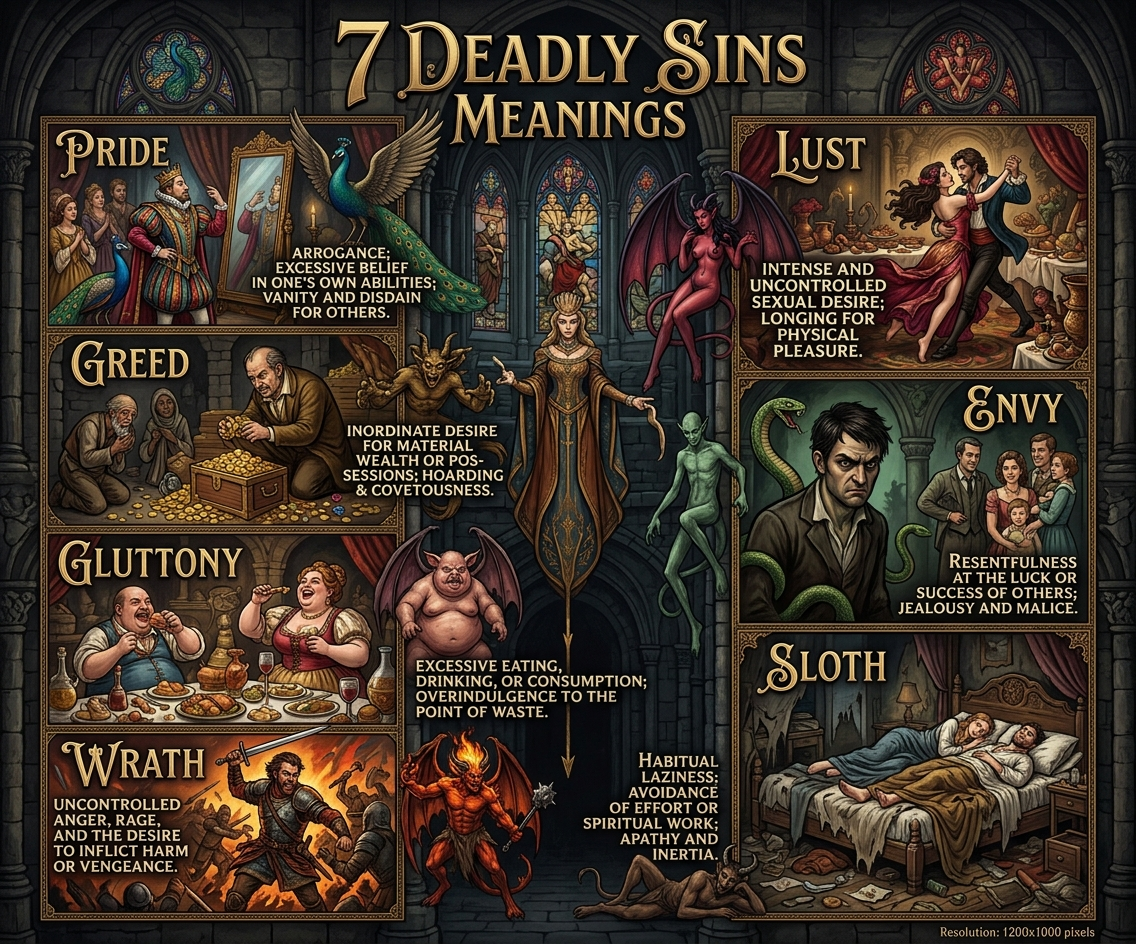
The 7 deadly sins meanings reveal how Christian tradition explains destructive habits such as pride, greed, lust, envy, gluttony, wrath, and sloth, and why these behaviors can shape choices.
Learning the 7 deadly sins meanings is not simply about memorizing seven names. It offers a fascinating look at human behavior, temptation, morality, virtue, and the long history of Christian teaching.
What are the seven deadly sins?
The seven deadly sins are traditionally known as pride, greed, lust, envy, gluttony, wrath, and sloth. In Catholic theology, they are more precisely called capital sins or capital vices because they can give rise to other sins and harmful behaviors.
Here is a quick overview:
| Deadly sin | Basic meaning |
|---|---|
| Pride | Excessive self-importance |
| Greed | Excessive desire for wealth or possessions |
| Lust | Disordered or excessive sexual desire |
| Envy | Resentment of another person’s good fortune |
| Gluttony | Excessive eating or drinking |
| Wrath | Intense anger with a desire for vengeance |
| Sloth | Lack of appropriate physical or spiritual effort |
The word “deadly” can be misleading if understood as meaning that every instance is automatically a mortal sin. In Catholic teaching, capital vices are called “capital” because they can generate other sins and vices.
Who was the first person to outline the seven deadly sins?
No single person invented the complete tradition in its final form. Early Christian thinkers, especially Evagrius Ponticus and John Cassian, wrote about groups of destructive thoughts and vices that influenced later Christian classifications.
Pope Gregory the Great played an important role in shaping the familiar seven-vices tradition during the sixth century. Later, Thomas Aquinas developed the capital vices in detail within medieval Christian theology.
A simple historical outline looks like this:
- Evagrius Ponticus: discussed eight evil thoughts.
- John Cassian: transmitted and discussed the tradition in Western Christianity.
- Gregory the Great: helped establish the familiar seven-vices framework.
- Thomas Aquinas: provided extensive theological analysis of the capital vices.
Therefore, describing Gregory as the “creator” of the seven deadly sins oversimplifies a tradition that developed gradually.
What famous works incorporate the seven deadly sins?
The seven deadly sins became powerful subjects in medieval art and literature. Writers and artists used them to explore temptation, morality, human weakness, punishment, repentance, and spiritual growth.
Some famous examples include:
- Hieronymus Bosch: Table of the Seven Deadly Sins
- Dante Alighieri: The Divine Comedy
- Geoffrey Chaucer: The Canterbury Tales
- David Fincher: Se7en (1995)
- Medieval morality plays and religious artwork
These works do not all present the sins in exactly the same theological way. Instead, they show how the concept moved from religious teaching into literature, visual art, theater, and modern entertainment.
Meaning and cultural significance
The 7 deadly sins meanings have remained culturally powerful because they describe recognizable human weaknesses. Pride can appear as arrogance, greed as endless accumulation, envy as resentment, and wrath as uncontrolled revenge.
Their significance extends beyond religious classrooms. Medieval writers used them to teach moral lessons, artists turned them into visual symbols, and modern filmmakers use them to build characters and stories. The seven vices therefore became part of Western cultural vocabulary.
The concept also encourages people to look beneath individual actions. A harmful action may have an underlying attitude behind it. Repeated selfishness, resentment, excessive desire, or avoidance can gradually become a pattern of behavior.
That is why the tradition focuses on vices rather than merely isolated mistakes. A vice can become an established tendency that influences future decisions. The opposite approach is to develop virtues that strengthen self-control, generosity, patience, humility, and responsible action.
The seven deadly sins and the corresponding seven heavenly virtues
The seven deadly sins are often presented alongside virtues that provide a constructive response to each vice. These pairings are widely used in Christian teaching, although specific lists can vary between traditions and sources.
| Deadly sin | Common opposing virtue | General idea |
|---|---|---|
| Pride | Humility | Recognizing one’s proper place |
| Greed | Charity | Giving rather than excessive possession |
| Lust | Chastity | Responsible control of sexual desire |
| Envy | Gratitude | Appreciating one’s blessings |
| Gluttony | Temperance | Practicing moderation |
| Wrath | Patience | Responding without destructive anger |
| Sloth | Diligence | Making appropriate effort |
These virtues are not merely rules for avoiding bad behavior. They represent positive qualities that can reshape habits over time. Someone dealing with envy, for example, can deliberately practice gratitude and goodwill rather than allowing comparison to control their thinking.
Similarly, humility challenges pride, temperance challenges excessive appetite, and patience challenges destructive anger. This approach makes the subject more constructive because it focuses not only on what should be avoided but also on what should be developed.
Pride
Pride is traditionally understood as an excessive or disordered estimation of oneself. Healthy confidence and satisfaction in an achievement are not automatically sinful. Pride becomes a vice when self-importance turns into arrogance, superiority, vanity, or rejection of one’s dependence on God and others.
In Christian theology, pride can affect the way a person views success. Instead of recognizing help, opportunity, or gifts received from others, an excessively proud person may believe that every accomplishment proves their superiority.
Common signs associated with excessive pride include:
- Refusing to admit mistakes
- Constantly seeking admiration
- Looking down on others
- Rejecting reasonable criticism
- Taking all credit for shared achievements
- Believing oneself superior to others
The corresponding virtue is humility. Humility does not mean thinking poorly of yourself. Instead, it involves seeing yourself honestly, recognizing your abilities without exaggerating them, and appreciating the contributions of other people.
What does pride mean as a deadly sin?
As a capital vice, pride concerns an excessive focus on one’s own excellence or importance. It can lead someone to seek admiration, reject correction, underestimate others, or take credit without recognizing the people and circumstances that contributed to success.
How does pride affect a person?
Excessive pride can make learning and relationships difficult. Someone who cannot accept criticism may repeat the same mistakes, while someone who constantly needs recognition may struggle to appreciate other people’s achievements.
Greed
Greed, traditionally associated with avarice or covetousness, involves an excessive desire for wealth, possessions, status, power, or other desirable things. Wanting financial security or working toward success is not automatically greedy.
The problem arises when desire becomes unreasonable or controlling. A person may become so attached to gaining more that fairness, generosity, relationships, or moral responsibilities are pushed aside.
Greed can appear in several forms:
- Obsession with accumulating money
- Excessive attachment to possessions
- Desire for constant status
- Wanting power for selfish reasons
- Resenting people who have more
- Unwillingness to share despite having enough
The Christian response traditionally emphasizes charity and generosity. Catholic teaching also distinguishes legitimate desire for useful goods from disordered covetousness.
What does greed mean as a deadly sin?
Greed becomes a capital vice when the desire for wealth, possessions, influence, or other goods becomes excessive and disordered. It is not simply wanting money; it concerns allowing acquisition and possession to dominate one’s priorities.
How does greed affect a person?
Unchecked greed can create a constant feeling that there is never enough. It may also encourage selfish decisions, unfair treatment, dishonesty, or neglect of relationships when gaining more becomes more important than people.
Envy
Envy is often confused with jealousy, but the two concepts are not exactly the same. Envy traditionally involves sadness or resentment over another person’s good fortune, excellence, possessions, relationships, or advantages.
The problem becomes especially serious when another person’s success feels like a personal loss. Instead of being inspired by someone’s achievement, an envious person may wish that person did not have it.
Envy may focus on:
- Wealth
- Beauty
- Career success
- Relationships
- Social status
- Talent
- Recognition
- Opportunities
The healthier response is gratitude, goodwill, and appreciation. Recognizing another person’s success does not diminish your own worth.
What does envy mean as a deadly sin?
Envy involves resentment toward another person’s good fortune combined with an excessive desire to possess what they have. It can become destructive when a person wants another individual’s success, happiness, or advantage to disappear.
How is envy different from jealousy?
Envy generally means wanting something another person has. Jealousy more commonly involves fear that something you already have, especially affection or attention, may be taken away by someone else.
For example, wishing you had someone’s professional success may be envy. Feeling threatened because a partner gives another person attention is commonly described as jealousy.
Gluttony
Gluttony is traditionally associated with excessive consumption, especially excessive eating and drinking. Enjoying food is not inherently sinful. The concern is what happens when appetite becomes unreasonable and self-control is repeatedly abandoned.
Historically, drunkenness has also been connected with gluttony because it involves excessive consumption of intoxicating drinks. The central idea is therefore not pleasure itself but excess and lack of moderation.
| Ordinary enjoyment | Excessive indulgence |
|---|---|
| Enjoying a meal | Eating beyond reasonable limits |
| Celebrating with food | Making consumption an obsession |
| Enjoying a drink responsibly | Drinking excessively |
| Appreciating good food | Allowing appetite to dominate judgment |
The opposing virtue is temperance, which encourages moderation and balanced enjoyment rather than complete rejection of pleasure.
What does gluttony mean as a deadly sin?
Gluttony refers to excessive eating or drinking and the disordered pursuit of consumption. The issue is not enjoying food but allowing appetite or consumption to exceed reasonable limits.
Is gluttony only about food?
Traditional discussions focus mainly on eating and drinking. Modern writers sometimes extend the idea to other forms of excessive consumption, but those broader applications should be distinguished from the traditional theological meaning.
Read More: 5 Road Sign Meanings: Understanding Colors and Shapes of Road Signs
Wrath
Wrath is more intense than ordinary anger. It involves strong hatred, resentment, or a desire for vengeance. Anger itself is a normal human emotion and is not automatically sinful.
A person can become angry about injustice and still respond thoughtfully. Wrath becomes destructive when resentment is deliberately nurtured and revenge or another person’s suffering becomes the goal.
Common features associated with wrath include:
- Intense resentment
- Hatred
- Desire for revenge
- Desire to punish another person
- Loss of reasonable judgment
- Persistent hostility
Christian theology also distinguishes human wrath from divine judgment. God’s wrath is understood within the context of divine righteousness and justice rather than being treated as uncontrolled human rage.
What does wrath mean as a deadly sin?
Wrath traditionally involves intense anger combined with resentment or a desire for vengeance. It goes beyond experiencing anger and focuses on allowing anger to become hateful, destructive, or revenge-driven.
What is the difference between wrath and anger?
Anger is a normal emotional response that can arise when someone experiences injustice, frustration, or harm. Wrath describes a more destructive pattern in which resentment and vengeance become central.
Sloth
Sloth is commonly associated with laziness, but its traditional theological meaning is deeper. It can refer to a culpable lack of physical or spiritual effort and is closely connected with the older term acedia.
A person who needs rest is not automatically guilty of sloth. Rest is a normal human need. The concern is persistent unwillingness to make appropriate effort toward meaningful duties or spiritual responsibilities.
Sloth may involve:
- Avoiding important responsibilities
- Persistent lack of effort
- Indifference toward spiritual duties
- Discouragement
- Neglect of worthwhile obligations
- Resistance to meaningful action
The opposing virtue is diligence, which means making appropriate effort and remaining committed to worthwhile responsibilities.
What does sloth mean as a deadly sin?
Sloth refers to a persistent lack of appropriate effort, especially toward moral or spiritual responsibilities. It is more than occasional tiredness or procrastination and can involve deep reluctance or indifference.
What is acedia?
Acedia is an important historical theological term associated with spiritual listlessness, discouragement, or indifference. It should not simply be translated as modern laziness because its traditional meaning includes resistance toward spiritual responsibilities.
The Seven Deadly Sins and Human Behavior
The 7 deadly sins meanings remain relevant because each vice describes a pattern that can appear in ordinary human life. People may recognize the desire for praise, the temptation to compare themselves with others, or the urge to retaliate after being hurt.
However, the tradition does not mean that experiencing an emotion automatically makes someone guilty of a deadly sin. Feelings and deliberate choices are different things. Catholic teaching recognizes that passions can have different moral qualities depending on how they relate to reason and action.
The seven vices are better understood as recurring tendencies that can shape behavior. This makes the concept useful for examining habits rather than simply labeling people as “proud,” “greedy,” or “angry.”
A useful self-reflection approach is to ask:
- Do I regularly compare myself with others?
- Do I struggle to admit mistakes?
- Do I place possessions above relationships?
- Do I allow anger to control my responses?
- Do I avoid responsibilities unnecessarily?
- Do I struggle with moderation?
- Do I constantly need recognition?
These questions are not a substitute for theological teaching, but they demonstrate why the seven vices continue to attract attention centuries after their development.
Why Are They Called “Deadly” Sins?
The 7 deadly sins meanings become clearer when the word “deadly” is understood through the traditional concept of capital vices. They are called capital because they can serve as sources from which other sins and vices develop.
The Catholic Catechism explains that capital sins are classified according to the principal vices they generate. It lists pride, avarice, envy, wrath, lust, gluttony, and sloth or acedia.
This does not mean every occurrence of one of these tendencies automatically qualifies as a mortal sin.
The distinction is important:
- Capital vice: a root tendency that can generate other sins.
- Mortal sin: a grave moral offense meeting specific conditions.
- Venial sin: a less serious offense or one lacking the conditions required for mortal sin.
This terminology helps prevent a common misunderstanding in which “deadly sin” and “mortal sin” are treated as exact synonyms.
Seven Deadly Sins vs. Mortal and Venial Sins
The 7 deadly sins meanings are sometimes confused with the Catholic distinction between mortal and venial sin. These concepts are connected but describe different aspects of moral theology.
| Concept | Meaning |
|---|---|
| Capital vice | A principal vice capable of generating other sins |
| Mortal sin | Grave matter committed with full knowledge and deliberate consent |
| Venial sin | A less serious sin, or one lacking the conditions for mortal sin |
According to Catholic teaching, mortal sin requires grave matter, full knowledge, and deliberate consent. If one of these conditions is absent, the act may not constitute mortal sin.
Therefore, calling pride, greed, lust, envy, gluttony, wrath, and sloth “deadly” does not mean that every thought, emotion, or minor act involving them is automatically a mortal sin.
The Seven Deadly Sins in Christianity
The seven capital vices are especially associated with Christian moral theology and have been particularly influential in Catholic tradition. They relate to wider Christian teachings about sin, virtue, temptation, free will, repentance, and spiritual growth.
Their purpose is not simply to create a list of forbidden feelings. Instead, the tradition examines how desires can become disordered and how repeated choices can develop into habits.
Christian moral teaching also places strong emphasis on virtue. A person is not expected merely to avoid wrongdoing but to cultivate qualities that support love of God and neighbor, self-control, justice, generosity, and responsible action.
This makes the subject broader than seven negative labels. It becomes a discussion about how human desires can be directed toward healthier and more constructive ends.
The Seven Deadly Sins in Medieval Art and Literature
During the Middle Ages, the seven sins became common subjects in religious art, literature, sermons, and morality plays. Their visual and literary popularity partly came from their ability to turn complex moral ideas into recognizable human characters and behaviors.
One famous example is Hieronymus Bosch’s Table of the Seven Deadly Sins. The artwork presents moral behavior through a collection of scenes, allowing viewers to see different forms of wrongdoing in everyday life.
Literature also made extensive use of moral themes surrounding sin and virtue:
- Dante’s The Divine Comedy
- Chaucer’s The Canterbury Tales
- Medieval morality plays
- Religious sermons and devotional texts
- Medieval paintings and manuscripts
The sins were therefore not limited to theological books. They became part of the artistic language used to discuss human weakness, judgment, repentance, and salvation.
Read More: Rune Meanings: The 24 Elder Futhark Runes Explained
The Seven Deadly Sins in Modern Culture
The concept continues to appear in modern movies, television, literature, music, games, and other entertainment. Modern creators often adapt the sins symbolically rather than following Catholic theology precisely.
The 1995 film Se7en, directed by David Fincher, is perhaps one of the most recognizable examples. Its crime story is structured around the seven sins, demonstrating how an ancient moral framework can become a modern storytelling device.
Modern uses often treat the sins as symbols for:
- Obsession
- Revenge
- Greed
- Violence
- Desire
- Vanity
- Jealousy
- Self-destruction
These modern interpretations can be entertaining, but they should not automatically be treated as accurate explanations of Christian theology. Popular culture frequently simplifies or changes traditional concepts for dramatic purposes.
How the Seven Deadly Sins Can Be Overcome
The 7 deadly sins meanings become more useful when paired with the virtues traditionally used to counter destructive tendencies. The emphasis shifts from simply identifying a weakness to developing a better habit.
Here are practical examples of the traditional approach:
- Pride: practice humility and acknowledge others’ contributions.
- Greed: practice generosity and responsible sharing.
- Lust: practice self-control and respect.
- Envy: practice gratitude and goodwill.
- Gluttony: practice moderation.
- Wrath: practice patience and thoughtful responses.
- Sloth: practice diligence and perseverance.
These responses should not be understood as instant solutions. Virtue generally develops through repeated choices. A person who wants to become more patient, for example, needs opportunities to practice patience rather than simply learning its definition.
Within Christian practice, prayer, repentance, charitable action, spiritual discipline, and participation in a faith community may also support the development of virtue.
Frequently Asked Questions
Are the seven deadly sins mentioned in the Bible?
The Bible discusses many behaviors and attitudes associated with the seven sins, including pride, envy, greed, anger, sexual immorality, excessive eating and drinking, and spiritual negligence. However, the familiar standardized list of seven capital vices developed through Christian tradition rather than appearing as one complete list in a single biblical passage.
What is the most serious of the seven deadly sins?
Pride has often received special attention in Christian theological discussions, but there is no need to treat the seven as a simple ranking from worst to least serious. They are collectively classified as capital vices because each can generate other sins.
What are the seven heavenly virtues?
The seven heavenly virtues are commonly presented as virtues associated with overcoming the seven deadly sins. Common pairings include humility with pride, charity with greed, chastity with lust, gratitude or goodwill with envy, temperance with gluttony, patience with wrath, and diligence with sloth.
Are the seven deadly sins the same as mortal sins?
No. Capital sins are root vices that can generate other sins, while mortal sin describes a grave offense committed with full knowledge and deliberate consent. The two classifications therefore should not be treated as identical.
Who created the seven deadly sins?
No single individual created the entire tradition in its final form. Evagrius Ponticus and John Cassian contributed important early classifications, while Gregory the Great helped establish the familiar seven-vices framework. Thomas Aquinas later developed the subject extensively.
Why are the seven deadly sins important in Christianity?
They provide a framework for understanding recurring moral tendencies that can influence behavior. The tradition also emphasizes that people should cultivate virtues rather than merely avoid wrongdoing.
What is the difference between envy and jealousy?
Envy usually means wanting something another person has, while jealousy often involves fear of losing something one already possesses, especially affection or attention. In everyday conversation, however, the terms are frequently used interchangeably.
Is anger always a sin?
No. Anger is a normal human emotion. The moral concern arises when anger becomes unreasonable, hateful, vindictive, or destructive. Wrath traditionally refers to an intensified form involving resentment and a desire for vengeance.
Is enjoying food considered gluttony?
No. Enjoying food is not automatically gluttonous. Gluttony concerns excessive consumption and a lack of reasonable moderation. Sharing a meal, celebrating with food, or enjoying a favorite dish does not by itself constitute the vice.
What does sloth really mean?
Sloth is more than ordinary tiredness or taking a break. Its traditional theological meaning involves culpable lack of appropriate effort, particularly toward moral or spiritual responsibilities. Acedia adds the idea of spiritual listlessness or discouragement.
Conclusion
The 7 deadly sins meanings bring together centuries of Christian reflection on pride, greed, lust, envy, gluttony, wrath, and sloth. Their deeper purpose is understanding how destructive habits develop.
Studying the 7 deadly sins meanings also reveals their lasting cultural influence, from medieval theology and art to modern literature and film. Their opposing virtues provide a constructive path toward better habits and choices.

MeaningShelf shares meaningful quotes, thoughtful messages, and helpful word meanings, managed by Lily Anderson, an SEO content writer with 2 years of experience, creating engaging content that inspires readers and helps them find the right words for every moment.
3 thoughts on “7 Deadly Sins: Meanings, Examples & Virtues”