
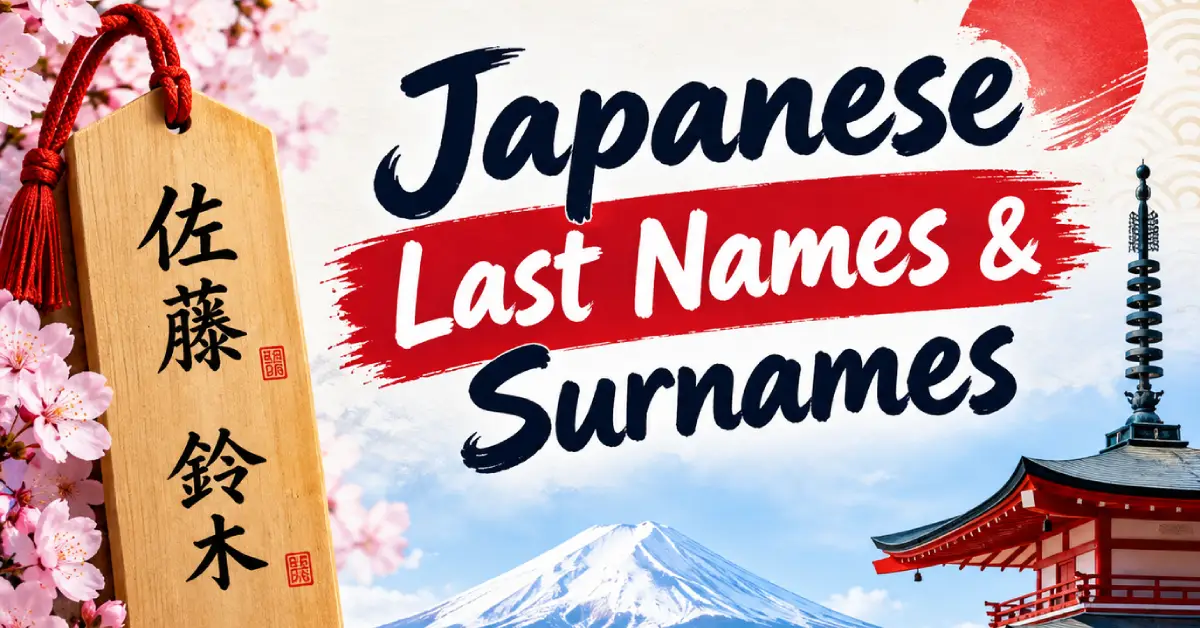
Japanese Last Names & surnames connect families with nature, places, occupations, and older traditions. Exploring Japanese last names and meanings can reveal stories hidden inside kanji, from mountains, rivers, fields, forests, and villages.
Whether researching family history, choosing a character name, or exploring Japanese culture, Japanese last names and meanings offer clues about language and naming traditions. Kanji, readings, pronunciation, and spellings vary.
Japanese Last Names & surnames A-Z(70,628)
Japanese surnames often reflect landscapes, communities, or plants. Mountains, rice fields, rivers, forests, bridges, villages, ponds, and wells frequently helped identify families in older communities.
English spellings can differ through Romanization. Satou, Satō, and Satoh may represent 佐藤. Checking original kanji helps when researching pronunciation, meaning, genealogy, or historical records.
Most Common Japanese Last Names
Familiar surnames include Satou, Suzuki, Takahashi, Tanaka, and Watanabe. The supplied reference lists approximate household figures, but rankings can vary by database and date today.
Kanji adds information. A surname may describe a landscape, plant, object, or positive idea, yet literal translation does not always prove an individual’s historical origin.
Satou
佐藤 Japanese last names and meanings widely recognized across Japan. 佐 means assist or aid, while 藤 means wisteria. This surname is today.
Suzuki
鈴木 Japanese last names and meanings鈴 means bell or chime, while 木 means tree or wood. Together, the characters create a simple natural image.
Takahashi
高橋 Japanese last names and meanings高 means high or excellent, while 橋 means bridge. The surname can suggest a high place or a bridge.
Tanaka
田中 Japanese last names and meanings田 means rice field and 中 means middle or center. The surname is commonly understood as referring to the middle of a rice field.
Watanabe
渡辺 Japanese last names and meanings渡 means cross or pass, while 辺 means edge or vicinity. The name can suggest a place near a crossing.
Itou
伊藤 Japanese last names and meanings伊藤 contains 伊 and 藤, with 藤 meaning wisteria. Romanization may appear as Itou, Itō, or Ito.
Yamamoto
山本 Japanese last names and meanings山 means mountain and 本 means base or origin. The surname can describe a location near the base of a mountain.
Nakamura
中村 Japanese last names and meanings中 means middle or center and 村 means village. The name can suggest a central part of a village.
Kobayashi
小林 Japanese last names and meanings小 means small or young, while 林 means woods. The surname creates an image of a smaller woodland area.
Read More: 23 Pride Flags and Their Meanings Explained
Saitou
斎藤 Japanese last names and meanings斎 is associated with purification or ritual, while 藤 means wisteria. The surname has several Romanized spellings.
Katou
加藤 Japanese last names and meanings加 means add or join, while 藤 means wisteria. Katou may also be written Katō in Romanization.
Yoshida
吉田 Japanese last names and meanings吉 means auspicious, good, or fortunate, while 田 means rice field. The surname combines positive symbolism with agriculture.
Yamada
山田 Japanese last names and meanings山 means mountain and 田 means rice field. The combination describes a landscape where mountains and cultivated fields meet.
Sasaki
佐々木 Japanese last names and meanings佐 means assist or aid, 々 repeats the preceding character, and 木 means tree or wood. The name has three written elements.
Matsumoto
松本 Japanese last names and meanings松 means pine and 本 means base or origin. Pine can symbolize longevity and prosperity in Japanese cultural traditions.
Yamaguchi
山口 Japanese last names and meanings山 means mountain and 口 means mouth or entrance. The surname can describe an opening or entrance associated with a mountain.
Inoue
井上 井 means well and 上 means above or up. The surname may evoke a place located above or near a well. Its written form provides a useful clue, not a complete family history.
Kimura
木村 木 means tree or wood and 村 means village. The name can suggest a village associated with trees or woodland. The kanji also helps distinguish it from similar Romanized spellings.
Shimizu
清水 清 means clear, fresh, or serene, while 水 means water. The surname creates an image of clean, clear water. Its written form provides a useful clue, not a complete family history.
Hayashi
林 林 means woods or a group of trees. This surname directly reflects the natural environment and uses one main kanji. The meaning becomes clearer when pronunciation and kanji are considered together.
Yamazaki
山崎 山 means mountain and 崎 refers to a cape or rugged landform. The surname can suggest mountainous or steep terrain. The kanji also helps distinguish it from similar Romanized spellings.
Mori
森 森 means forest or a dense collection of trees. It is a clear example of a surname directly based on nature. The meaning becomes clearer when pronunciation and kanji are considered together.
Hashimoto
橋本 橋 means bridge and 本 means base or origin. The surname may describe a location associated with the base of a bridge. Its written form provides a useful clue, not a complete family history.
Ikeda
池田 池 means pond or pool and 田 means rice field. The name suggests cultivated land located near water. The meaning becomes clearer when pronunciation and kanji are considered together.
Abe
阿部 阿 can refer to a hill or slope, while 部 means part, group, or section. Family-specific origins may differ. Its written form provides a useful clue, not a complete family history.
Ishikawa
石川 石 means stone and 川 means river. The surname creates an image of stones beside or within flowing water. The meaning becomes clearer when pronunciation and kanji are considered together.
Yamashita
山下 山 means mountain and 下 means below or underneath. The name can describe someone living below or near a mountain. The kanji also helps distinguish it from similar Romanized spellings.
Ogawa
小川 小 means small and 川 means river or stream. The surname is commonly understood as referring to a small river. Its written form provides a useful clue, not a complete family history.
Ishii
石井 石 means stone and 井 means well. The combination can evoke a well associated with stones or a stony place. The meaning becomes clearer when pronunciation and kanji are considered together.
Nakashima
中島 中 means middle and 島 means island. The surname can evoke an island situated centrally within surrounding waters. The kanji also helps distinguish it from similar Romanized spellings.
Sakamoto
坂本 坂 means slope or hill and 本 means base or origin. The surname can suggest the base of a slope. Its written form provides a useful clue, not a complete family history.
Read More: Ford Dashboard Symbols and Meanings Guide
Okada
岡田 岡 means hill or mound and 田 means rice field. The name suggests cultivated land associated with raised terrain. The meaning becomes clearer when pronunciation and kanji are considered together.
Maeda
前田 前 means front or before and 田 means rice field. The surname can describe a field positioned in front of another place. Its written form provides a useful clue, not a complete family history.
Fujita
藤田 藤 means wisteria and 田 means rice field. The name combines a flowering plant with cultivated agricultural land. The meaning becomes clearer when pronunciation and kanji are considered together.
Sakai
酒井 酒 means sake or alcohol and 井 means well. The literal characters do not necessarily reveal a specific family’s historical origin. Its written form provides a useful clue, not a complete family history.
Gotou
後藤 後 means after, behind, or successor, while 藤 means wisteria. Romanization may appear as Gotou, Gotō, or Goto. The kanji also helps distinguish it from similar Romanized spellings.
Hasegawa
長谷川 長 means long or chief, 谷 means valley, and 川 means river. Together, the characters create a vivid landscape. The meaning becomes clearer when pronunciation and kanji are considered together.
Kondou
近藤 近 means near or close and 藤 means wisteria. The surname joins an idea of proximity with a recurring plant character. Its written form provides a useful clue, not a complete family history.
Murakami
村上 村 means village and 上 means above or rising. The name may describe an upper part of a village. The kanji also helps distinguish it from similar Romanized spellings.
Oota
太田 太 means great, thick, or large and 田 means rice field. The surname combines size or importance with agriculture. The meaning becomes clearer when pronunciation and kanji are considered together.
Kikuchi
菊地 菊 means chrysanthemum and 地 means earth or land. The surname has a strong botanical and landscape connection. Its written form provides a useful clue, not a complete family history.
Arai
新井 新 means new or fresh and 井 means well. The name can evoke a newly established place associated with a well. The meaning becomes clearer when pronunciation and kanji are considered together.
Ueda
上田 上 means above or rising and 田 means rice field. The surname can describe an upper field or higher farmland. The kanji also helps distinguish it from similar Romanized spellings.
Nakano
中野 中 means middle or center and 野 means field or open countryside. The name suggests a centrally located field. Its written form provides a useful clue, not a complete family history.
Aoki
青木 青 can mean blue, green, or young, while 木 means tree or wood. The surname creates a vivid image of greenery. The meaning becomes clearer when pronunciation and kanji are considered together.
Endou
遠藤 遠 means far or distant and 藤 means wisteria. The surname combines distance with a plant character common in Japanese names. Its written form provides a useful clue, not a complete family history.
Nishimura
西村 西 means west or western and 村 means village. The surname can describe a village or settlement on the western side. The kanji also helps distinguish it from similar Romanized spellings.
Fujii
藤井 藤 means wisteria and 井 means well. The surname joins a plant with a local water source. The meaning becomes clearer when pronunciation and kanji are considered together.
Okamoto
岡本 岡 means hill or mound and 本 means base or origin. The name can suggest the base of a hill. Its written form provides a useful clue, not a complete family history.
Takeuchi
竹内 竹 means bamboo and 内 means inside or within. The surname connects a culturally important plant with a sense of location. The kanji also helps distinguish it from similar Romanized spellings.
Kaneko
金子 金 can mean gold, metal, or money, while 子 means child. The literal meanings should not be treated as a complete family history. The meaning becomes clearer when pronunciation and kanji are considered together.
Fukuda
福田 福 means fortune, blessing, or happiness and 田 means rice field. The name combines positive symbolism with agriculture. Its written form provides a useful clue, not a complete family history.
Fujiwara
藤原 藤 means wisteria and 原 means plain or open land. Fujiwara also has important historical associations with an ancient Japanese clan. The kanji also helps distinguish it from similar Romanized spellings.
Nakagawa
中川 中 means middle or center and 川 means river. The surname can suggest a river running through or near a central area. Its written form provides a useful clue, not a complete family history.
Harada
原田 原 means plain or open land and 田 means rice field. The surname creates an image of cultivated fields on open ground. The meaning becomes clearer when pronunciation and kanji are considered together.
Miura
三浦 三 means three and 浦 means bay, shore, or inlet. The surname can evoke a coastal setting or shoreline. Its written form provides a useful clue, not a complete family history.
Takeda
武田 武 means military, brave, or martial and 田 means rice field. The name combines martial imagery with agriculture. The kanji also helps distinguish it from similar Romanized spellings.
Ono
小野 小 means small or young and 野 means field or open countryside. The surname can suggest a small open field. The meaning becomes clearer when pronunciation and kanji are considered together.
Morita
森田 森 means forest and 田 means rice field. The surname brings woodland and cultivated land together in one written name. Its written form provides a useful clue, not a complete family history.
Tamura
田村 田 means rice field and 村 means village. The name can suggest a village associated with agricultural fields and reflects the agricultural landscape. The kanji also helps distinguish it from similar Romanized spellings.
Last Name Search
Searching a Japanese surname works best with Romanized spelling and kanji. Different readings or spellings can point to related forms, while written characters reveal meanings.
Search tools may support Japanese or English characters, exact matches, initials, meanings, and categories such as common, rare, nature, flower, beauty, fortune, strength, and wisdom.
Explore Last Names by Meaning
Japanese surnames can be explored through nature, geography, identity, and qualities. Mountains, rivers, trees, forests, fields, islands, valleys, bridges, ponds, and wells appear throughout vocabulary.
Meaning searches can highlight fortune, happiness, beauty, courage, wisdom, prosperity, flowers, snow, moon, sun, and love. These categories help organize names, not historical explanations today.
Frequently Asked Questions
What do Japanese last names and meanings usually describe?
They describe places, landscapes, plants, occupations, or qualities. Examples include Tanaka, connected with rice fields, Yamamoto, connected with mountains, and Ishikawa, connected with stones and rivers. A literal translation helps, but it does not establish historical origin of each family surname.
Which Japanese last names and meanings are most common?
The supplied reference identifies Satou, Suzuki, Takahashi, Tanaka, and Watanabe among the most common examples. It also gives approximate household figures. Because surname databases use different methods and dates, rankings should be treated as reference information rather than permanent national rankings.
Why do Japanese last names and meanings often involve nature?
Families historically used landmarks and landscapes as useful identifiers. Mountains, rice fields, rivers, forests, villages, ponds, wells, and islands could distinguish one community from another. This explains why nature and geography appear so often in Japanese family names across generations.
Can Japanese last names and meanings change with different kanji?
Yes. The same pronunciation can sometimes be written with different kanji, and the written characters may carry different meanings. Romanization can also vary, so checking the original Japanese spelling is important when studying pronunciation, genealogy, or a particular family’s records.
How should I research Japanese last names and meanings?
Begin with the surname’s original kanji, then check its reading, Romanized spellings, dictionary meanings, and historical records. Search databases can filter names by meaning or features. For genealogy, genealogical documents are more reliable than assuming a literal translation explains a surname.
Conclusion
Understanding Japanese last names and meanings makes surnames more than labels. Their kanji can point toward mountains, rivers, fields, flowers, villages, family history, and traditions shaped by surroundings around them.
From names such as Satou and Suzuki to less familiar surnames, Japanese last names and meanings reveal connections between language and landscape. Checking kanji and reading helps avoid interpretations alone.

MeaningShelf shares meaningful quotes, thoughtful messages, and helpful word meanings, managed by Lily Anderson, an SEO content writer with 2 years of experience, creating engaging content that inspires readers and helps them find the right words for every moment.
2 thoughts on “100+ Japanese Last Names & Surnames”