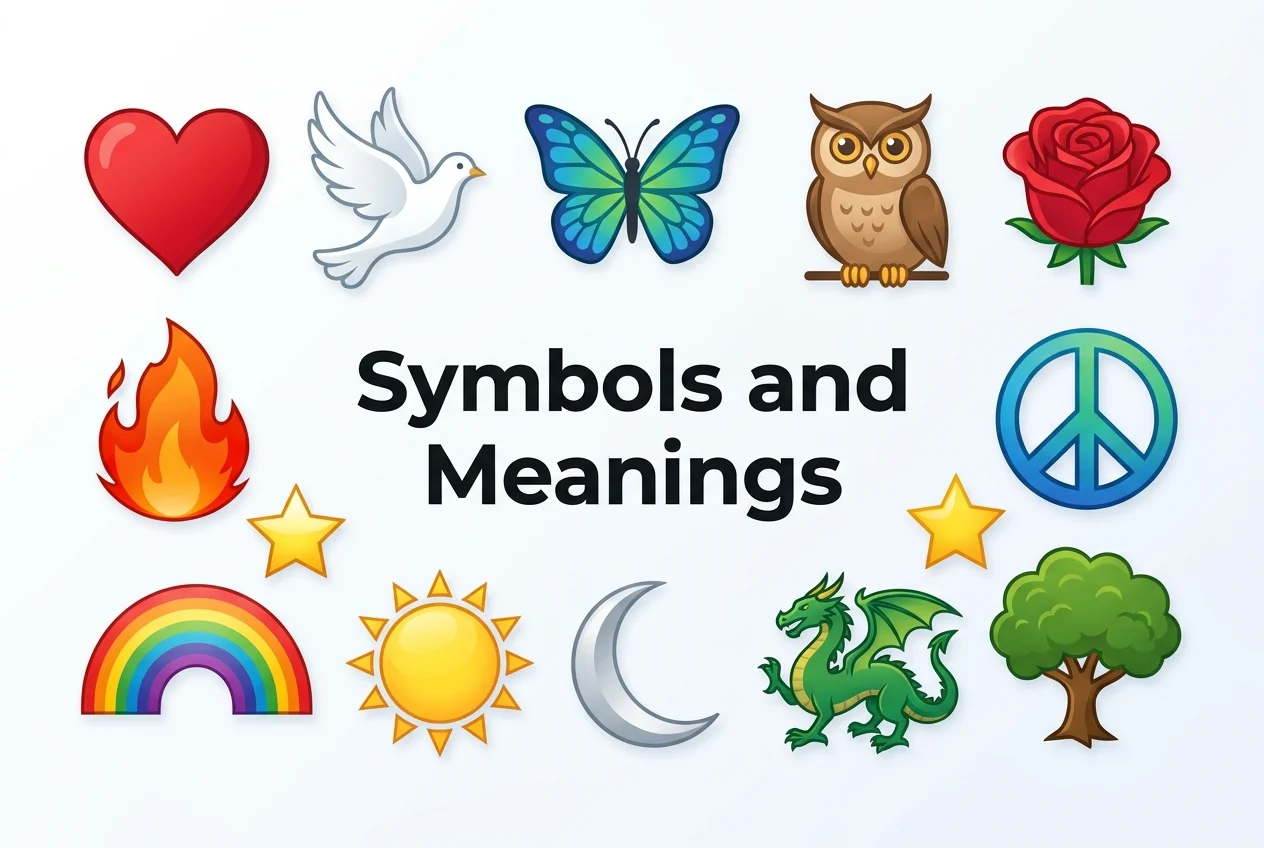
Symbols communicate ideas without needing long explanations. A simple heart can suggest love, while a dove can suggest peace. Their meaning often comes from culture, history, context, and shared human experiences.
Understanding symbols and meanings makes visual communication easier. Designers, writers, marketers, and storytellers use familiar images to create feelings, explain ideas, and help audiences understand messages quickly.
Why Are Symbols Important in Graphic Design?
Symbolism gives visual elements a meaning beyond their literal appearance. A picture, shape, color, or object can represent an idea, emotion, belief, or experience that people recognize.
In graphic design, symbols and meanings help audiences understand messages quickly. However, context matters because the same symbol can have different interpretations across cultures, religions, historical periods, and communities.
- Symbol: A visual representation
- Meaning: The idea it communicates
- Context: What changes its interpretation
- Culture: What shapes shared understanding
20 Common Symbols and Meanings
The following symbols are widely used in visual communication, storytelling, art, religion, branding, and popular culture. Their meanings are not always fixed, so surrounding imagery and audience expectations should always be considered.
| Symbol | Common association |
|---|---|
| Raven | Mystery, death |
| Dove | Peace |
| Butterfly | Transformation |
| Cross | Faith, Christianity |
| Water | Life, cleansing |
| Owl | Wisdom |
| Rose | Love |
| Fire | Passion, destruction |
| Arrow | Direction, progress |
| Flag | Identity, pride |
1 Raven
🖼️ Visual: 🐦⬛ Raven
The raven often carries associations with mystery, death, darkness, and the unknown. Its symbolism appears in literature and storytelling, where its dark appearance and intelligence can create an eerie or thoughtful mood.
- Represents: Mystery
- Often suggests: Death or darkness
- Useful for: Dramatic storytelling
2 Dove
🖼️ Visual: 🕊️ Dove
The dove is strongly associated with peace, harmony, hope, and gentleness. Its peaceful image makes it useful in messages about reconciliation, unity, kindness, and nonviolence across many forms of visual communication.
- Represents: Peace
- Suggests: Harmony and hope
- Useful for: Peace-focused designs
3 Butterfly
🖼️ Visual: 🦋 Butterfly
The butterfly commonly represents transformation, change, freedom, and rebirth. Its movement from caterpillar to butterfly makes it a natural visual metaphor for personal growth, renewal, new beginnings, and major life changes.
- Represents: Transformation
- Suggests: Freedom and renewal
- Useful for: Growth themes
4 Cross
🖼️ Visual: ✝️ Cross
The cross is strongly connected with Christianity and Christian faith. It can represent belief, sacrifice, salvation, devotion, and spirituality. Its meaning is especially dependent on religious and cultural context.
- Represents: Christian faith
- Suggests: Sacrifice and devotion
- Useful for: Religious communication
5 Water
🖼️ Visual: 💧 Water
Water can represent life, cleansing, renewal, healing, and spiritual purification. Because water is essential for life and appears in many religious and cultural traditions, its symbolic meaning can extend far beyond its physical form.
- Represents: Life
- Suggests: Cleansing and renewal
- Useful for: Nature and spiritual themes
Want to use symbols in your own visuals?
Simple visual icons can make presentations, social graphics, educational materials, and storytelling easier to understand. Choose symbols that match your audience and message rather than selecting an image only because it looks attractive.
6 Owl
🖼️ Visual: 🦉 Owl
The owl is one of the best-known symbols of wisdom, knowledge, intelligence, and learning. Its association with wisdom appears repeatedly in mythology, literature, education, and modern visual communication.
- Represents: Wisdom
- Suggests: Knowledge
- Useful for: Education and learning
7 Rose
🖼️ Visual: 🌹 Rose
The rose is widely associated with love, romance, beauty, passion, and affection. Color can also influence its interpretation, making roses flexible symbols for romantic messages, friendship, appreciation, or emotional storytelling.
- Represents: Love
- Suggests: Romance and beauty
- Useful for: Emotional designs
8 Fire
🖼️ Visual: 🔥 Fire
Fire can symbolize passion, energy, transformation, destruction, warmth, and power. Its meaning changes with context: flames may suggest danger in one design while representing creativity, desire, or renewal in another.
- Represents: Energy
- Suggests: Passion or destruction
- Useful for: Powerful visual themes
9 Arrows
🖼️ Visual: ➡️ Arrow
Arrows commonly communicate movement, direction, progress, ambition, and forward motion. In visual design, they can guide attention or suggest a journey toward a goal. Their simple shape makes them highly adaptable.
- Represents: Direction
- Suggests: Progress
- Useful for: Navigation and movement
10 Flags
🖼️ Visual: 🚩 Flag
Flags often represent identity, nationality, pride, belonging, or group membership. Their colors and symbols add further meaning, so interpretation depends heavily on the country, community, organization, or movement represented.
- Represents: Identity
- Suggests: Pride and belonging
- Useful for: National or group themes
| Visual element | Possible association |
|---|---|
| Red | Valor, revolution, blood |
| White | Harmony, nonviolence |
| Blue | Freedom |
| Green | Agriculture, fertility |
| Yellow | Wealth |
11 Rain/Storms
🖼️ Visual: 🌧️ Rain
Rain often represents sadness, loneliness, melancholy, or approaching trouble in storytelling. It can also symbolize cleansing and purification, especially when a character experiences emotional change during or after a storm.
- Represents: Sadness
- Can suggest: Cleansing
- Useful for: Emotional storytelling
12 Peace sign
🖼️ Visual: ☮️ Peace Sign
The modern peace sign was created in the 1950s for the British Campaign for Nuclear Disarmament. It later became widely associated with anti-war and anti-nuclear movements.
- Represents: Peace
- Origin: Nuclear disarmament campaign
- Later use: Anti-war movements
13 Occult symbols
🖼️ Visual: 🔮 Occult Symbol
Occult symbolism generally relates to hidden, mystical, supernatural, or esoteric ideas. Different traditions use different symbols, including imagery associated with witchcraft, Kabbalah, and other mystical or spiritual systems.
- Represents: Mystery
- Suggests: Hidden knowledge
- Context: Spiritual or mystical traditions
14 Hearts
🖼️ Visual: ❤️ Heart
The heart is one of the most recognizable symbols of love, affection, romance, friendship, and emotional connection. Different heart colors can add different tones, so the surrounding message is important when interpreting them.
- Represents: Love
- Suggests: Affection
- Useful for: Emotional communication
15 Colors
🖼️ Visual: 🎨 Colors
Colors can communicate emotion, identity, cultural meaning, and visual emphasis. Red may suggest passion or danger, while other colors can represent different ideas depending on culture and context.
| Color | Common association |
|---|---|
| Red | Passion, danger |
| White | Peace, purity |
| Blue | Calm, freedom |
| Green | Nature, growth |
| Yellow | Energy, happiness |
| Black | Darkness, mystery |
Read More: Lightsaber Color Meanings: What Every Star Wars Color Means
16 Skulls
🖼️ Visual: 💀 Skull
Skulls commonly symbolize death, mortality, danger, warning, and fear. The skull-and-crossbones has appeared in warning imagery and historical symbolism, while modern culture also uses skulls in Halloween, pirate, and artistic imagery.
- Represents: Death
- Suggests: Danger and mortality
- Useful for: Warnings and dramatic themes
Want to communicate visually with symbols?
A strong visual symbol should support the message rather than distract from it. Consider your audience, cultural context, colors, placement, and surrounding imagery before using a symbol in a design.
17 Crescent
🖼️ Visual: 🌙 Crescent
The crescent moon has been used by cultures long before its later association with Islam. Because it represents a growing lunar phase, it can also suggest new beginnings, growth, rebirth, and dreams becoming reality.
- Represents: Growth
- Suggests: New beginnings
- Also associated with: Rebirth
18 Stars
🖼️ Visual: ⭐ Stars
Stars can represent hope, dreams, wishes, magic, distance, and the unknown. Their meaning depends on context and design. Shooting stars, for example, are commonly connected with wishes and aspirations.
- Represents: Hope
- Suggests: Dreams and wishes
- Useful for: Inspirational designs
19 Light
🖼️ Visual: 💡 Light
Light commonly represents knowledge, goodness, clarity, hope, guidance, and understanding. It is often contrasted with darkness to visually communicate the difference between awareness and uncertainty, safety and danger, or good and evil.
- Represents: Knowledge
- Suggests: Hope and clarity
- Useful for: Inspirational themes
20 Darkness
🖼️ Visual: 🌑 Darkness
Darkness can symbolize mystery, fear, uncertainty, secrecy, sadness, or the unknown. In storytelling, dark imagery can create suspense or represent emotional and psychological challenges without directly explaining them.
- Represents: Mystery
- Suggests: Fear or uncertainty
- Useful for: Dramatic storytelling
Bonus Visual Symbols and Meanings
The next group expands beyond the first twenty symbols and includes animals, shapes, celestial objects, and mythical figures. Their interpretations can shift significantly depending on culture, religion, mythology, and storytelling context.
| Symbol | Common symbolic idea |
|---|---|
| Lion | Strength |
| Swan | Grace |
| Spider | Creativity |
| Wolf | Loyalty |
| Phoenix | Rebirth |
| Triangle | Balance |
| Rainbow | Hope |
| Circle | Wholeness |
| Dragon | Power |
| Angel | Protection |
21 Lion
🖼️ Visual: 🦁 Lion
The lion commonly represents strength, courage, power, leadership, authority, and royalty. Its reputation as a powerful animal has made it a popular symbol in heraldry, branding, storytelling, and visual communication.
- Represents: Strength
- Suggests: Leadership
- Useful for: Powerful branding
22 Swan
🖼️ Visual: 🦢 Swan
The swan is often associated with grace, beauty, elegance, love, and transformation. Its appearance and behavior have made it a recurring image in art, mythology, literature, and romantic storytelling.
- Represents: Grace
- Suggests: Beauty
- Useful for: Elegant visual themes
23 Spider
🖼️ Visual: 🕷️ Spider
The spider can represent creativity, patience, mystery, connection, and intricate work. Its web provides a strong visual metaphor for creation and interconnectedness, although the animal can also evoke fear.
- Represents: Creativity
- Suggests: Connection
- Useful for: Mystery or nature themes
24 Wolf
🖼️ Visual: 🐺 Wolf
The wolf can symbolize loyalty, instinct, independence, strength, family, and the wild. Its social nature and connection with wilderness make it useful in stories about belonging, survival, freedom, and identity.
- Represents: Loyalty
- Suggests: Independence
- Useful for: Nature storytelling
25 Viking
🖼️ Visual: ⚔️ Viking
Viking imagery can represent exploration, strength, adventure, courage, warfare, and historical identity. Modern visual representations often draw from Norse culture, mythology, ships, weapons, and legendary figures.
- Represents: Adventure
- Suggests: Strength
- Useful for: Historical themes
26 Phoenix
🖼️ Visual: 🔥🦅 Phoenix
The phoenix is commonly associated with transformation, rebirth, renewal, and rising after destruction. Its legendary cycle makes it a powerful visual metaphor for starting again after hardship or major change.
- Represents: Rebirth
- Suggests: Renewal
- Useful for: Transformation themes
27 Triangle
🖼️ Visual: 🔺 Triangle
Triangles can communicate different ideas depending on orientation and context. They may suggest stability, direction, strength, balance, or change. Their geometric structure makes them common in logos and visual design.
- Represents: Structure
- Suggests: Balance or direction
- Useful for: Graphic design
28 Rainbow
🖼️ Visual: 🌈 Rainbow
Rainbows are commonly associated with hope, new beginnings, dreams, prosperity, and positive change. They are also widely associated with LGBTQ+ identity and diversity in contemporary visual culture.
- Represents: Hope
- Suggests: New beginnings
- Also associated with: Diversity
Want to use symbols in your own visuals?
Symbols work best when the audience can quickly connect the visual with the intended idea. Use familiar imagery for immediate recognition, or unusual symbolism when you want viewers to pause and interpret the message.
29 Circles
🖼️ Visual: ⭕ Circle
Circles commonly represent wholeness, completeness, unity, eternity, and continuous movement. Their lack of a beginning or ending makes them especially useful for ideas involving cycles, connection, harmony, and completeness.
- Represents: Wholeness
- Suggests: Continuity
- Useful for: Unity-focused designs
30 Dragon
🖼️ Visual: 🐉 Dragon
The dragon is an important symbol in many Asian cultural traditions and is associated with strength, power, wisdom, luck, and magic. Its meaning can differ considerably between cultures and historical traditions.
- Represents: Power
- Suggests: Wisdom and luck
- Useful for: Mythical storytelling
Read More: Rose Color Meanings: What Each Rose Color Means
31 Angels
🖼️ Visual: 👼 Angel
Angels are recognized in religious traditions as messengers or spiritual beings associated with God. They commonly represent guardianship, divinity, protection, goodness, and spiritual guidance in religious and artistic imagery.
- Represents: Protection
- Suggests: Goodness
- Useful for: Spiritual imagery
32 Demons
🖼️ Visual: 👹 Demon
Demons can symbolize internal struggles, temptation, hidden weaknesses, addictions, fear, or destructive desires in storytelling. Their meaning depends strongly on the religious, cultural, literary, or fictional setting where they appear.
- Represents: Inner struggle
- Suggests: Temptation
- Useful for: Dark storytelling
33 Peacock
🖼️ Visual: 🦚 Peacock
The peacock is associated with beauty, confidence, grace, royalty, awakening, and self-expression. Its striking feathers make it especially useful when a design needs to communicate visual beauty, pride, attention, or individuality.
- Represents: Beauty
- Suggests: Confidence
- Useful for: Luxury or artistic themes
34 Eggs
🖼️ Visual: 🥚 Egg
The egg is a widely recognized symbol of new life, birth, fertility, resurrection, potential, and growth. Its enclosed form naturally supports ideas about something new developing before it emerges into the world.
- Represents: New life
- Suggests: Potential
- Useful for: Growth themes
35 Witches
🖼️ Visual: 🧙 Witch
Witches are commonly associated with magic, spells, witchcraft, supernatural ideas, and fictional fantasy. Their meaning varies greatly, from historical or spiritual interpretations to modern entertainment and fantasy characters.
- Represents: Magic
- Suggests: Supernatural themes
- Useful for: Fantasy storytelling
36 Rabbits
🖼️ Visual: 🐇 Rabbit
Rabbits are often associated with fertility, reproduction, abundance, speed, and new life. Their cultural symbolism varies, but their ability to reproduce quickly has strongly influenced fertility-related interpretations.
- Represents: Fertility
- Suggests: Abundance
- Useful for: Spring and nature themes
37 Trees and forests
🖼️ Visual: 🌳 Tree
Trees and forests can symbolize life, growth, nature, strength, stability, knowledge, and connection. A tree’s roots, trunk, and branches also provide useful visual metaphors for family, history, and personal development.
- Represents: Growth
- Suggests: Strength and life
- Useful for: Nature themes
38 Planets
🖼️ Visual: 🪐 Planets
Planets can symbolize exploration, mystery, distance, discovery, and the vastness of the universe. Their use in visual storytelling can create associations with science, imagination, astrology, space travel, or the unknown.
- Represents: Exploration
- Suggests: Mystery
- Useful for: Space-related designs
39 Sun
🖼️ Visual: ☀️ Sun
The sun commonly represents light, energy, warmth, life, power, and renewal. Because sunlight supports life and contrasts naturally with darkness, it often appears in imagery about hope, positivity, vitality, and new beginnings.
- Represents: Life
- Suggests: Energy and hope
- Useful for: Positive visual themes
40 Moon
🖼️ Visual: 🌙 Moon
The moon can symbolize mystery, cycles, dreams, night, change, and the passage of time. Its changing phases provide a natural visual connection to transformation, renewal, and recurring stages of life.
- Represents: Cycles
- Suggests: Mystery and dreams
- Useful for: Night or spiritual themes
Conclusion
Symbols make complex ideas easier to communicate through familiar visual forms. From hearts and doves to moons and trees, symbols and meanings help audiences connect images with emotions, ideas, stories, and experiences.
The best use of symbols and meanings depends on context, audience, and cultural understanding. Choose visuals carefully, explain unusual symbolism when needed, and remember that one image can communicate different ideas to different people.
Frequently Asked Questions:
What are symbols and meanings?
Symbols are images, signs, shapes, or objects that represent deeper ideas, emotions, beliefs, or concepts beyond their literal appearance.
What are the most common symbols and meanings?
Common examples include hearts for love, doves for peace, owls for wisdom, butterflies for transformation, and roses for romance.
Why are symbols and meanings important?
They help people communicate complex ideas quickly through familiar visual signs, especially in graphic design, storytelling, art, and communication.
How do symbols and meanings change across cultures?
A symbol can have different interpretations depending on a culture, religion, historical period, or social context.
What are the symbols and meanings of colors?
Colors can represent different ideas, such as red for passion, white for peace, blue for calm, and green for nature or growth.
What are symbols and meanings in graphic design?
Designers use visual symbols to communicate messages, create emotions, guide attention, and make information easier for audiences to understand.
What are the symbols and meanings of animals?
Animals can represent qualities such as wisdom, strength, loyalty, freedom, transformation, or mystery depending on the animal and cultural context.
What are spiritual symbols and meanings?
Spiritual symbols can represent faith, protection, healing, divinity, rebirth, enlightenment, or connection with religious and spiritual beliefs.
How can I use symbols and meanings in my designs?
Choose symbols that match your message and audience, then consider their cultural context, color, placement, and surrounding visual elements.
What are the symbols and meanings of love and peace?
Hearts and roses commonly represent love, while doves and the peace sign are widely recognized as symbols of peace and harmony.

MeaningShelf shares meaningful quotes, thoughtful messages, and helpful word meanings, managed by Lily Anderson, an SEO content writer with 2 years of experience, creating engaging content that inspires readers and helps them find the right words for every moment.
1 thought on “40 Common Symbols and Meanings: How to Use Them”