
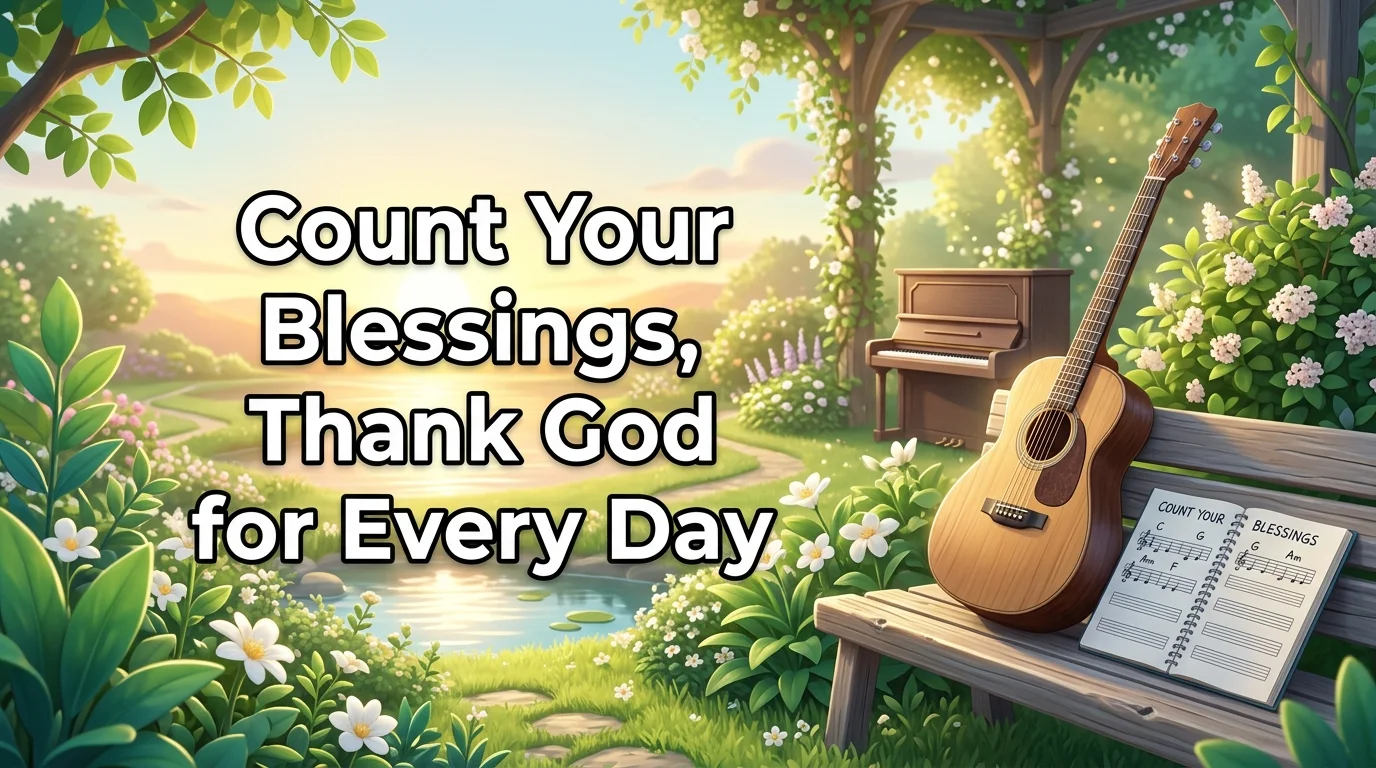
Learning the Counting My Blessings chords is a great way to bring a song of faith and gratitude into your daily worship. Whether you play guitar, piano, or another instrument, a few basic chords can help you get started without feeling overwhelmed.
In this guide, you’ll find the basic chords for Seph Schlueter’s popular worship song, tips for playing them, beginner-friendly practice advice, and ideas for singing along. You can use these tips for personal worship, family gatherings, or church music practice. 🙏
🎸 Counting My Blessings Chords: Quick Guide
The popular version by Seph Schlueter uses a simple set of chords in the key of G. A basic chord chart can help you learn the song’s main progression before moving on to the full arrangement.
Here are the key details to get started:
- Artist: Seph Schlueter
- Key: G major
- Main chords: G, D, Em, and C
- Additional chord: D/F# in some arrangements
- Time signature: 6/8
- Instruments: Guitar and piano
- Skill level: Beginner-friendly with practice
Different arrangements may use other keys or chord variations. The guide below focuses on a simple version suitable for practice.
🎶 Basic Counting My Blessings Guitar Chords
You can start with four familiar guitar chords: G major, D major, E minor, and C major. These chords appear in many worship songs, so learning them can also help you play other Christian music.
Main Chords to Learn
G
G Major
A bright, open chord often used to begin the progression.
D
D Major
Practice moving to this chord without stopping the rhythm.
Em
E Minor
A minor chord that adds a more thoughtful sound.
C
C Major
An open chord that completes this common four-chord pattern.
A Simple Chord Progression
A useful starting pattern for practice is:
G – D – Em – C
Play each chord slowly and listen to how it sounds as you move from one chord to the next. This is a beginner practice pattern, not a complete, official transcription of every section of the song.
Some arrangements use D/F#, which means a D major chord with F-sharp as the bass note. You can learn that variation after you feel comfortable with the basic chords.
🎹 Counting My Blessings Piano Chords
Piano players can use the same basic chords to practice a simple accompaniment. Start with your right hand, then add your left hand when the chord changes feel comfortable.
Basic Piano Chord Notes
| Chord | Notes |
|---|---|
| G major | G – B – D |
| D major | D – F# – A |
| E minor | E – G – B |
| C major | C – E – G |
Play the notes of each chord together with your right hand. With your left hand, play the root note to give the music a steady foundation.
For example, play G with your left hand while your right hand plays G, B, and D. Move to the next chord when you are ready.
Beginner tip: Practice each chord on its own before trying to play the full progression with both hands.
🎼 How to Play Counting My Blessings in 6/8 Time
The song’s original arrangement uses a 6/8 time signature. This means each measure has six eighth-note beats, often felt as two groups of three.
You can count slowly:
1 – 2 – 3 – 4 – 5 – 6
Try giving a little extra weight to beats 1 and 4. This can help you feel the flowing rhythm often heard in worship music.
For guitar, begin with gentle downstrokes. For piano, try playing a bass note followed by the chord notes in a repeating pattern.
- Start slowly.
- Count all six beats.
- Change chords without rushing.
- Keep your playing soft at first.
- Increase the speed as you improve.
You do not need to play loudly to make the song meaningful. A steady rhythm and clear chords are a good place to begin. 🌿
🙌 Tips for Beginners Learning the Song
If you are new to guitar or piano, learning a worship song may take a few practice sessions. That is normal. Focus on one small part at a time.

1. Learn One Chord at a Time
Start with G major. Make sure each guitar string rings clearly, or that each piano note sounds clean. Then move on to D, Em, and C.
2. Practice the Chord Changes
Move between G and D several times. Next, try D to Em, followed by Em to C.
These small steps can help your fingers become more comfortable with the chord shapes.
3. Use a Slow Tempo
Do not worry about matching the recording at first. A slower pace gives you time to change chords and keep your rhythm steady.
4. Listen to the Song
Listen to Seph Schlueter’s recording and pay attention to the rhythm, chord changes, and way the music builds. Use a licensed chord chart if you need the exact arrangement.
5. Practice for Ten Minutes
Short practice sessions can be more useful than trying to learn everything at once.
- Spend three minutes on chord shapes.
- Spend three minutes on chord changes.
- Spend four minutes on the rhythm.
Repeat the routine as needed. With regular practice, the transitions may start to feel more natural.
❤️ What Is the Meaning of Counting My Blessings?
The song by Seph Schlueter focuses on gratitude, faith, and remembering the good things God has done. Its message encourages listeners to look back on their lives with a thankful heart, even after difficult seasons.
The idea of counting blessings can also become a daily habit. You might take a few moments to think about the people who support you, the help you have received, or the small things that brought you joy.
Here are a few simple ways to practice gratitude:
- Thank God for another day.
- Write down three things you appreciate.
- Pray for someone who needs support.
- Tell a loved one why they matter.
- Celebrate small steps forward.
These habits can help make gratitude part of your everyday life. 🙏
🌸 A Short Prayer of Gratitude
Dear God, thank You for the blessings in my life, both big and small. Help me notice Your goodness during happy days and difficult times. Give me a thankful heart, patience when life feels hard, and kindness toward the people around me. May my words and actions show love and gratitude each day. Amen.
You can say this prayer before practicing the song, during quiet time, or whenever you want to pause and give thanks.

🎤 How to Use the Song for Worship
Counting My Blessings can be a meaningful choice for personal worship or a group setting. Its theme of gratitude makes it a natural fit for times of prayer, reflection, and thanksgiving.
If you are preparing to play it with others, keep these tips in mind:
- Agree on the song’s key before starting.
- Choose a tempo everyone can follow.
- Practice chord changes as a group.
- Keep the accompaniment steady.
- Use a licensed chart for the full arrangement.
If you lead worship, ask the other musicians what key feels comfortable for the singers. A good arrangement should support the voices rather than make the song harder to sing.
Frequently Asked Questions
What are the Counting My Blessings chords?
For Seph Schlueter’s version, a basic practice progression is G, D, Em, and C. Some arrangements also use D/F# and other chord variations.
What key is Counting My Blessings in?
The original recording is in G major. Other arrangements may use different keys to suit a singer or group.
Is Counting My Blessings easy to play on guitar?
The basic chords are beginner-friendly. New players may need extra practice with chord changes and the song’s 6/8 rhythm.
Can I play Counting My Blessings on piano?
Yes. You can start with G, D, Em, and C, using the chord notes listed in this guide. A licensed arrangement can help you learn the full song.
What does D/F# mean in a chord chart?
D/F# is a D major chord with F-sharp as the lowest note. This is called an alternate bass note.
Who sings Counting My Blessings?
The popular contemporary Christian worship song discussed here is performed by Seph Schlueter. There is also a separate gospel song with the same title by Tasha Cobbs Leonard and Mary Mary, so check the artist before choosing a chord chart.
Conclusion
Learning the Counting My Blessings chords is a good way to bring music and gratitude into your daily routine. Start with G, D, Em, and C, practice the changes at a comfortable pace, and work on the rhythm one step at a time.
Whether you play for yourself, your family, or a church group, let the song remind you to be thankful for life’s blessings, big and small. May your music bring peace to your heart and encouragement to those who hear it. ❤️

MeaningShelf shares meaningful quotes, thoughtful messages, and helpful word meanings, managed by Lily Anderson, an SEO content writer with 2 years of experience, creating engaging content that inspires readers and helps them find the right words for every moment.