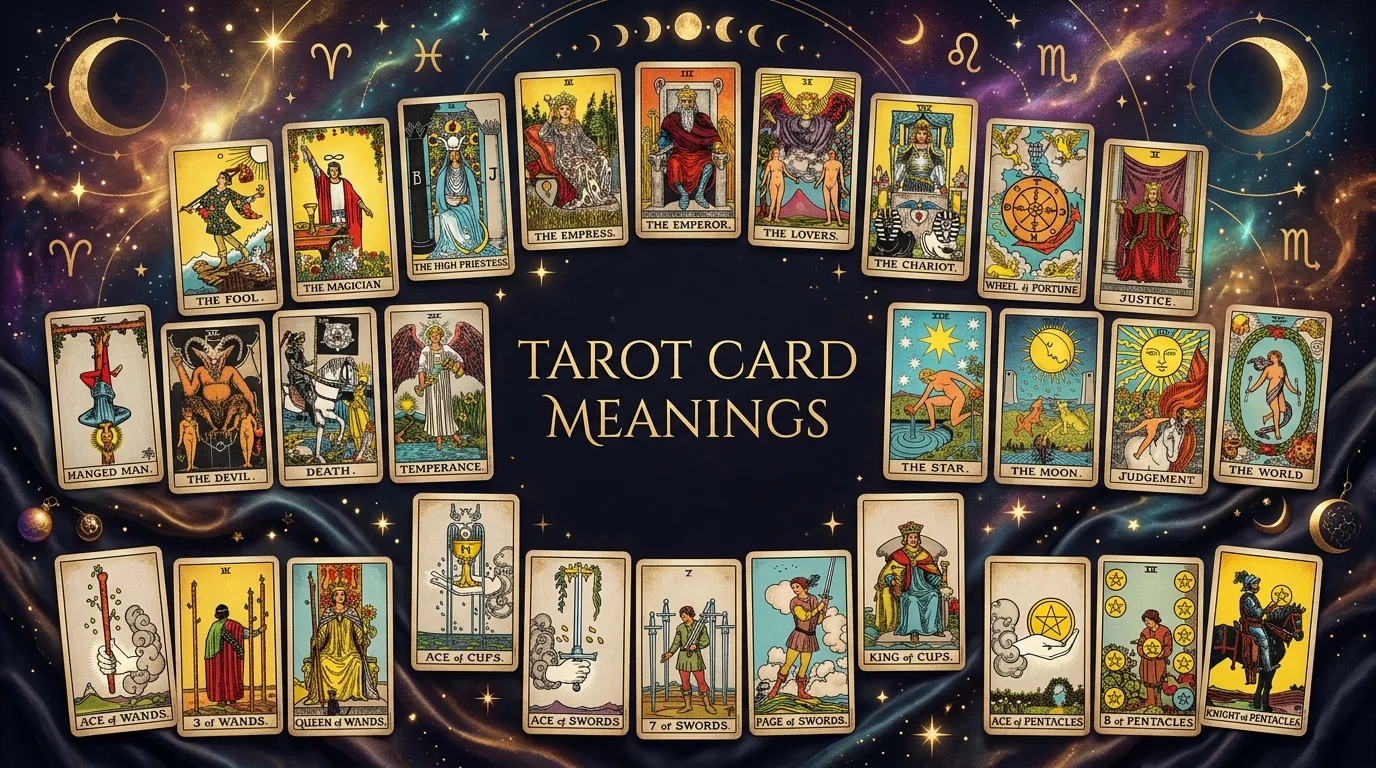
✨ Tarot can feel mysterious at first, but understanding the cards becomes easier when you learn their symbols, stories, emotions, and practical themes instead of memorizing isolated definitions.
🔮 A tarot deck contains 78 cards divided into Major and Minor Arcana. Each card offers a different perspective, helping readers explore questions about relationships, choices, personal growth, work, and everyday experiences.
What Are Tarot Card Meanings?
Tarot card meanings describe the themes, symbols, emotions, and situations traditionally connected with each card. A card can suggest an experience, challenge, opportunity, mindset, or lesson depending on the reading.
🔍 The meaning is not always fixed. The question, card position, surrounding cards, and whether the card appears upright or reversed can all influence its interpretation. Good readings consider the complete picture rather than one keyword.
How Many Cards Are in a Tarot Deck?
🃏 A traditional tarot deck contains 78 cards. It has 22 Major Arcana cards and 56 Minor Arcana cards, creating a system that combines major life themes with ordinary experiences.
The Minor Arcana contains four suits: Wands, Cups, Swords, and Pentacles. Each suit has fourteen cards, including ten numbered cards and four court cards: Page, Knight, Queen, and King.
| 🃏 Part of Deck | 🔢 Number |
|---|---|
| Major Arcana | 22 |
| Minor Arcana | 56 |
| Wands | 14 |
| Cups | 14 |
| Swords | 14 |
| Pentacles | 14 |
| Total | 78 |
Major Arcana Tarot Card Meanings
🌟 The Major Arcana contains 22 cards representing major themes, turning points, personal development, and important lessons. These cards often stand out when a reading concerns significant changes or deeper life experiences.
The sequence begins with The Fool and ends with The World. Together, these cards are commonly viewed as a symbolic journey involving beginnings, challenges, transformation, understanding, completion, and renewed possibilities.
The Fool
🎒 The Fool represents beginnings, curiosity, freedom, spontaneity, and stepping into unfamiliar territory. It often encourages openness to experience while reminding you to balance enthusiasm with awareness.
Key themes:
- 🌱 New beginnings
- 🦋 Freedom
- 🧭 Adventure
- 💭 Curiosity
In a reading, The Fool can suggest starting a new journey without knowing every detail. Its energy is adventurous, but it also asks whether you are prepared to learn along the way.
The Magician
✨ The Magician symbolizes ability, initiative, communication, focus, and using available resources effectively. It suggests that potential becomes powerful when intention is combined with practical action.
Key themes:
- 🎯 Focus
- 🛠️ Skill
- 💬 Communication
- ⚡ Initiative
This card can encourage confidence in your skills. Rather than waiting for circumstances to change, The Magician asks you to recognize what you already possess and use it wisely.
The High Priestess
🌙 The High Priestess represents intuition, mystery, inner knowledge, silence, and information that may not yet be visible. She encourages patience instead of demanding immediate answers.
Key themes:
- 🔮 Intuition
- 🤫 Silence
- 🌙 Mystery
- 🧠 Inner knowledge
When this card appears, paying attention to subtle feelings and observations may be useful. It often points toward reflection, careful listening, and allowing hidden information to become clearer naturally.
Read More:
The Empress
🌸 The Empress is associated with creativity, nurturing, abundance, beauty, comfort, growth, and connection with nature. Her energy encourages development through patience, care, and supportive surroundings.
Key themes:
- 🌱 Growth
- 💐 Nurturing
- 🎨 Creativity
- ✨ Abundance
In practical readings, she may highlight creativity, family, relationships, or projects that need consistent attention. Her message is often about allowing something valuable to grow rather than forcing immediate results.
The Emperor
👑 The Emperor represents structure, authority, discipline, responsibility, stability, and leadership. He brings organized energy to situations that may otherwise feel uncertain or uncontrolled.
Key themes:
- 🏛️ Structure
- 👑 Leadership
- 📋 Discipline
- 🛡️ Stability
This card can point toward boundaries and practical planning. It may encourage someone to take responsibility, establish clear expectations, or create a dependable foundation before moving forward.
The Hierophant
📚 The Hierophant commonly represents tradition, established systems, teaching, shared beliefs, institutions, and learning from recognized structures. It can point toward guidance or conventional approaches.
Its appearance does not automatically mean tradition is always correct. Depending on the question, it may encourage learning from experience while considering whether existing rules genuinely support your situation.
The Lovers
❤️ The Lovers are strongly associated with relationships, attraction, values, choices, connection, and meaningful alignment. Although often viewed romantically, the card can also concern important decisions.
Key themes:
- ❤️ Love
- 🤝 Connection
- ⚖️ Choices
- 💞 Alignment
Its deeper theme is choosing in a way that reflects your values. In relationships, it may suggest mutual connection, while in other readings it can highlight commitment and personal responsibility.
The Chariot
🏇 The Chariot represents determination, direction, control, confidence, movement, and overcoming competing forces. It often appears when success requires focused effort rather than passive waiting.
Key themes:
- 🏆 Determination
- 🎯 Direction
- 🚀 Progress
- 💪 Control
This card encourages you to choose a direction and maintain discipline. Progress can become possible when emotions, ambitions, and competing priorities are brought under conscious control.
Strength
🦁 Strength represents courage, patience, compassion, self-control, and quiet confidence. Its traditional imagery emphasizes influence through calmness rather than force.
The card can suggest handling difficult circumstances with emotional maturity. True strength here is not about dominating others; it is about managing fear, anger, uncertainty, or pressure with steady awareness.
The Hermit
🏮 The Hermit symbolizes solitude, reflection, wisdom, study, and searching for deeper understanding. It often encourages stepping away from noise so an important question can be considered honestly.
Key themes:
- 🧘 Reflection
- 🔦 Inner guidance
- 📖 Wisdom
- 🌙 Solitude
This card does not necessarily indicate loneliness. It can represent purposeful solitude, private learning, or taking enough time to understand yourself before accepting outside opinions.
Wheel of Fortune
🎡 The Wheel of Fortune represents cycles, changing circumstances, opportunity, timing, and events beyond complete personal control. It reminds readers that situations can shift unexpectedly.
Its message is not simply “good luck.” The card can highlight changing conditions and encourage adaptability. When circumstances turn, flexibility may matter more than trying to control every outcome.
Justice
⚖️ Justice is associated with fairness, truth, accountability, balance, and consequences. It encourages looking at circumstances honestly rather than allowing emotion alone to determine conclusions.
Key themes:
- ⚖️ Balance
- 🧾 Accountability
- 🔎 Truth
- 📜 Fairness
In practical questions, Justice can highlight agreements, responsibility, decisions, or the results of previous actions. It asks you to consider evidence, fairness, and personal accountability before making a judgment.
The Hanged Man
🪢 The Hanged Man represents pause, surrender, patience, perspective, and seeing circumstances differently. It often appears when pushing harder is less useful than stepping back.
Rather than suggesting failure, this card can indicate a period of reconsideration. A new perspective may become available when you stop trying to force an immediate solution.
Death
🦋 Death represents transformation, endings, release, transition, and the beginning of something different. It rarely means literal physical death in an ordinary tarot interpretation.
Key themes:
- 🔄 Transformation
- 🍂 Endings
- 🦋 Renewal
- 🚪 Transition
The card can appear when an old pattern, situation, identity, or expectation needs to change. Its message may feel uncomfortable, but endings can create space for meaningful renewal.
Temperance
🌈 Temperance represents balance, moderation, patience, healing, cooperation, and combining different elements carefully. It encourages gradual progress instead of extreme reactions.
This card can be helpful when circumstances feel emotionally intense. It suggests finding a workable middle ground, allowing time for adjustment, and bringing conflicting needs into better balance.
The Devil
⛓️ The Devil is commonly associated with attachment, temptation, unhealthy patterns, material fixation, fear, and feeling trapped. It can highlight behaviors or beliefs that reduce personal freedom.
Its appearance does not automatically mean something evil is happening. Instead, it may invite honest examination of habits, dependencies, pressures, or desires that have gained too much control.
The Tower
⚡ The Tower represents disruption, sudden change, revelation, instability, and the collapse of structures that cannot continue as they are. Its energy can feel dramatic and uncomfortable.
Yet disruption is not necessarily meaningless destruction. The Tower may expose an inconvenient truth or remove a false sense of security, allowing a more honest foundation to develop afterward.
The Star
⭐ The Star symbolizes hope, renewal, inspiration, openness, healing, and optimism after difficulty. It often brings a calmer tone following challenging cards such as The Tower.
Key themes:
- ⭐ Hope
- 💧 Healing
- 🌱 Renewal
- 💡 Inspiration
In personal readings, The Star can encourage trust in gradual recovery and renewed purpose. It reminds you that progress may begin with a small return of hope.
The Moon
🌙 The Moon represents uncertainty, intuition, dreams, hidden information, imagination, and emotional confusion. It can appear when appearances do not provide the complete story.
The card encourages careful observation rather than immediate assumptions. Feelings can provide useful information, but they should be considered alongside evidence when a situation is unclear.
The Sun
☀️ The Sun is associated with joy, clarity, confidence, vitality, success, openness, and positive energy. It is generally considered one of the most encouraging cards in the deck.
Key themes:
- ☀️ Joy
- 🏆 Success
- 🔆 Clarity
- 😊 Confidence
Its presence can suggest greater visibility and understanding. Something that once felt confusing may become easier to recognize, allowing confidence and enthusiasm to replace unnecessary doubt.
Judgement
📯 Judgement represents reflection, awakening, accountability, realization, renewal, and answering an important personal call. It often concerns recognizing what has been learned from previous experiences.
This card encourages honest evaluation rather than harsh self-criticism. It may suggest accepting the past, understanding its lessons, and making a conscious decision about what happens next.
The World
🌍 The World represents completion, achievement, integration, fulfillment, and the end of a significant cycle. It can indicate that separate experiences have finally come together into a clearer whole.
Completion does not always mean stopping permanently. It can also signal readiness for another chapter after gaining the knowledge, confidence, or experience needed to move forward.
Minor Arcana Tarot Card Meanings
🃏 The Minor Arcana contains 56 cards focused more heavily on everyday experiences, relationships, thoughts, actions, responsibilities, resources, and emotional situations.
The four suits provide different perspectives:
- 🔥 Wands: action and creativity
- 💧 Cups: emotions and relationships
- 🌬️ Swords: thoughts and communication
- 🌍 Pentacles: work and material matters
Wands
🔥 Wands are traditionally connected with fire, action, passion, creativity, ambition, motivation, confidence, and personal energy. They often describe what someone wants to pursue or create.
Wands commonly highlight:
- 🔥 Passion
- 🎨 Creativity
- 🚀 Action
- 🏆 Ambition
The suit can appear when initiative matters. Its cards may discuss inspiration, competition, leadership, progress, challenges, or the effort required to turn an idea into something real.
Cups
💧 Cups are traditionally associated with water, emotions, relationships, intuition, compassion, connection, and inner experiences. They often describe how people feel and relate to one another.
Cups commonly highlight:
- ❤️ Love
- 💧 Emotions
- 🤝 Relationships
- 🔮 Intuition
This suit can appear in questions involving romance, friendship, family, emotional healing, or personal fulfillment. Its cards encourage awareness of feelings without assuming every emotion automatically represents objective truth.
Swords
🌬️ Swords are traditionally connected with air, thoughts, communication, decisions, truth, conflict, and mental challenges. They often describe how a person thinks about a situation.
Swords commonly highlight:
- 🧠 Thoughts
- 💬 Communication
- ⚔️ Conflict
- ⚖️ Decisions
Their energy can feel intense because the suit frequently addresses difficult conversations, uncertainty, worry, disagreements, or important choices. Clear communication and honest thinking can be especially important when these cards appear.
Pentacles
🌍 Pentacles are traditionally associated with earth, money, work, career, stability, health, resources, and practical responsibilities. They often bring attention to tangible aspects of life.
Pentacles commonly highlight:
- 💰 Money
- 💼 Career
- 🏠 Stability
- 🌱 Growth
These cards can concern earning, saving, building, learning practical skills, managing resources, or creating long-term security. Their lessons usually develop through consistent effort rather than instant results.
Read More:
Tarot Card Meanings Upright and Reversed
🔄 An upright card appears in its normal orientation, while a reversed card appears upside down. Readers may interpret reversals as blocked, delayed, internalized, excessive, or otherwise altered expressions of the card.
A reversed card does not simply mean the opposite of its upright meaning. Context matters, and some readers choose not to use reversals at all. Both approaches can work when applied consistently.
| 🃏 Position | 🔍 Common interpretation |
|---|---|
| Upright | Direct or balanced expression |
| Reversed | Blocked, delayed, internal, excessive, or altered expression |
Tarot Card Meanings for Love
❤️ Love readings often explore emotions, communication, attraction, relationship patterns, commitment, boundaries, and personal expectations. Cards should be interpreted within the specific question rather than treated as guaranteed predictions.
For example:
- 💞 Two of Cups: mutual connection
- ❤️ The Lovers: alignment or meaningful choice
- 🏡 Ten of Cups: emotional fulfillment
- 🌹 Ace of Cups: emotional beginning
Difficult cards do not automatically predict a breakup; they can identify issues that deserve attention.
Tarot Card Meanings for Career and Money
💼 Career readings can explore ambition, workplace relationships, decisions, professional development, stability, opportunities, and challenges. Pentacles are especially relevant to practical matters, although every suit can contribute useful information.
💰 Money questions require similar context. A positive card does not guarantee financial success, and a difficult card does not guarantee loss. Tarot can encourage reflection, but financial decisions should still rely on sound evidence.
Tarot Card Meanings for Feelings
💗 When tarot is used to explore feelings, the cards can represent emotional themes, attitudes, relationship dynamics, or possible perspectives. They cannot objectively verify another person’s private thoughts.
Cards such as Cups may emphasize emotional connection, while Swords can highlight communication or mental tension. The most responsible approach is to treat the reading as reflection rather than proof of someone else’s feelings.
Tarot Card Meanings for Yes or No Questions
❓ Tarot can be used for yes-or-no questions, but the cards are often more nuanced than a simple binary answer. Context and the reader’s chosen method influence interpretation.
Some readers associate cards such as The Sun with “yes” and challenging cards with “no,” while others use upright or reversed positions. There is no universally binding yes-or-no system.
How to Interpret Tarot Cards
🔍 Start with the question, observe the card’s imagery, consider its traditional themes, and then examine its position within the spread. Avoid choosing an interpretation before considering the whole reading.
A simple process:
- 🎯 Identify the question.
- 👀 Study the imagery.
- 🃏 Consider the card’s traditional themes.
- 🔗 Look at surrounding cards.
- 💭 Connect everything to the question.
The strongest interpretation often comes from combining these elements rather than relying on one keyword.
Tarot Card Symbolism
🎨 Tarot imagery contains recurring symbols involving colors, animals, landscapes, objects, numbers, gestures, and elemental associations. These details can add layers to a card’s traditional interpretation.
The Rider-Waite-Smith tradition is particularly influential because its illustrated Minor Arcana made symbolic scenes easier to interpret. However, different tarot decks can use different artwork and systems.
Tarot Card Keywords
📝 Keywords provide a quick way to remember a card’s central themes, but they should not replace contextual interpretation. A short list is useful for learning, while a full reading requires more flexibility.
A practical beginner method is to remember several broad ideas for each card and then ask how those ideas relate to the actual question, spread position, and surrounding cards.
| 🔮 Suit | 🧩 Core themes |
|---|---|
| 🔥 Wands | Action, passion, creativity |
| 💧 Cups | Emotions, love, relationships |
| 🌬️ Swords | Thoughts, communication, conflict |
| 🌍 Pentacles | Work, money, stability |
Tarot Card Meanings for Beginners
🌱 Beginners do not need to memorize all 78 cards immediately. Start with the deck’s structure, learn the four suits, and gradually become familiar with the Major Arcana.
A simple learning plan:
- 🃏 Learn the 22 Major Arcana.
- 🔥 Learn one Minor Arcana suit at a time.
- 📝 Keep a tarot journal.
- 🔍 Study card imagery.
- 🔄 Compare upright and reversed interpretations.
Practice simple spreads and record what you notice. Repeated exposure helps card themes become familiar, while comparing different questions teaches you how context can change an interpretation.
How to Read a Tarot Spread
🔮 A tarot spread gives each card a position or role. A three-card spread, for example, might explore past, present, and future, while another spread could examine a situation, challenge, and advice.
The spread itself does not guarantee accuracy. Its purpose is to organize the reading so each card contributes to a specific part of the question.
Tarot Card Combinations
🔗 Two or more cards can create a different emphasis when read together. A card associated with change may feel more practical beside Pentacles and more emotional beside Cups.
Look for repeated themes instead of trying to invent a completely new meaning for every combination. Similar symbols, numbers, suits, or emotional patterns can reveal useful connections.
Tarot Court Cards
👑 The sixteen court cards consist of Pages, Knights, Queens, and Kings across the four suits. They may represent people, personality traits, stages of development, or ways of approaching situations.
| 👑 Court | 🔑 Common theme |
|---|---|
| Page | Learning, messages, curiosity |
| Knight | Movement, pursuit, action |
| Queen | Inner maturity, understanding |
| King | Authority, mastery, leadership |
| These are flexible associations rather than rigid rules. Context determines whether a court card describes a person, behavior, role, or developing quality. |
The Four Tarot Suits
🌟 The four suits help organize the Minor Arcana into broad areas of human experience. Wands emphasize action, Cups emotions, Swords thought, and Pentacles practical concerns.
| 🔥 Wands | Action, passion, creativity |
| 💧 Cups | Emotions, love, relationships |
| 🌬️ Swords | Thought, communication, conflict |
| 🌍 Pentacles | Work, money, stability |
These categories overlap. A career question can involve Cups because workplace relationships matter, while a relationship question can involve Swords because communication and decisions matter.
Tarot Numbers and Patterns
🔢 Numbers provide another layer of interpretation within the Minor Arcana. Aces commonly introduce potential, while numbered cards can show development, challenges, progression, or completion.
Number symbolism should support rather than override the card itself. Consider the number alongside its suit, imagery, position, and neighboring cards to create a balanced interpretation.
Tarot and Personal Reflection
🪞 Tarot is often most useful as a reflective practice rather than a guaranteed prediction system. A card can encourage you to examine assumptions, emotions, priorities, and choices from another perspective.
Writing down your reactions can reveal patterns that are easy to miss during a quick reading. The value may come from the questions a card raises as much as its traditional symbolism.
Tarot and Intuition
🔮 Intuition can play a role in tarot reading, especially when a reader notices an image, emotion, or connection that feels relevant to the question.
Intuition works best alongside careful observation. Instead of treating every first impression as fact, consider it a possibility and compare it with the card’s established symbolism and reading context.
Are Tarot Cards Predictive?
🔍 Tarot is commonly used for reflection, guidance, storytelling, spiritual practice, and exploring possible perspectives. There is no scientific evidence that tarot cards can reliably predict future events.
People may still find readings personally meaningful. A thoughtful reading can help someone examine choices and possibilities, but important decisions should be supported by real-world information and professional advice when appropriate.
How to Choose a Tarot Deck
🃏 Beginners often find illustrated decks easier to learn because visual scenes provide clues beyond written keywords. The Rider-Waite-Smith tradition is especially useful because many modern learning resources reference it.
When choosing a deck, consider:
- 🎨 Artwork you understand
- 📖 A useful guidebook
- 🃏 Clear card imagery
- 💖 A style you genuinely enjoy
Choose artwork that feels understandable and engaging. A beautiful deck is less useful if its imagery makes you uncomfortable or consistently distracts you from the reading.
How to Learn Tarot Faster
⚡ Learn the deck in groups rather than attempting to memorize 78 isolated definitions. Start with the Major Arcana, then learn each suit and its court cards.
Try this routine:
- 🃏 Pull one card daily.
- 📝 Write your first impression.
- 📚 Compare it with traditional themes.
- 🔍 Notice the imagery.
- 📖 Review your journal weekly.
Practice simple spreads and record what you notice. Repeated exposure helps card themes become familiar, while comparing different questions teaches you how context can change an interpretation.
Common Tarot Reading Mistakes
⚠️ One common mistake is treating every card as having one permanent definition. Another is ignoring the question and surrounding cards while searching for a familiar keyword.
Avoid these habits:
- ❌ Treating every difficult card as negative
- ❌ Assuming reversals always mean the opposite
- ❌ Ignoring the spread position
- ❌ Using one keyword for every situation
Cards such as Death, The Tower, or The Devil can represent transformation, revelation, attachment, or necessary change.
Can One Tarot Card Have Several Meanings?
🔄 Yes. A single card can have several related interpretations because tarot symbolism is broad and context changes how a theme appears.
The same card may describe an emotion in one reading, a decision in another, or a relationship pattern somewhere else. The key is to preserve its central theme while adapting it to the question.
How Context Changes a Tarot Reading
🎯 Context determines which part of a card’s symbolism deserves attention. A question about work may emphasize practical or professional themes, while a relationship question can emphasize emotional or communication themes.
The card’s position matters too. A card representing a challenge should be interpreted differently from the same card appearing as advice or an outcome.
Frequently Asked Questions About Tarot
❓ Understanding common questions can make the system less intimidating for new readers. The following answers address practical concerns about the deck, interpretations, reversals, and responsible tarot practice.
How many tarot cards are in a standard deck?
🃏 A traditional tarot deck contains 78 cards: 22 Major Arcana cards and 56 Minor Arcana cards divided equally among four suits.
What are the four tarot suits?
🔥 The four Minor Arcana suits are Wands, Cups, Swords, and Pentacles. Each contains fourteen cards, including ten numbered cards and four court cards.
What is the Major Arcana?
🌟 The Major Arcana contains 22 cards representing broad themes, life lessons, transitions, archetypal experiences, and significant stages of personal development.
What is the Minor Arcana?
🃏 The Minor Arcana contains 56 cards covering everyday experiences involving emotions, actions, thoughts, communication, work, money, relationships, and practical responsibilities.
What does a reversed tarot card mean?
🔄 A reversed card may represent blocked, delayed, internalized, excessive, or altered energy. Its interpretation depends on the reader’s method and the surrounding context.
What is the strongest tarot card?
⭐ There is no universally strongest tarot card. Cards such as The Sun, The World, The Magician, or Strength can be powerful in different contexts.
Can tarot cards predict the future?
🔮 Tarot has no scientifically established ability to predict future events reliably. It is better approached as a reflective tool for exploring possibilities, perspectives, and personal questions.
What tarot card represents love?
❤️ Several cards can relate to love, including The Lovers, Two of Cups, Ten of Cups, and Ace of Cups. The question and surrounding cards determine the emphasis.
What tarot card represents money?
💰 Pentacles are strongly associated with money, work, resources, and material stability. Specific cards can highlight earning, saving, investment, effort, security, or financial challenges.
Should beginners use reversed cards?
🔄 Beginners can use reversals if they understand the method and apply it consistently. Starting with upright cards can also make learning the basic structure easier.
Conclusion
✨ Learning tarot card meanings becomes much easier when you understand the deck as a connected system rather than memorizing 78 separate definitions without context.
🔮 Tarot card meanings can guide reflection on relationships, emotions, choices, work, and personal growth, but thoughtful interpretation works best when symbolism, context, intuition, and real-world judgment work together.

MeaningShelf shares meaningful quotes, thoughtful messages, and helpful word meanings, managed by Lily Anderson, an SEO content writer with 2 years of experience, creating engaging content that inspires readers and helps them find the right words for every moment.