
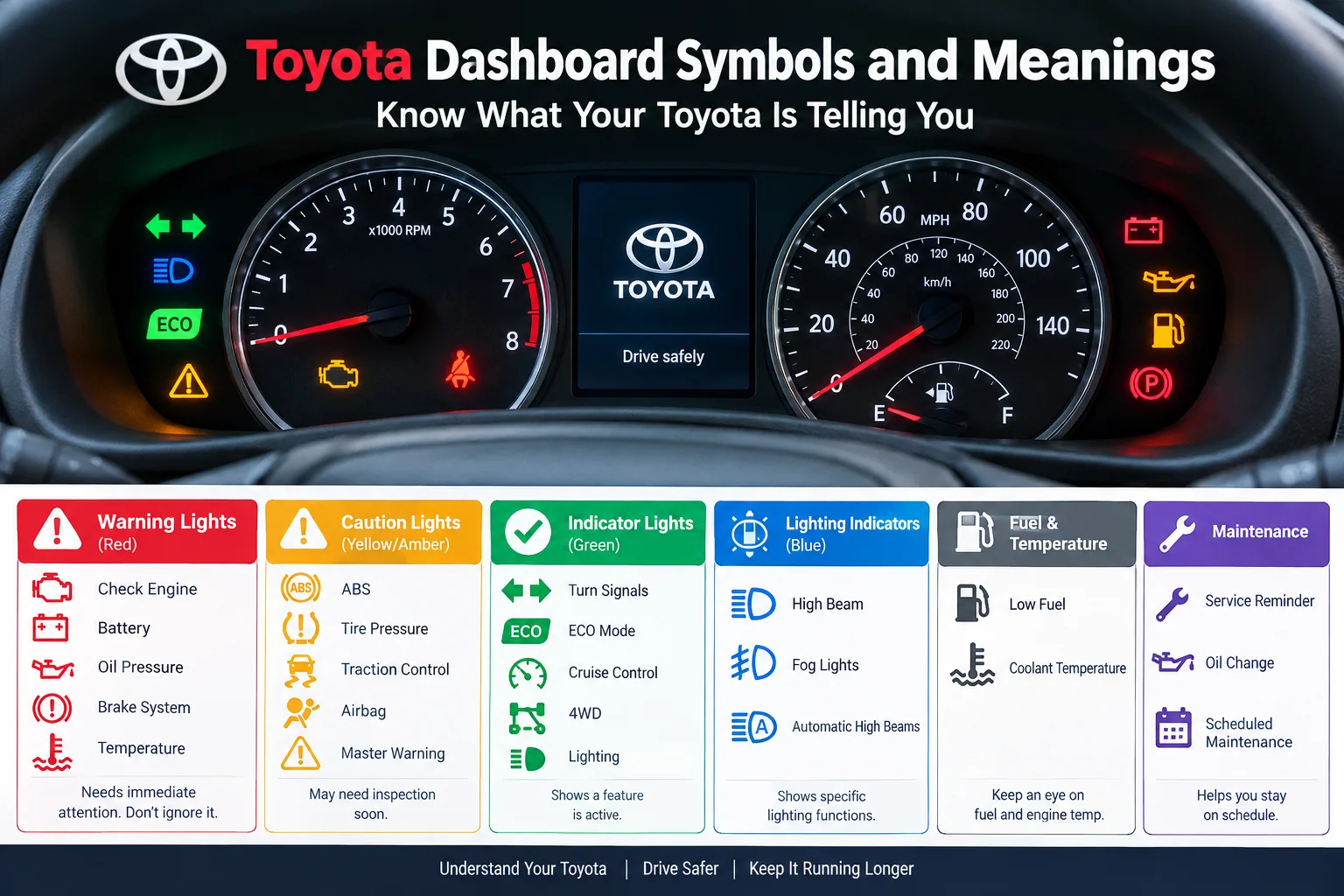
A strange light on your Toyota dashboard can instantly make you wonder whether you should keep driving, find a service center, or simply wait for it to disappear after startup.
This guide explains toyota dashboard symbols and meanings in simple language, covering warning lights, indicator colors, safety systems, and common symbols. Learning toyota dashboard symbols and meanings helps you react calmly and appropriately.
Get Directions
If a dashboard warning concerns you, start with your vehicle’s owner’s manual. Toyota symbols can differ between models, trims, powertrains, and model years, so the same-looking indicator may not always have identical functions.
For service or directions, use Toyota’s official dealer resources or a trusted Toyota service center. When contacting a technician, provide your exact model and year so the warning can be identified correctly.
Common Toyota Warning Lights To Know
Toyota dashboards contain both warning lights and indicator lights. A warning generally tells you that something may require attention, while an indicator can simply show that a feature or system is operating.
Common Toyota warning lights include the ABS, brake, battery charging, low engine oil pressure, tire pressure, SRS airbag, seatbelt, low fuel, and malfunction indicator lights. Some illuminate briefly during startup as part of the vehicle’s self-check.
| Dashboard light | General purpose | Typical response |
|---|---|---|
| ABS | Anti-lock braking system issue | Arrange inspection |
| Battery | Charging-system problem | Seek prompt assistance |
| Oil can | Low engine oil pressure | Stop safely and follow manual |
| Tire pressure | Low tire pressure | Check tire pressures |
| SRS | Airbag-system issue | Arrange inspection |
| Check engine | Detected malfunction | Diagnose the vehicle |
| Low fuel | Fuel level is low | Refuel |
| Seatbelt | Seatbelt reminder | Fasten seatbelt |
Understanding toyota dashboard symbols and meanings becomes much easier when you first separate urgent warnings from ordinary operating indicators.
Understanding Toyota Dashboard Symbols and Meanings: Your Vehicle’s Communication System
Your dashboard is essentially a communication system between the vehicle and driver. Symbols can tell you that a feature is operating, a fluid or fuel level needs attention, or a vehicle system has detected a problem.
Rather than memorizing every symbol, learn the main categories. Warning lights, driving indicators, safety systems, lighting symbols, fuel indicators, and maintenance reminders each communicate something different.
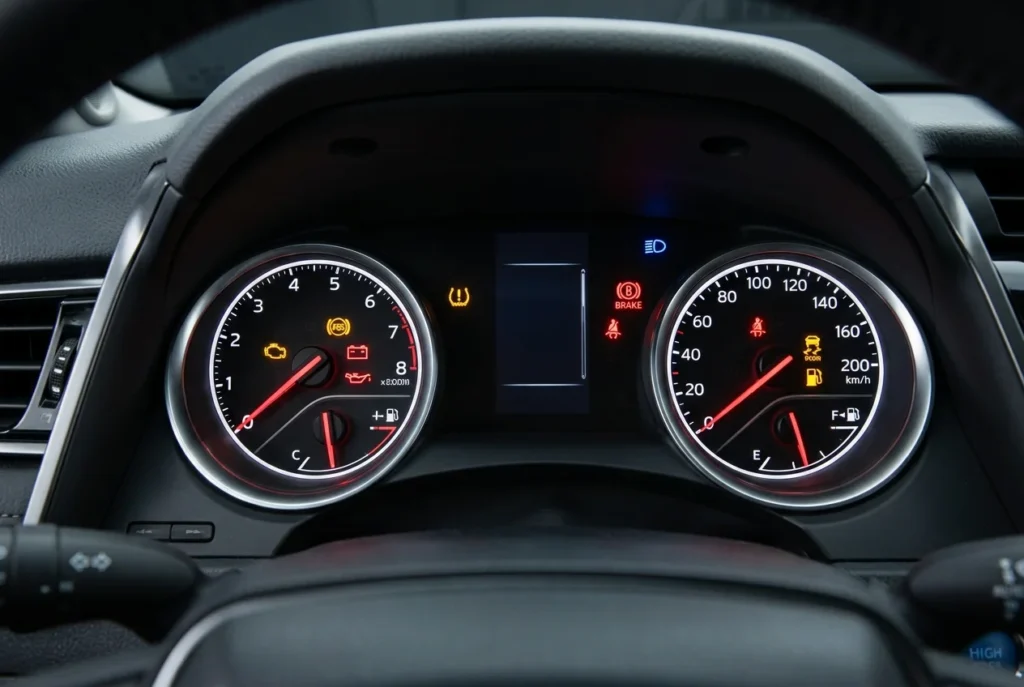
Color-Coded Warning System Explained
Dashboard colors can provide a quick visual clue, although the exact meaning depends on the vehicle and system. Toyota generally uses colors to distinguish operating indicators from conditions that need attention.
| Color | General indication |
|---|---|
| Green | Feature or system operating |
| Blue | Certain active lighting or system functions |
| Yellow/Amber | Attention or inspection may be needed |
| Red | Potentially urgent condition |
Do not judge a warning solely by color. Read the accompanying message and consult your owner’s manual whenever you are unsure.
ABS Warning Light
The ABS warning light relates to the anti-lock braking system. If it remains illuminated, the system may have detected a malfunction. Your conventional brakes may still operate, but the anti-lock function could be affected.
What to do:
- Drive cautiously.
- Avoid assuming the light will disappear.
- Have the braking system inspected promptly.
Red Battery Symbol
The red battery symbol generally indicates a problem with the vehicle’s charging system rather than simply telling you that the battery is old. A charging fault can eventually leave the vehicle unable to operate.
Watch for:
- Battery or charging warning
- Flickering electrical equipment
- Difficulty starting
- Other electrical abnormalities
Arrange professional inspection promptly if the warning stays illuminated.
Speedometer With an Arrow
A speedometer symbol with an arrow can relate to cruise-control operation on equipped Toyota vehicles. The exact icon and function vary by model, so the owner’s manual is the best reference for your vehicle.
It may indicate that cruise control is active or that a related setting has been selected. Do not interpret every speedometer-shaped symbol as a warning.
Steering Wheel With Exclamation Point
A steering wheel with an exclamation point can indicate a power steering or electric power steering warning. Steering assistance may be affected if the system develops a fault.
If the steering suddenly feels unusually heavy, reduce speed and stop somewhere safe. Follow the warning instructions in your Toyota manual before continuing your journey.
Sideways Jellyfish Light
The unusual “sideways jellyfish” description usually refers to a headlight symbol. A blue headlight indicator commonly shows that the high beams are operating.
This is an indicator rather than automatically a fault. If your Toyota has automatic high beams, additional symbols or messages may appear depending on the vehicle’s equipment.
Read More: 9 Heart Color Meanings: What Every Heart Really Means
Oil Can Spout With Drip
The oil-can symbol is associated with engine oil pressure. It should not be confused with a routine maintenance reminder telling you that an oil change is due.
| Symbol | What it indicates |
|---|---|
| Oil can | Low engine oil pressure warning |
| Maintenance reminder | Scheduled service information |
| Flashing or persistent warning | Requires attention |
If the low-oil-pressure warning remains on while the engine is running, stop safely and follow your owner’s manual immediately.
Gas Pump Light
The gas-pump symbol normally indicates that fuel is getting low. It is one of the easiest dashboard symbols to recognize, but the remaining range differs by Toyota model and driving conditions.
Refuel when practical rather than relying on a fixed mileage or gallon figure. Your vehicle’s fuel gauge, range display, and owner’s manual provide more useful model-specific information.
Triangle With an Exclamation Point in the Middle
A triangle containing an exclamation point is commonly the Master Warning Light. It can accompany a buzzer or message when the vehicle detects a condition that needs attention.
When this symbol appears, check the Multi-Information Display for additional information. The triangle itself may not identify the exact problem, so the accompanying message is important.
The Person & Seatbelt Light
The person-and-seatbelt symbol is the seatbelt reminder. It alerts the driver or passengers when a seatbelt needs to be fastened.
| Situation | Recommended action |
|---|---|
| Driver unbelted | Fasten seatbelt |
| Passenger unbelted | Ask passenger to buckle up |
| Warning continues unexpectedly | Check seating and manual |
Seatbelt reminders can vary by model, so follow the specific instructions displayed by your Toyota.
TRAC OFF or TRC OFF
TRAC OFF or TRC OFF indicates that a traction-control function has been switched off. The exact abbreviation depends on the Toyota model.
Traction control helps manage wheel spin in suitable driving situations. If you did not intentionally disable it, check your dashboard settings and owner’s manual to understand why the indicator is showing.
Car With a Lock
A car with a lock is generally associated with Toyota’s security or engine immobilizer system. It can appear or flash as part of normal anti-theft operation.
If the indicator behaves differently from what your manual describes or remains illuminated with another warning, investigate further. Security-system indicators vary according to the vehicle’s key and immobilizer equipment.
Car With Squiggly Lines
A car with squiggly lines is commonly associated with the Slip Indicator. It can illuminate when vehicle stability or traction-control functions are operating.
If the light flashes while driving, the system may be actively responding to wheel slip or changing road conditions. If it stays illuminated unexpectedly, consult your manual.
Car With Squiggly Lines & OFF
A car with squiggly lines and “OFF” generally indicates that a traction or stability-control function has been disabled.
If you intentionally switched the system off, the indicator may be normal. If you did not, check the vehicle’s settings and owner’s manual before assuming there is a mechanical fault.
Seated Passenger With a Ball on Their Lap
This unusual symbol represents the SRS airbag warning system, not a passenger carrying an object. A persistent SRS warning can indicate a problem within the supplemental restraint system.
Because airbags are important safety equipment, do not ignore a continuing warning. Arrange an inspection according to Toyota’s recommended procedures for your specific vehicle.
Parentheses With an Exclamation Point in the Middle
This symbol represents the Tire Pressure Warning Light. It indicates that one or more tires may have insufficient air pressure.
Check all four tires, and include the spare if your vehicle’s system monitors it. Inflate them to the pressure specified on the vehicle information label rather than guessing from the tire sidewall.
Left & Right Arrows
The left and right arrows are turn-signal indicators. The corresponding arrow flashes when the turn signal is operating.
They are normal driving indicators, not warning lights. If the flashing behavior suddenly becomes unusual, inspect the exterior turn-signal lamps because lighting faults can affect indicator behavior.
ECO Light
The ECO indicator relates to fuel-efficient driving or an Eco driving mode, depending on the Toyota model.
It is generally an operating indicator rather than a malfunction warning. Some Toyota vehicles use the indicator to show efficient acceleration or driving behavior, while others connect it with a selectable driving mode.
Chassis With Wheels
A chassis-with-wheels symbol can represent a four-wheel-drive or drivetrain function on equipped Toyota vehicles.
Because Toyota offers several four-wheel-drive systems, the same general visual description should not be used to identify every model’s exact function. Check the owner’s manual for the symbol shown on your dashboard.
Sideways Jellyfish With a Slash
The sideways headlight symbol with a slash generally represents a fog-light indicator on equipped Toyota vehicles.
The symbol appears when the relevant fog-light function is operating. Not every Toyota has front fog lights, so availability and exact indicator design depend on the model and trim.
Gas Pump With Arrow
A gas pump with an arrow tells you which side of the vehicle contains the fuel filler door.
It is particularly useful when driving an unfamiliar Toyota. Instead of guessing which way to position the vehicle at a fuel station, simply check the direction of the arrow beside the fuel-pump icon.
Thermometer in Waves
A thermometer over waves represents an engine coolant-temperature warning. It can indicate that the coolant temperature has become excessively high.
If this warning indicates overheating, stop safely and follow the owner’s manual. Continuing to drive an overheating vehicle can result in serious engine damage.
KDSS Light
KDSS stands for Kinetic Dynamic Suspension System, available on certain Toyota vehicles. A KDSS warning can indicate that the suspension system needs attention.
Because KDSS is not available across the Toyota range, the symbol should only be interpreted within the context of a vehicle equipped with this system.
Car Veering Out of Lane
A car moving between lane markings can indicate a lane-departure or lane-assistance system. Toyota models may use systems such as Lane Departure Alert or Lane Tracing Assist.
These technologies are driver-assistance features, not substitutes for attention. Keep your hands, eyes, and judgment focused on the road even when assistance is active.
4LO Light
The 4LO indicator identifies low-speed four-wheel-drive operation on equipped Toyota vehicles.
4LO is designed for specific low-speed conditions and off-road situations. It is not a normal setting for everyday highway driving. If the indicator flashes unexpectedly, consult the vehicle’s operating instructions.
Malfunction/Check Engine Light
The malfunction indicator lamp is commonly called the check engine light. It means the vehicle’s diagnostic system has detected a fault.
Possible causes vary widely, so the symbol alone cannot tell you exactly what has failed. A qualified diagnostic scan may be needed to identify the underlying issue.
| Light behavior | General response |
|---|---|
| Remains illuminated | Arrange diagnosis |
| Flashes | Treat as more urgent |
| Appears with other warnings | Follow displayed instructions |
Vehicle on Flat Surface
A vehicle-shaped symbol on a flat surface can represent a terrain-management or driving-mode function on equipped Toyota models.
The exact meaning depends on the vehicle and available equipment. Check the Multi-Information Display and owner’s manual rather than assuming that similar symbols have identical functions across Toyota models.
Read More: 40 Common Symbols and Meanings: How to Use Them
Open Door Warning
The open-door warning indicates that one or more doors may not be fully closed.
Before moving the vehicle, check every door and confirm that it has latched properly. Some Toyota models also display which door is open, making it easier to identify the problem.
PARK Light
A PARK indicator can relate to the parking brake or parking system, depending on the Toyota model.
Before driving, confirm that the parking brake is released when appropriate. If a brake-related warning remains illuminated unexpectedly, consult the owner’s manual and arrange an inspection if required.
Cars Crashing With Star and Arrow Light
A symbol showing vehicles with a star or collision graphic can relate to Toyota’s Pre-Collision System on equipped models.
It may indicate system operation, a detected condition, or a warning requiring attention depending on the accompanying message. Driver-assistance technology should always be treated as supplemental rather than autonomous driving.
Chassis With Wheels & an X
A chassis-with-wheels symbol containing an X can represent a rear differential lock on equipped Toyota vehicles.
Differential-lock systems are designed for specific traction situations. Their operation varies between models, so use the vehicle’s manual for instructions about when to engage, disengage, or troubleshoot the system.
RCTA OFF Light
RCTA means Rear Cross Traffic Alert. An RCTA OFF indicator means the system is switched off on an equipped vehicle.
When this feature is unavailable, take extra care when reversing. Check mirrors, surroundings, and blind areas directly instead of depending on electronic alerts.
A/T P Light
An A/T P warning can indicate that the automatic transmission is not properly recognized as being in Park or that a related parking-system condition exists.
If it remains displayed after selecting Park correctly, follow your owner’s manual. Do not assume the transmission warning will resolve itself without checking the cause.
A-TRAC Light
A-TRAC means Active Traction Control. On equipped Toyota vehicles, it helps manage wheel slip in appropriate driving conditions.
The indicator can appear when the system is operating. If it flashes unexpectedly or appears with another malfunction warning, consult the manual and have the system checked when recommended.
AUTO LSD Light
AUTO LSD stands for Automatic Limited Slip Differential. The system is designed to improve traction in certain driving conditions by managing wheel spin.
It is not a universal feature across Toyota models. If the indicator appears, use the owner’s manual to understand the appropriate operating conditions and limitations for your vehicle.
Car With Side-to-Side Arrows
A car with side-to-side arrows can indicate automatic running-board operation on equipped Toyota vehicles.
The symbol may appear while running boards are deploying or retracting. If the boards do not move correctly or the indicator remains on unexpectedly, inspect the system according to the vehicle’s instructions.
Two Cars With OFF
Two cars with “OFF” commonly indicate that a blind-spot monitoring function has been switched off on an equipped Toyota.
The exact system name can differ by model. If the feature is unavailable, rely on direct observation, mirrors, and careful lane changes rather than expecting an electronic warning.
Two Cars With Waves in Side View Mirror
Two cars with waves in the side mirror commonly represent blind-spot monitoring. The system can alert you when a vehicle is detected in a monitored blind area.
Remember that detection systems have limitations. Always check mirrors and surroundings before changing lanes, even when the indicator does not show a warning.
Shoeprint, Pedal, and Arrow Light
This symbol can represent a Brake Override System or Drive-Start Control warning on equipped Toyota vehicles.
Because these systems relate to braking or accelerator operation, take the warning seriously. If it appears with a buzzer or message, stop safely when appropriate and follow the owner’s manual.
BRAKE Light
A BRAKE warning can indicate a brake-system condition. The exact meaning depends on the symbol, color, and Toyota model.
A persistent red brake warning should not be ignored. If braking performance feels different, stop safely and seek qualified assistance rather than continuing to drive normally.
Chassis With Wheels and Center X
A chassis with wheels and an X in the center can represent a center differential lock on equipped four-wheel-drive Toyota vehicles.
This symbol communicates drivetrain status rather than automatically indicating a fault. The correct operating procedure varies by model, so consult the owner’s manual before using the function.
Vehicle Outline on Mountain
A vehicle outline on a mountain can represent Crawl Control on equipped Toyota models.
Crawl Control is designed to help maintain controlled low-speed movement over certain difficult surfaces. It is an off-road assistance feature, and its availability and operation depend on the vehicle.
SUV on a Downhill Slope
An SUV descending a slope can indicate Downhill Assist Control on equipped Toyota vehicles.
The system helps manage speed during certain downhill driving conditions. It is not a replacement for attentive driving, and drivers should follow the vehicle-specific instructions for engaging and using the feature.
The Importance of Regular Symbol Checks
A dashboard deserves attention every time you drive. Some indicators are completely normal, while others can signal a condition that needs prompt inspection.
A simple routine can help:
- Notice new or unfamiliar symbols.
- Check whether the light is red, yellow, green, or blue.
- Read any accompanying dashboard message.
- Pay attention to unusual sounds or driving behavior.
- Consult the owner’s manual.
- Seek professional inspection when recommended.
Regular checks make toyota dashboard symbols and meanings easier to understand before a warning becomes a roadside surprise.
Some dashboard warnings require immediate attention, so always check your Toyota owner’s manual for the exact meaning of a symbol and the recommended action
Common Toyota Vehicle Status Indicators
Vehicle status indicators communicate what your Toyota is doing. They can include security, turn-signal, cruise-control, lighting, fuel, traction, and driving-mode indicators.
These symbols do not automatically mean that something is broken. The important question is whether the indicator is showing normal operation or appearing alongside a warning message.
Driving Mode Indicators
Driving-mode indicators tell you when certain driving settings or assistance systems are active. Depending on the Toyota model, these may include ECO, Sport, four-wheel drive, traction-control, or terrain-management indicators.
| Indicator type | What it may communicate |
|---|---|
| ECO | Efficient driving or Eco mode |
| 4WD | Four-wheel-drive operation |
| 4LO | Low-speed four-wheel drive |
| A-TRAC | Active traction control |
| AUTO LSD | Limited-slip function |
| Terrain mode | Selected terrain assistance |
Exact functions vary by vehicle, so check your model-specific manual.
Safety and Security Indicators
Safety and security indicators include seatbelt reminders, SRS airbag warnings, stability-control symbols, anti-theft indicators, blind-spot monitoring, RCTA, and Pre-Collision System messages.
If a safety warning remains illuminated, do not dismiss it simply because the vehicle still drives. Understanding toyota dashboard symbols and meanings can help you recognize when a safety feature may need attention.
Lighting and Fuel Status
Lighting and fuel indicators are among the easiest dashboard symbols to recognize once you know their purpose.
Common examples include:
- Turn-signal arrows
- High-beam indicator
- Fog-light indicator
- Low-fuel warning
- Fuel-door arrow
- ECO indicator
These symbols normally communicate vehicle operation rather than a mechanical failure.
Maintenance Reminders
Maintenance reminders help you keep track of scheduled vehicle care. They should not be confused with warnings such as low engine oil pressure or a malfunction indicator.
Your Toyota’s recommended service schedule depends on the model, powertrain, mileage, and operating conditions. Always use the appropriate owner’s manual and maintenance guide for your vehicle.
Don’t Play Guessing Games With Toyota Dashboard Symbols and Meanings: Visit Us in Irving, TX
If a warning symbol appears and you cannot identify it, do not rely on a random online image alone. Compare the symbol with your owner’s manual and read any accompanying message on the Multi-Information Display.
For readers in Irving, Texas, the supplied source identifies Toyota of Irving as a local service option. Before visiting, verify current hours, services, and contact information directly with the dealership.
Frequently Asked Questions
What do the different dashboard lights mean?
Toyota dashboard lights communicate different conditions, from normal system operation to warnings that require inspection. The exact meaning depends on your Toyota model, year, equipment, symbol, color, and accompanying dashboard message.
What does a triangle with an exclamation point mean on Toyota?
A triangle with an exclamation point commonly represents the Master Warning Light. It can accompany another warning or message, so check the Multi-Information Display to determine what condition triggered it.
What is the most serious warning light in a car?
There is no single universal “most serious” dashboard light for every vehicle. Red oil-pressure and overheating warnings can require immediate action, while other warnings may require prompt inspection rather than immediate shutdown.
The safest approach is simple: if a warning indicates overheating, low oil pressure, serious braking trouble, or another urgent condition, stop safely and follow your Toyota manual.
Conclusion
Understanding toyota dashboard symbols and meanings takes much of the mystery out of unexpected dashboard warnings. Learn the common symbols, colors, safety indicators, and system messages before you actually need them.
Keep your owner’s manual available, pay attention to unfamiliar lights, and never ignore an important warning. With toyota dashboard symbols and meanings understood, you can respond more confidently and know when professional service is needed.

MeaningShelf shares meaningful quotes, thoughtful messages, and helpful word meanings, managed by Lily Anderson, an SEO content writer with 2 years of experience, creating engaging content that inspires readers and helps them find the right words for every moment.
1 thought on “Toyota Dashboard Symbols and Meanings: A Simple Guide”