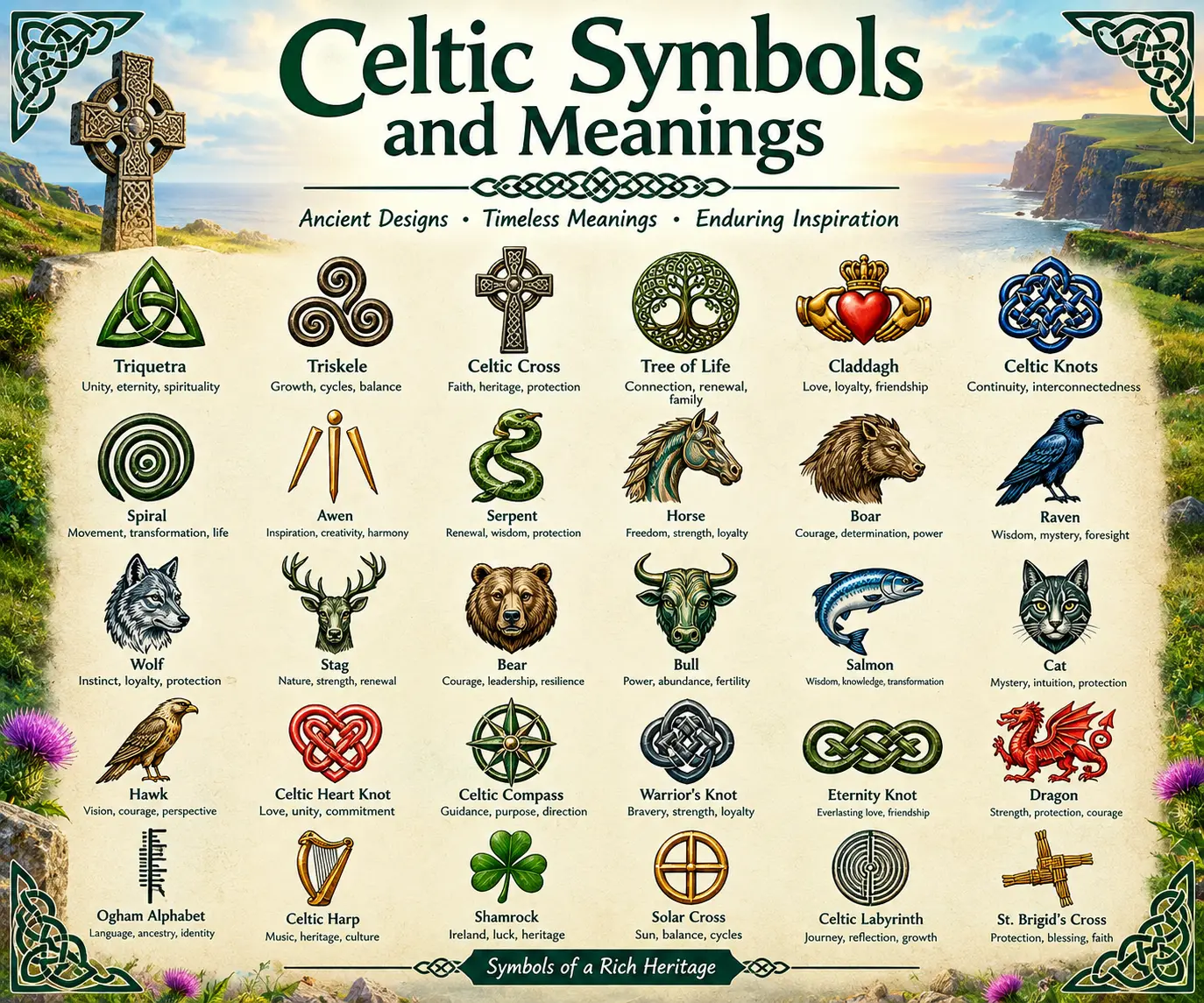
Celtic symbols have fascinated people through intricate knots, crosses, spirals, animals, and nature-inspired designs. They connect with Irish, Scottish, Welsh, medieval, spiritual, artistic, and modern cultural traditions.
Understanding celtic symbols and meanings requires context because not every popular design is ancient. Some come from medieval art, while others developed through later Celtic Revival movements and modern interpretations.
Celtic Symbols: Meanings, History, and Modern Interpretations
Celtic symbols come from different periods and traditions rather than one single Celtic culture. Common themes include:
- Protection and strength
- Love and loyalty
- Nature and renewal
- Spiritual connection
- Family and heritage
Some designs have strong historical evidence, while others are modern interpretations inspired by Celtic art. Understanding celtic symbols and meanings means looking at their history before assigning a specific interpretation.
Quick Guide to Major Celtic Symbols and Meanings
Here is a quick look at several famous designs:
| Symbol | Common modern association |
|---|---|
| Triquetra | Unity and threefold connection |
| Triskele | Cycles and movement |
| Celtic Cross | Christianity and heritage |
| Claddagh | Love, loyalty, friendship |
| Tree of Life | Nature and connection |
| Awen | Inspiration and creativity |
| Celtic Knots | Continuity and interconnectedness |
These associations can vary according to historical context, cultural tradition, and modern use.
Celtic Symbol Guides to Explore Next
Celtic symbolism includes many different designs, so starting with familiar examples makes the subject easier to understand. These symbols frequently appear in:
- Jewelry
- Tattoos
- Artwork
- Manuscripts
- Monuments
- Modern cultural designs
The following guides introduce some of the most recognizable Celtic-inspired motifs and explain their commonly understood meanings.
Celtic Knots
Celtic knots use interwoven lines that appear continuous. They are strongly associated with medieval Insular art and are commonly interpreted today as symbols of continuity, eternity, connection, loyalty, and lasting relationships.
Trinity Knot
The Trinity Knot, also called the Triquetra, has three connected points. Modern interpretations associate it with unity, eternity, spirituality, relationships, and threefold ideas, although its historical meanings vary by context.
Celtic Cross
The Celtic Cross combines a Christian cross with a surrounding ring. It became prominent in medieval Irish and British Christian art and is now strongly associated with Irish heritage and Celtic identity.
Tree of Life
The Celtic Tree of Life is commonly interpreted through roots, branches, growth, family, nature, balance, and interconnectedness. Modern designs often use it to represent the relationship between life, ancestry, and nature.
Claddagh
The Claddagh features two hands holding a heart beneath a crown. It is traditionally associated with friendship, loyalty, and love, making it one of Ireland’s most recognizable cultural symbols.
Triquetra (Trinity Knot)
The Triquetra is a three-pointed interlaced design. Today, it is often associated with:
- Unity
- Eternity
- Spiritual connection
- Threefold relationships
The design appears in Christian and medieval contexts, so calling it exclusively an ancient Celtic religious symbol can oversimplify its history. Its modern popularity has expanded its symbolic meaning considerably.
Triskele (Triple Spiral)
The Triskele, or Triple Spiral, consists of three spiraling arms arranged around a center. Spiral motifs have very old European histories, including famous prehistoric examples in Ireland.
Modern interpretations often connect the Triskele with:
- Movement
- Growth
- Transformation
- Cycles
- Progress
These modern meanings should not automatically be treated as proven beliefs of every ancient Celtic community.
Celtic Cross
The Celtic Cross features a cross surrounded by a circular ring. It is especially associated with medieval Christian monuments in Ireland and Britain and with the wider Insular artistic tradition.
Today, it can represent:
- Christian faith
- Irish heritage
- Celtic identity
- Remembrance
- Spiritual tradition
Its exact meaning depends on the historical and cultural setting in which it appears.
Awen
Awen is a Welsh term associated with inspiration, particularly poetic and artistic inspiration. Its familiar modern symbol consists of three rays and became important in later Welsh cultural and Druidic revival traditions.
Today, Awen is often connected with:
- Creativity
- Inspiration
- Harmony
- Spiritual awareness
- Artistic expression
Its modern symbolism reflects both Welsh tradition and later revival movements.
Spiral
Spiral motifs are among the oldest recurring forms found in prehistoric European art. Their presence does not automatically prove a specifically Celtic meaning because spirals appeared across many cultures.
In modern Celtic-inspired artwork, spirals commonly suggest:
- Growth
- Movement
- Renewal
- Transformation
- Life cycles
Newgrange is particularly famous for its prehistoric spiral carvings.
Claddagh
The Claddagh is an Irish ring design featuring hands, a heart, and a crown. These elements are traditionally explained as representing friendship, love, and loyalty.
The Claddagh has a documented connection with Galway and Irish jewelry traditions. Unlike some designs labeled ancient Celtic, it is better understood through its Irish cultural history and later popularity.
Celtic Tree of Life (Crann Bethadh)
The Celtic Tree of Life commonly shows branches extending upward and roots reaching downward. Modern interpretations connect it with:
- Growth
- Family
- Ancestry
- Nature
- Balance
- Interconnection
Crann Bethadh means “tree of life” in Irish. Contemporary Celtic Tree of Life designs vary widely, so not every decorative version should be treated as an ancient artifact.
Celtic Knot Symbols
Celtic knotwork uses interlaced lines that appear to continue without an obvious beginning or ending. The style became especially prominent in medieval Insular manuscripts and decorative artwork.
Common modern associations include:
- Eternity
- Continuity
- Loyalty
- Interconnection
- Lasting relationships
Different knot designs can have different modern names and interpretations, so there is no single meaning shared by every knot.
Dara Knot
The Dara Knot is a Celtic-inspired knot commonly associated with the oak tree. Its name relates to an Irish word connected with oak or oak woodland.
Modern interpretations often associate it with:
- Strength
- Resilience
- Wisdom
- Stability
- Deep roots
Its modern symbolic popularity is much clearer than evidence for one specific ancient meaning.
Wheel of Balance
The Wheel of Balance is a Celtic-inspired geometric design commonly associated with harmony and equilibrium. Its circular structure naturally suggests completeness, cycles, and interconnected forces.
Modern interpretations may connect it with:
- Balance
- Harmony
- Stability
- Life cycles
- Spiritual unity
Specific ancient origins and meanings should be distinguished from modern symbolic interpretations.
Read More: 7 Deadly Sins: Meanings, Examples & Virtues
Shield Knot
The Shield Knot is a four-sided interlaced design commonly presented as a Celtic protection symbol. Its enclosed structure has encouraged modern associations with safety and defence.
It is often interpreted as representing:
- Protection
- Strength
- Security
- Courage
- Guardianship
However, claims that this exact design was universally used as an ancient Celtic protective emblem require caution.
Celtic Sailor’s Knot
The Celtic Sailor’s Knot is a modern Celtic-inspired design associated with sailors, journeys, relationships, and enduring bonds. Its intertwined structure naturally suggests connection across distance.
Modern meanings commonly include:
- Loyalty
- Friendship
- Love
- Commitment
- Safe journeys
It remains especially popular in jewelry because its continuous form visually represents an enduring relationship.
Love Knot
The Love Knot is a modern Celtic-inspired name used for interwoven designs representing romantic connection and devotion. Its continuous lines can suggest a bond that remains connected over time.
Common modern associations include:
- Eternal love
- Commitment
- Loyalty
- Partnership
- Emotional connection
There is no single ancient Celtic design universally recognized by this exact name.
Motherhood Knot
The Motherhood Knot is a contemporary Celtic-inspired design representing maternal love and family connection. Its interwoven structure visually emphasizes the lasting relationship between parent and child.
Modern interpretations commonly include:
- Maternal love
- Family
- Protection
- Parenthood
- Unbreakable bonds
It is particularly popular in modern jewelry and personalized gifts.
Celtic Five-Fold Symbol
The Celtic Five-Fold Symbol uses five connected elements arranged around a central point. Modern Celtic spirituality often interprets its structure through balance and interconnectedness.
Common modern associations include:
- Harmony
- Nature
- Balance
- Elements
- Spiritual connection
Because five-part symbolism appears across different cultures, its exact meaning should be considered within the context of the specific design.
Serpent
Serpents appear in Celtic and wider European mythology, where their meanings can vary. They may be associated with transformation, fertility, the earth, mystery, and supernatural power.
Modern interpretations often focus on:
- Renewal
- Transformation
- Wisdom
- Mystery
- Life cycles
The meaning changes according to the specific mythology, artwork, or modern tradition being discussed.
Horse
Horses played important practical, social, and mythological roles in Celtic cultures. Epona, known from the Roman world, was particularly associated with horses and was worshipped across parts of the Roman Empire.
Modern Celtic symbolism often connects horses with:
- Freedom
- Strength
- Movement
- Travel
- Loyalty
Their importance combines historical, archaeological, and mythological traditions.
Boar
The boar appears in Celtic artistic and cultural traditions and was connected with hunting, feasting, warfare, and elite imagery. Its physical power made it an impressive animal in ancient symbolism.
Modern interpretations commonly associate the boar with:
- Courage
- Strength
- Determination
- Protection
- Warrior spirit
These associations are best treated as symbolic interpretations rather than one universal Celtic belief.
Raven
Ravens appear in Irish and Welsh mythology and can be connected with warfare, prophecy, mystery, and supernatural forces. The Morrígan is particularly associated with battle and transformation in Irish mythology.
Modern interpretations commonly connect the raven with:
- Wisdom
- Mystery
- Foresight
- Transformation
- Protection
Its meaning becomes clearer when connected to a particular mythological story.
Wolf
The wolf appears in European folklore and modern Celtic-inspired symbolism as an image of strength, independence, loyalty, and protection.
Common modern associations include:
- Courage
- Instinct
- Freedom
- Loyalty
- Guardianship
Although wolves lived in regions inhabited by ancient Celtic communities, many detailed symbolic meanings found today are later interpretations.
Stag
The stag is strongly associated with forests, wilderness, strength, and renewal in Celtic-inspired imagery. Its antlers, which grow and shed naturally, also encourage associations with seasonal cycles.
Cernunnos, a figure known from Gallo-Roman evidence, is famously depicted with antlers. Modern interpretations therefore connect the stag with:
- Nature
- Strength
- Sovereignty
- Fertility
- Renewal
Bear
The bear appears in Celtic and wider European traditions and is commonly associated with physical power, courage, leadership, and protection.
Modern Celtic-inspired interpretations often emphasize:
- Strength
- Resilience
- Confidence
- Leadership
- Guardianship
The exact meaning depends on the specific cultural or mythological context rather than one universal Celtic tradition.
Bull
The bull appears in Celtic archaeological material, mythology, and artistic traditions. Cattle were economically important, while bulls could represent power, wealth, fertility, and status.
Irish mythology contains famous cattle-centered stories, including the Táin Bó Cúailnge. Modern interpretations commonly associate the bull with:
- Strength
- Abundance
- Prosperity
- Determination
- Fertility
Salmon
The salmon has an especially important place in Irish mythology through the Salmon of Knowledge. In this story, the magical salmon is connected with wisdom and supernatural knowledge.
Modern interpretations commonly associate the salmon with:
- Wisdom
- Knowledge
- Inspiration
- Transformation
- Learning
This is a strong example of a modern symbolic meaning being closely connected with a specific mythological tradition.
Cat
Cats appear in Irish and Scottish folklore and can be portrayed as mysterious, supernatural, or otherworldly creatures. Their symbolism varies considerably between individual stories.
Modern Celtic-inspired interpretations commonly connect cats with:
- Mystery
- Independence
- Intuition
- Protection
- Supernatural awareness
These meanings should be understood as folklore-inspired rather than a single ancient Celtic doctrine.
Hawk
The hawk is commonly associated with vision, freedom, observation, and height. Its sharp eyesight makes it a natural symbol of awareness and perspective in modern Celtic-inspired symbolism.
Modern interpretations may include:
- Clear vision
- Courage
- Freedom
- Awareness
- Perspective
Specific ancient Celtic meanings are difficult to establish without connecting the bird to a particular source or tradition.
Celtic Heart Knot
The Celtic Heart Knot combines interlaced knotwork with a heart shape. It is primarily a modern Celtic-inspired design associated with romantic love and emotional connection.
Modern meanings often include:
- Eternal love
- Loyalty
- Commitment
- Partnership
- Emotional unity
Its popularity is especially strong in contemporary jewelry, wedding designs, gifts, and tattoos.
Celtic Compass
The Celtic Compass is generally a modern Celtic-inspired design representing direction, guidance, travel, and purpose. Its circular structure and directional elements make it popular in contemporary symbolic artwork.
Modern interpretations commonly include:
- Guidance
- Direction
- Purpose
- Travel
- Personal journey
There is no single ancient artifact proving one universal Celtic compass symbol.
Warrior’s Knot
The Warrior’s Knot is a modern Celtic-inspired knot associated with courage, protection, strength, loyalty, and warrior identity. Its interwoven form suggests resilience and bonds that withstand difficulty.
Common interpretations include:
- Bravery
- Strength
- Protection
- Loyalty
- Endurance
The term is primarily used in contemporary Celtic-inspired jewelry, tattoos, and artwork.
Eternity Knot
The Eternity Knot is a modern name for continuous Celtic-style knotwork. Because the lines appear to have no clear beginning or ending, the design naturally suggests continuity.
It is commonly associated with:
- Eternity
- Lasting love
- Friendship
- Spiritual connection
- Continuity
Several different knot designs can be marketed under this name.
Dragon
Dragons are especially prominent in Welsh tradition and Celtic-inspired imagery. The red dragon is strongly associated with Wales and has become an important national symbol.
Modern Celtic dragon symbolism commonly emphasizes:
- Strength
- Protection
- Courage
- Power
- Sovereignty
Not every dragon design marketed as Celtic, however, can be traced to an ancient Celtic source.
Ogham Alphabet
Ogham is an early medieval writing system found primarily in inscriptions on stones in Ireland and parts of Britain. Its letters consist of groups of strokes positioned around a stemline.
Ogham is particularly important because surviving inscriptions provide direct historical evidence. Later traditions connected Ogham letters with trees, although historical evidence and modern tree associations should not automatically be treated as identical.
Read More: 5 Road Sign Meanings: Understanding Colors and Shapes of Road Signs
Celtic Harp
The harp has a deep connection with Irish cultural identity and is one of Ireland’s best-known national symbols. Irish harp traditions developed over centuries and became closely connected with music and heritage.
The famous Trinity College Harp is an important example, although its traditional association with Brian Boru is not securely established. Modern symbolism commonly emphasizes:
- Music
- Culture
- Heritage
- Art
- Irish identity
Shamrock
The shamrock is strongly associated with Ireland and St. Patrick. Traditional accounts say St. Patrick used the three-leaved plant as an illustration when teaching about the Christian Trinity.
Today, it commonly represents:
- Ireland
- Irish heritage
- St. Patrick
- Luck
- Cultural identity
It should not automatically be treated as identical to every ancient Celtic three-part symbol.
Solar Cross
The Solar Cross consists of a cross enclosed within a circle. Similar forms occur across different cultures, making it difficult to describe the design as exclusively Celtic.
Modern Celtic-inspired interpretations may associate it with:
- The sun
- Seasons
- Balance
- Four directions
- Natural cycles
Historical interpretation requires consideration of the specific artifact and culture.
Celtic Labyrinth
The Celtic Labyrinth is generally a modern interpretation combining labyrinth structures with Celtic-inspired patterns. Modern users often connect it with personal journeys and spiritual reflection.
Common associations include:
- Life journey
- Reflection
- Transformation
- Spiritual exploration
- Personal growth
Labyrinths themselves have widespread histories, so they should not automatically be presented as uniquely Celtic.
Serch Bythol (Eternal Love Knot)
Serch Bythol is a Welsh phrase commonly translated as “everlasting love.” The modern design is generally represented through connected three-cornered forms.
It is widely interpreted as representing:
- Eternal love
- Commitment
- Partnership
- Loyalty
- Spiritual connection
Its modern popularity is especially strong in Celtic-inspired jewelry and tattoo designs.
Quaternary Knot (Fourfold Knot)
The Quaternary Knot is a four-part interlaced Celtic-style design. Modern interpretations often connect its four sections with balance and interconnected aspects of existence.
Common associations include:
- Four directions
- Four seasons
- Balance
- Elements
- Completeness
However, these meanings are not universally established for every historical fourfold knot.
St. Brigid’s Cross
St. Brigid’s Cross is traditionally associated with St. Brigid of Kildare and is commonly made from rushes or similar plant materials. It has an important place in Irish Christian folk tradition.
The cross is associated with:
- St. Brigid
- Irish heritage
- Household protection
- Blessing
- Christian tradition
It is better understood through Irish Christian folk culture than simply labeling it an ancient pre-Christian Celtic symbol.
Griffin (Celtic Mythological Creature)
The griffin is a legendary creature combining an eagle and lion. It belongs to a much broader Eurasian artistic and mythological tradition rather than being exclusively Celtic.
Modern Celtic-inspired artwork may use griffins to represent:
- Courage
- Guardianship
- Nobility
- Strength
- Protection
Its appearance in Celtic-themed designs reflects later artistic adaptation as well as broader mythology.
Hound (Celtic Symbol of Loyalty and Protection)
Hounds appear in Irish and Welsh mythology and literature, where dogs can be connected with hunting, warriors, loyalty, protection, and supernatural encounters.
Modern Celtic symbolism often associates the hound with:
- Loyalty
- Courage
- Protection
- Devotion
- Guardianship
Specific myths provide more useful historical context than assigning one meaning to every Celtic dog image.
Swan (Celtic Symbol of Transformation and Grace)
Swans feature in Irish and Welsh stories, particularly tales involving supernatural transformation. Their beauty and association with water have also influenced later symbolic interpretations.
Modern meanings commonly include:
- Transformation
- Grace
- Beauty
- Love
- Loyalty
The Children of Lir is one famous Irish story connecting swans with magical transformation.
Green Man (Celtic Symbol of Nature, Renewal, and Fertility)
The Green Man is a foliage-covered human face found in medieval European architectural decoration. Although often marketed as an ancient Celtic symbol, its origins and meanings are more complicated.
Modern interpretations commonly connect it with:
- Nature
- Renewal
- Fertility
- Vegetation
- Seasonal cycles
Its popularity grew strongly through later artistic and spiritual traditions.
The Dagda (Celtic God of Strength, Wisdom, and Fertility)
The Dagda is an important figure in medieval Irish mythology and belongs to the Tuatha Dé Danann. He is portrayed as powerful and associated with abundance, knowledge, and supernatural objects.
Modern descriptions commonly connect him with:
- Strength
- Wisdom
- Fertility
- Generosity
- Abundance
His importance comes from a substantial Irish mythological and literary tradition.
Celtic Arrow (Symbol of Direction, Purpose, and Warrior Spirit)
The Celtic Arrow is mainly a modern Celtic-inspired design rather than one universally documented ancient Celtic symbol. Its pointed shape naturally suggests movement, direction, focus, and purpose.
Modern interpretations commonly associate it with:
- Direction
- Determination
- Courage
- Protection
- Warrior spirit
It is especially popular in contemporary tattoos, jewelry, and personal symbolic artwork.
Understanding Celtic Symbols in Context
Understanding celtic symbols and meanings requires remembering that Celtic culture covered different communities, languages, periods, and regions. Irish, Scottish, Welsh, and continental traditions were not identical.
A useful way to evaluate a symbol is to ask:
- Is there archaeological evidence?
- Does it appear in medieval manuscripts?
- Is it connected with mythology?
- Did the Celtic Revival popularize it?
- Is its current meaning modern?
This approach helps separate historical evidence from modern symbolism.
Frequently Asked Questions About Celtic Symbols
Celtic symbolism includes archaeology, mythology, medieval Christianity, folklore, nature imagery, and modern cultural interpretation. That mixture explains why the same design may receive different meanings in different sources.
When researching celtic symbols and meanings, consider the symbol’s historical period and cultural setting instead of assuming every popular explanation describes an ancient belief.
What are the best-known Celtic symbols?
The best-known examples include:
- Triquetra
- Triskele
- Celtic Cross
- Claddagh
- Celtic knots
- Tree of Life
- Awen
- Ogham
- Celtic Harp
- St. Brigid’s Cross
Their histories and meanings are different, so they should not be treated as one unified category.
Are all Celtic symbols ancient?
No. Some designs have prehistoric or medieval backgrounds, while others are modern Celtic-inspired creations. The Celtic Revival also influenced how older motifs were interpreted and reused.
What does a Celtic knot symbolize?
A Celtic knot is commonly associated with continuity, eternity, interconnectedness, loyalty, and lasting relationships. Historically, knotwork is particularly important in medieval Insular art and manuscript decoration.
What is the Celtic symbol for love?
The Claddagh is one of the best-known Irish symbols associated with love, loyalty, and friendship. Modern Celtic-inspired love designs also include:
- Love Knots
- Celtic Heart Knots
- Serch Bythol
- Eternity Knots
What is the Celtic symbol for protection?
Modern Celtic-inspired symbolism commonly associates protection with designs such as the Shield Knot, Celtic Cross, hound, and dragon. Specific historical meanings should always be checked against reliable evidence.
What is the difference between the Triquetra and the Triskele?
The Triquetra is a three-pointed interlaced design, while the Triskele has three spiraling arms. Both are associated with threefold symbolism in modern interpretations, but their shapes and histories differ.
Celtic symbols remain popular because they combine beautiful visual patterns with themes of heritage, nature, relationships, spirituality, mythology, and personal identity. Their meanings become more interesting when history is included.
Rather than assuming every modern interpretation is ancient, look at the evidence behind each design. Understanding celtic symbols and meanings in context allows you to appreciate their historical roots and modern cultural significance.

MeaningShelf shares meaningful quotes, thoughtful messages, and helpful word meanings, managed by Lily Anderson, an SEO content writer with 2 years of experience, creating engaging content that inspires readers and helps them find the right words for every moment.
3 thoughts on “Celtic Symbols and Meanings: 44 Symbols Explained”