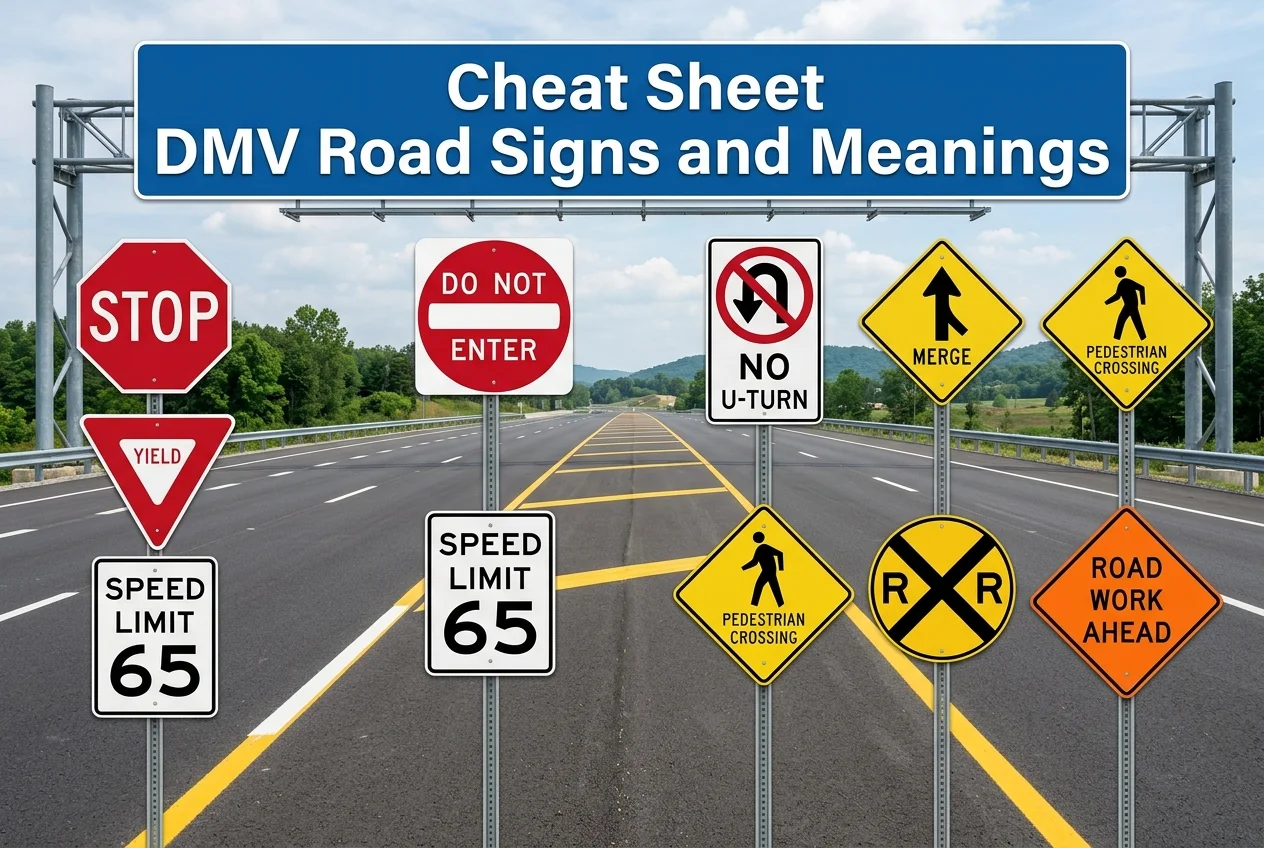
cheat sheet dmv road signs and meanings, Road signs help drivers understand rules, warnings, directions, and road conditions. Learning common road signs and meanings makes driving easier, safer, and more predictable.
From stop signs to pavement markings, each symbol gives drivers a clear message. Knowing what these signs mean helps you react properly and understand the road ahead.
Cheat Sheet DMV Road Signs and Meanings: Regulatory Signs
Regulatory signs tell drivers what they must do or must not do. They control movements, speed, parking, lane use, and other actions. Many regulatory signs use white, black, red, or combinations of these colors.
These signs are especially important because ignoring them can create dangerous situations or violate traffic laws. Always read the complete sign, including any added plaque or restriction.
🛑 Stop Sign
A stop sign tells drivers to come to a complete stop before entering or crossing the intersection. After stopping, check traffic, pedestrians, and other road users before continuing.
🔻 Yield Sign
A yield sign tells drivers to slow down and give the right-of-way to traffic or pedestrians when necessary. Stop if needed, then proceed only when the path is clear.
🚫 Do Not Enter Sign
A Do Not Enter sign tells drivers that they must not enter a particular roadway, ramp, or entrance from that direction. It is commonly used where traffic travels the opposite way.
↪️ One Way Sign
A One Way sign shows that traffic on a roadway or street moves in only one direction. Drivers should follow the indicated direction and avoid turning into opposing traffic.
⛔ Do Not Pass Sign
A Do Not Pass sign identifies a roadway area where passing is prohibited. Drivers should remain behind the vehicle ahead until the restriction ends or another legal passing opportunity appears.
➡️ Keep Right Sign
A Keep Right sign directs drivers to stay to the right of an island, median, obstruction, or other roadway feature. Follow the arrow and remain within the proper travel path.
🔢 Speed Limit Sign
A Speed Limit sign shows the maximum legal speed for that roadway under the posted conditions. Drivers should follow the displayed limit and adjust speed when conditions require slower travel.
↔️ Lane Use Control Sign
Lane use control signs tell drivers which movements are allowed from a specific lane. Arrows and words can indicate through movement, turning, merging, or other permitted lane uses.
↩️ No U-Turn Sign
A No U-Turn sign prohibits drivers from making a U-turn at the marked location. Drivers must continue forward or use another legal location where turning around is permitted.
Read More: Toyota Dashboard Symbols and Meanings: A Simple Guide
🚷 No Pedestrian Crossing Sign
A No Pedestrian Crossing sign indicates that pedestrians are not permitted to cross at that location. Pedestrians should use a designated crossing or another permitted route.
🅿️ No Parking Sign
A No Parking sign restricts parking where the sign applies. Additional wording may identify specific hours, days, vehicles, or conditions, so drivers should read the entire parking restriction.
Warning Signs
Warning signs alert drivers to conditions that may require extra attention or a change in driving behavior. Standard warning signs commonly use a black legend and border on a yellow background with a diamond shape.
These signs can warn about intersections, curves, road conditions, pedestrians, animals, railroad crossings, and changes in roadway design. They do not always require stopping, but they signal that drivers should be prepared.
⚠️ No Passing Zone Sign
A No Passing Zone warning sign alerts drivers that passing restrictions are approaching or apply in the area. It is commonly associated with limited visibility or roadway conditions where passing can be unsafe.
🚆 Railroad Crossing Sign
A railroad crossing warning sign alerts drivers that railroad tracks are ahead. Slow down, look and listen for trains, and be prepared to stop before crossing when necessary.
↔️ Two-Way Traffic Sign
A Two-Way Traffic sign warns that vehicles may travel in opposite directions on the roadway. Drivers should remain in their lane and watch carefully for oncoming traffic.
🔀 Merging Traffic Sign
A Merging Traffic sign warns that traffic from another lane or roadway may enter the driver’s path. Maintain awareness, check surrounding vehicles, and be prepared for merging traffic.
↘️ Lane Ends Sign
A Lane Ends sign warns that a travel lane will end ahead. Drivers should prepare to merge safely into another lane while checking mirrors and blind spots for nearby vehicles.
🌉 Narrow Bridge Sign
A Narrow Bridge sign warns that the roadway becomes narrower at a bridge or similar structure. Drivers should reduce speed and allow adequate space when meeting or passing other vehicles.
⬇️ Low Clearance Sign
A Low Clearance sign warns drivers that an overhead structure has limited vertical clearance. Tall vehicles should check their height before continuing to avoid striking the structure.
✚ Cross Road Sign
A Cross Road warning sign indicates that another roadway crosses the driver’s path ahead. Reduce speed as needed and watch for vehicles entering from either side.
⤴️ T Intersection Sign
A T Intersection warning sign shows that the current roadway ends at another road ahead. Drivers should prepare to turn and watch for traffic approaching from both directions.
🔄 Roundabout Sign
A Roundabout warning sign tells drivers that a circular intersection is ahead. Slow down, follow the lane markings, yield as required, and travel around the central island in the proper direction.
⚠️ Bump Sign
A Bump warning sign alerts drivers to a raised or uneven section of roadway. Slow down before reaching the bump to maintain vehicle control and reduce discomfort or damage.
〰️ Winding Road Sign
A Winding Road warning sign indicates several curves ahead. Drivers should reduce speed when appropriate, stay within their lane, and remain alert for changing road alignment.
🛞 Slippery Road Sign
A Slippery Road warning sign alerts drivers that pavement may become slippery, especially under certain weather or road conditions. Reduce speed and avoid sudden braking or steering.
🏫 School Zone Sign
A School Zone sign identifies an area where drivers should expect children, school activity, crossing pedestrians, and changing traffic conditions. Follow any posted speed limit or additional restrictions.
🚸 School Crossing Sign
A School Crossing warning sign alerts drivers to a designated crossing used by students. Slow down, watch for pedestrians, and be prepared to stop when people are crossing.
🚶 Pedestrian Crossing Sign
A Pedestrian Crossing sign warns drivers that pedestrians may cross the roadway ahead. Approach carefully, watch both sides of the road, and yield where required.
🚲 Bicycle Crossing Sign
A Bicycle Crossing warning sign alerts drivers that bicycles may cross or enter the roadway. Reduce speed when appropriate and watch carefully for cyclists approaching from either direction.
🦌 Deer Crossing Sign
A Deer Crossing warning sign indicates that deer or other wildlife may enter the roadway. Slow down, especially where visibility is limited, and watch the road edges carefully.
🚦 Traffic Signal Ahead Sign
A Traffic Signal Ahead warning sign tells drivers that a traffic signal is approaching. Be prepared to slow down, stop, or respond to changing signal indications.
Construction Signs / Work Zone Signs
Work-zone signs warn drivers about temporary changes caused by construction, maintenance, utility work, or other activities. Temporary traffic-control signs can use orange backgrounds with black legends and borders, distinguishing them from permanent warning signs.
Drivers should reduce speed when required, watch for workers and equipment, follow temporary lane markings, and obey flaggers or other traffic-control devices.
🚧 Road Work Ahead Sign
A Road Work Ahead sign warns drivers that construction or maintenance activity is approaching. Slow down, watch for changing lanes or traffic patterns, and follow temporary signs through the work area.
👷 Workers Sign
A Workers warning sign alerts drivers that road workers may be present near the roadway. Reduce speed when appropriate, stay alert, and follow temporary traffic-control instructions.
🚩 Flagger Ahead Sign
A Flagger Ahead sign warns drivers that a flagger may control traffic ahead. Slow down and be prepared to stop or follow the flagger’s hand signals and instructions.
Guide Signs
Guide signs help drivers navigate roads, highways, routes, exits, destinations, and important locations. They provide information rather than simply warning drivers about hazards or regulating movement.
Colors vary according to the type of information. Route markers identify designated routes, while directional signs help drivers choose the correct road, exit, or destination.
🛣️ Highway Guide Sign
Highway guide signs provide information about destinations, routes, exits, and directions. They help drivers choose the appropriate roadway and prepare for upcoming exits or changes in direction.
↗️ Exit Only Highway Sign
An Exit Only sign indicates that a particular lane or roadway movement leads to an exit rather than continuing along the main route. Drivers should move appropriately if they do not want to exit.
📍 Mile Marker
A Mile Marker identifies a location along a highway using a distance-based reference system. Drivers can use mile markers to understand their position and communicate a location during travel or emergencies.
🛣️ Interstate Route Marker
An Interstate Route Marker identifies an Interstate highway by its route number. These markers help drivers recognize major routes and follow directions toward specific destinations.
🛣️ County Route Marker
A County Route Marker identifies a designated county route. The exact design varies by jurisdiction, but the marker helps drivers recognize and follow the numbered roadway.
✈️ Airport Sign
An Airport guide sign directs drivers toward an airport or airport-related roadway. Follow the displayed direction and additional lane or destination information when approaching the facility.
Read More: 9 Heart Color Meanings: What Every Heart Really Means
Service Signs
Service signs direct drivers toward useful facilities and services along or near a roadway. Common examples include hospitals, fuel stations, food services, and other traveler facilities.
Many standard U.S. service signs use recognizable symbols to help drivers understand the service quickly, even when traveling at speed.
🏥 Hospital Sign
A Hospital service sign directs drivers toward a hospital or medical facility. It can be especially useful when someone needs medical assistance or when travelers are unfamiliar with the area.
🍴 Food Sign
A Food service sign indicates that food services are available nearby. Drivers can use the information to locate restaurants or other approved food facilities along the route.
⛽ Gas Station Sign
A Gas Station service sign indicates that fuel is available nearby. Drivers can follow the displayed direction or exit information to reach a gasoline or fuel facility.
⛽ Diesel Sign
A Diesel service sign indicates the availability of diesel fuel. It can help drivers of diesel-powered vehicles locate an appropriate fueling facility along their route.
Pavement Markings
Pavement markings work together with road signs to organize traffic and communicate rules directly on the roadway. They can separate opposing traffic, divide lanes, identify turning areas, mark crossings, or guide vehicle movement.
Common road markings include yellow lines, white lines, arrows, stop lines, yield markings, bike-lane symbols, and shared-lane markings. Their meaning depends on their color, pattern, location, and combination.
🟡 Double Solid Yellow Line
Double solid yellow lines separate opposing directions of traffic. Drivers generally should not cross them to pass. Specific crossing rules can vary according to roadway design and local law.
🟡 Broken Yellow Line
A broken yellow line separates opposing traffic where passing may be permitted when conditions are safe and legal. Drivers should check signs, visibility, traffic, and local rules before passing.
🟡 Broken Yellow + Solid Yellow Line
A combination of broken and solid yellow lines separates opposing traffic and can indicate different passing permissions for each direction. Drivers must follow the line on their side of the roadway.
⚪ Solid White Line
A solid white line separates lanes moving in the same direction or marks the edge of a roadway. Crossing restrictions depend on the specific location, markings, and applicable traffic rules.
⚪ Double Solid White Line
Double solid white lines separate lanes traveling in the same direction where crossing is restricted or discouraged. Drivers should remain in their lane unless a permitted movement is indicated.
⚪ Broken White Line
A broken white line separates lanes moving in the same direction. Drivers may change lanes where permitted, but they should check traffic, signal, and move only when safe.
↔️ Reversible Lanes
Reversible lanes are designed to carry traffic in different directions at different times. Special signs, signals, and pavement markings indicate when a lane is available for a particular direction.
↩️ Center Left Turn Lane
A center left-turn lane provides space for vehicles preparing to turn left from a roadway. Drivers should enter it only where permitted and use it for its intended turning movement.
🚗 HOV Lane
An HOV lane is reserved for vehicles meeting specified occupancy or eligibility requirements. Signs identify when the restriction applies and may include minimum passenger requirements or operating hours.
↔️ Edge Lines
Edge lines mark the boundary between the travel portion of a roadway and its shoulder or outer edge. They help drivers understand roadway limits, especially at night or in poor visibility.
⬆️ Directional Arrows
Directional arrows painted on pavement show permitted or required movements from a lane. They can indicate through travel, turning, merging, or combinations of movements.
🛑 Stop Line
A stop line shows where vehicles should stop when required by a stop sign, traffic signal, or other traffic-control device. Drivers should stop before the marked line.
🔻 Yield Line
A yield line marks the point where drivers should yield when required. It is commonly formed with triangular markings that help identify where a yielding vehicle should give way.
🚲 Bike Lane Markings
Bike lane markings identify a portion of the roadway intended for bicycle travel. Drivers should recognize the marked area and follow applicable rules concerning vehicles, bicycles, parking, and lane changes.
🚲 Sharrows
Shared-lane markings, often called sharrows, indicate that bicycles and motor vehicles share the roadway. The marking helps position cyclists and reminds drivers to expect bicycle traffic in the lane.
Understanding Road Signs and Meanings
Road signs communicate different types of information, so learning their basic categories makes them easier to understand. Regulatory signs establish rules, warning signs alert drivers to conditions ahead, and guide signs provide route and destination information.
Work-zone signs communicate temporary traffic changes, service signs point toward useful facilities, and pavement markings organize movement directly on the road. The MUTCD provides standardized guidance for these traffic-control devices in the United States.
When reading road signs, pay attention to more than the main symbol. Colors, shapes, arrows, words, numbers, supplementary plaques, lane markings, and the location of a sign can all change its meaning.
Why Are Road Signs Important?
Road signs help create predictable movement between drivers, pedestrians, cyclists, and other road users. They communicate rules and warnings before drivers reach intersections, curves, crossings, work zones, and other important areas.
Understanding road signs and meanings can also make unfamiliar roads easier to navigate. Instead of reacting at the last second, drivers can recognize a sign early and prepare for the upcoming roadway condition.
Quick Road Sign Categories
| Category | Main Purpose | Common Examples |
|---|---|---|
| Regulatory Signs | Control driver actions | Stop, Yield, Speed Limit |
| Warning Signs | Alert drivers to conditions ahead | Curve, Railroad, Pedestrian |
| Work Zone Signs | Warn about temporary conditions | Road Work, Workers, Flagger |
| Guide Signs | Provide route information | Highway, Exit, Route Marker |
| Service Signs | Identify useful facilities | Hospital, Food, Gas |
| Pavement Markings | Organize traffic movement | Yellow Lines, White Lines, Arrows |
Final Thoughts
Road signs are easier to understand when you learn what each category does. Regulatory signs tell you what is required, warning signs prepare you for hazards, and guide signs help you reach the right destination.
Pavement markings add another layer of information by showing lanes, boundaries, turning areas, and traffic movements. Learn the common symbols, colors, and shapes, but always follow the signs and markings posted for the specific roadway.

MeaningShelf shares meaningful quotes, thoughtful messages, and helpful word meanings, managed by Lily Anderson, an SEO content writer with 2 years of experience, creating engaging content that inspires readers and helps them find the right words for every moment.
1 thought on “Cheat Sheet DMV Road Signs and Meanings: Know Every Sign”