
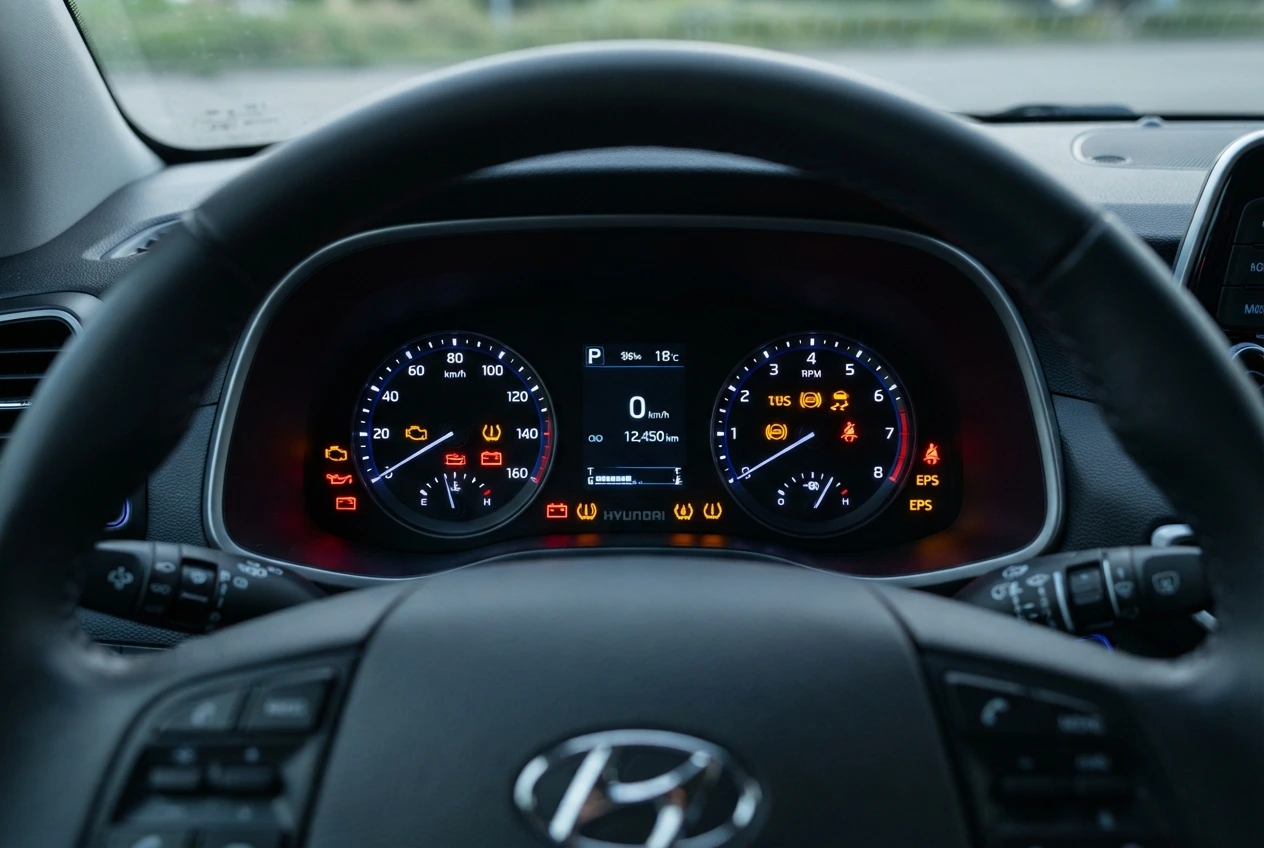
Seeing an unfamiliar light appear while driving can be stressful. Hyundai dashboard symbols and meanings help you understand whether a light signals normal operation, routine maintenance, or a potential vehicle problem.
From the check engine light to TPMS, ABS, ESC, and steering warnings, each indicator communicates something specific. Understanding Hyundai dashboard symbols and meanings can help you respond safely, avoid unnecessary worry, and recognize potential problems early.
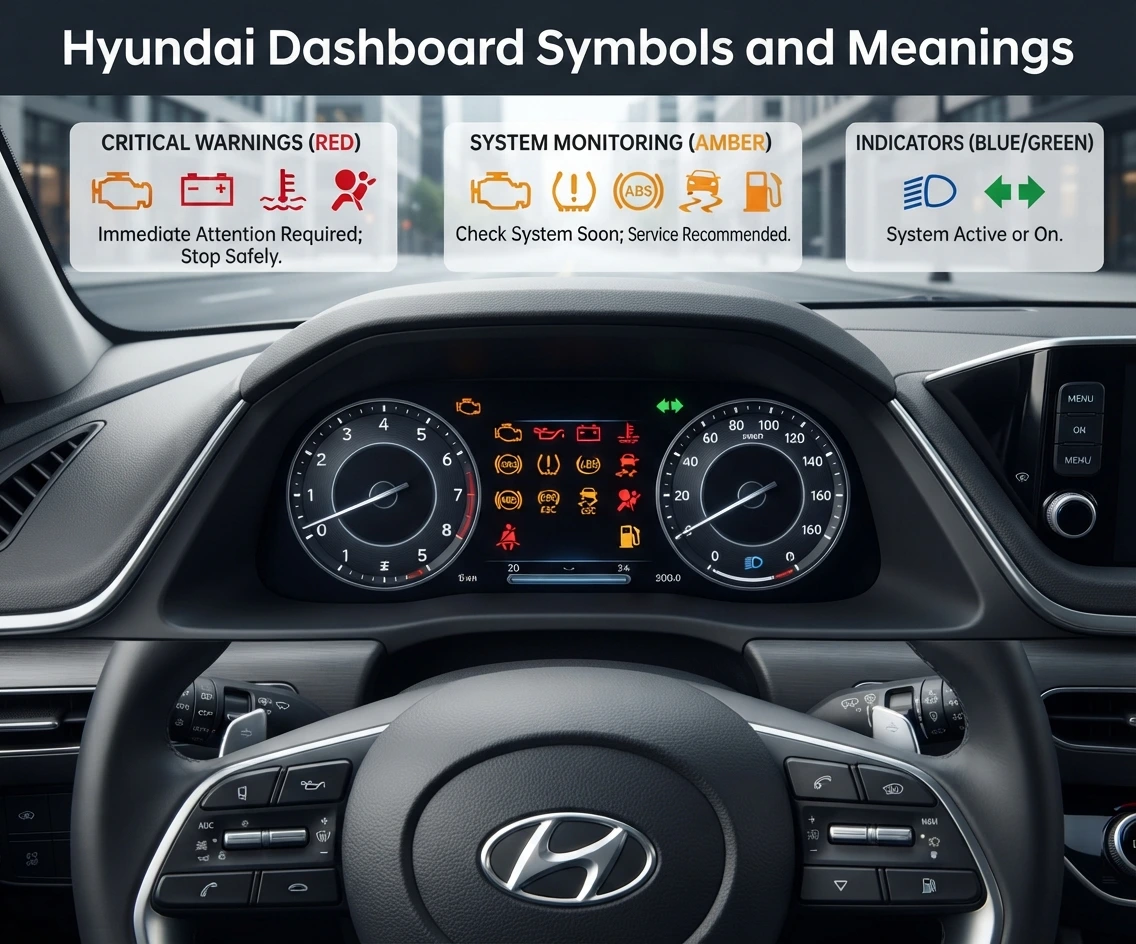
Hyundai Dashboard Symbols and Meanings Cheat Sheet
Hyundai uses warning lights and status indicators to communicate what is happening inside your vehicle. Depending on the model, year, trim, and equipment, the symbols and colors can vary slightly. Your owner’s manual remains the final reference for your specific vehicle.
As a quick guide, green or other status indicators generally show an active function, while yellow or amber warnings commonly indicate a condition requiring attention. Red warnings generally deserve immediate attention. Always consider the accompanying cluster message and driving conditions.
| Symbol or warning | General meaning | What to do |
|---|---|---|
| Check Engine | Engine or emissions-related fault | Have the vehicle diagnosed |
| Master Warning | Multiple possible system issues | Read the cluster message |
| Oil Pressure | Low engine oil pressure | Stop safely and check immediately |
| Engine Temperature | Engine temperature too high | Stop safely and allow cooling |
| TPMS | Low tire pressure or TPMS fault | Check tire pressures |
| Charging System | Charging-system problem | Have the system inspected |
| ABS | ABS malfunction | Arrange inspection |
| ESC | Stability-control activity or fault | Check the indicator behavior |
| Air Bag | Restraint-system problem | Arrange prompt inspection |
| EPS | Electric steering problem | Avoid driving if steering is affected |
| Low Fuel | Fuel level is low | Refuel soon |
| Seat Belt | Belt not fastened | Fasten the seat belt |
| Door Ajar | Door or liftgate is open | Close it securely |
Hyundai Dashboard Warning Lights List
Hyundai warning lights can indicate anything from an activated feature to a system malfunction. Hyundai dashboard symbols and meanings are easier to understand when you consider the light’s picture, color, whether it is steady or flashing, and any message shown on the cluster.
Because Hyundai produces many models, exact indicators are not identical across every vehicle. Hyundai dashboard symbols and meanings can also vary by model, year, trim, and equipment, especially with newer driver-assistance and electrified-vehicle systems. The following list covers common symbols and explains what they generally indicate.
| Warning area | Common concern |
|---|---|
| Engine | Malfunction, oil pressure, or overheating |
| Brakes | Brake system, parking brake, ABS, or EBD |
| Tires | Low pressure or TPMS malfunction |
| Electrical | Battery or charging-system fault |
| Steering | Electric power steering malfunction |
| Stability | ESC activation or malfunction |
| Safety | Airbag or driver-assistance issue |
| Visibility | High beam, fog light, or turn signal |
| Vehicle status | Fuel, doors, trunk, or seat belt |
Check Engine Light/Malfunction Indicator Light
The check engine light, also called the malfunction indicator lamp, can signal an emissions or engine-control problem. A loose fuel cap can sometimes trigger it, while other causes require professional diagnosis.
A continuously illuminated light should not be ignored, particularly if drivability changes. If the light flashes or the vehicle runs poorly, reduce driving and seek professional assistance promptly. The exact cause cannot be determined from the symbol alone.
Master Warning Light
The Master Warning Light can cover several conditions, including driver-assistance faults, exterior-light problems, TPMS issues, low washer fluid, or blocked sensors, depending on the Hyundai model and equipment.
Look for the accompanying message on the instrument cluster because that provides the useful detail. If the underlying issue is resolved, the master warning may switch off automatically on applicable models.
Read More: Number Meanings: Angel Numbers 000–999 Explained
Engine Oil Pressure Warning Light
This warning indicates that engine oil pressure may be too low. Insufficient lubrication can damage internal engine components, so it deserves immediate attention rather than being treated as a routine maintenance reminder.
If it illuminates while driving, safely stop the vehicle and follow your owner’s manual instructions. Continuing to operate an engine with inadequate oil pressure can result in severe mechanical damage.
Engine Temperature Warning Light
The engine temperature warning indicates that the engine may be overheating or operating at an excessively high temperature. Continuing to drive can cause serious engine damage, especially if coolant loss is involved.
Move somewhere safe and stop the vehicle when conditions allow. Do not open a hot coolant reservoir. Allow the engine to cool and follow the instructions in your owner’s manual.
Tire Pressure Monitoring System (TPMS) Light
The TPMS warning commonly indicates that one or more tires are significantly underinflated. Some Hyundai models show the affected tire on the cluster, making the warning easier to investigate.
Check all tires with an accurate pressure gauge and inflate them according to the vehicle’s recommended specification. If the light flashes and then remains illuminated, a TPMS malfunction may also be involved.
Charging System Warning Light
The charging system warning can indicate a problem involving the alternator or electrical charging system. A charging fault may eventually leave the vehicle unable to maintain sufficient electrical power.
If the light stays on while driving, avoid unnecessary electrical loads and arrange an inspection as soon as practical. On some vehicles, Hyundai specifically advises checking the alternator drive belt when appropriate.
Hybrid Battery Charge Warning Light
Hybrid and plug-in hybrid Hyundai vehicles can display warnings related to their high-voltage battery or hybrid control system. The exact indicator and required action depend on the particular model and system.
Do not attempt to repair or handle high-voltage components yourself. If a hybrid battery warning remains illuminated or a related warning message appears, follow the vehicle manual and seek qualified Hyundai service.
Parking Brake Light/Brake Fluid Warning Light
A parking-brake warning can appear when the parking brake is applied. If the warning remains on after releasing it, the vehicle may have low brake fluid or another braking-system concern, depending on the model.
Do not assume a persistent warning is harmless. Because braking performance is critical, safely stop when appropriate and have the braking system inspected if the warning does not clear.
Anti-Lock Brake System (ABS) Warning Light
The ABS warning light indicates a problem with the anti-lock braking system when it remains illuminated after startup. Normal hydraulic braking may still operate, but the anti-lock function may not be available.
Drive cautiously and arrange an inspection. If the ABS warning appears together with another brake warning, treat the situation more seriously because Hyundai notes that combined warnings can indicate reduced braking-system performance.
Electronic Stability Control (ESC) Light
The ESC indicator can blink while the system is actively helping control wheel slip or vehicle stability. A continuously illuminated ESC warning can indicate a system malfunction that requires attention.
If the light only flashes briefly during slippery driving, it may simply show that the system is operating. If it stays on, check the owner’s manual and arrange an inspection if necessary.
Electronic Stability Control (ESC) OFF Light
The ESC OFF indicator generally illuminates when the driver has intentionally switched off electronic stability control using the appropriate control. It can also briefly appear during the vehicle’s startup sequence.
If ESC has been turned off unintentionally, restore the system according to your vehicle’s instructions. Remember that disabling ESC can reduce the assistance available during certain loss-of-traction situations.
Air Bag Warning Light
The airbag warning light relates to the vehicle’s supplemental restraint system. If it remains illuminated after the normal startup check, a fault may exist in the airbag or related restraint components.
Because airbags are important safety equipment, do not ignore a persistent warning. Have the system professionally inspected, particularly after electrical work, a collision, or other event that could affect restraint-system components.
Electric Power Steering Warning Light
The EPS warning relates to the electric power steering system. A malfunction can make steering heavier or change the assistance available, making the vehicle more difficult to control.
If the warning remains illuminated, pay attention to any change in steering effort. Safely stop if steering becomes difficult or unpredictable and arrange professional inspection before continuing normal driving.
Automatic Emergency Braking (AEB) Warning Light
An AEB or forward-collision warning can indicate that the vehicle’s forward safety system is disabled, malfunctioning, or unable to operate normally. Sensor obstruction can also affect some driver-assistance systems.
Clean accessible sensors only as described in your manual and check for relevant messages. If a warning remains after the obstruction is removed, professional diagnosis may be necessary.
Lane Keeping Assist System (LKAS) Light
The lane-keeping indicator communicates the status of lane assistance. Depending on the model, it can show that operating conditions are met, unavailable, disabled, or affected by a malfunction.
Weather, road markings, camera visibility, and other conditions can affect operation. A persistent yellow warning should be investigated, especially after checking that the relevant forward-facing sensor area is unobstructed.
Read More: Crystal Meanings: 25 Gemstones and Their Symbolism
Immobilizer Light
The immobilizer indicator is associated with the vehicle’s key recognition and security system. On some Hyundai models, the indicator can illuminate when the vehicle recognizes the smart key and can behave differently when the key is absent.
If the vehicle will not start and the immobilizer indicator is flashing, verify that the correct smart key is present. A key-battery issue or system fault may require further troubleshooting.
Low Fuel Level Light
The low fuel warning indicates that the fuel tank is nearly empty. It is a reminder to refuel rather than a mechanical fault, but the remaining driving distance can vary considerably with traffic, speed, weather, and driving habits.
Refuel as soon as reasonably possible. Avoid repeatedly driving with very little fuel because running out can leave you stranded and may create additional problems.
High Beam Indicator Light
The high beam indicator shows that the vehicle’s high-beam headlights are switched on. It is normally a status indicator rather than a malfunction warning.
Remember to switch to low beams when approaching other road users or when required by local traffic conditions. Using high beams appropriately improves visibility without creating unnecessary glare for other drivers.
Left/Right Turn Signal Indicator
The left and right arrows show that the corresponding turn signal is operating. When both arrows flash together, the hazard-warning function may be active.
If an indicator begins flashing unusually fast or a cluster message says to check the turn signal, a bulb or lighting-system problem may be present. Check the exterior lights when safe.
Smart High Beam Light
The Smart High Beam or High Beam Assist indicator shows the status of an automatic high-beam function on equipped vehicles. The system can adjust high-beam operation based on surrounding traffic and conditions.
Do not assume automatic lighting is suitable in every situation. Keep your attention on the road and manually control the headlights whenever conditions require it.
Fog Light Indicator
The fog light indicator confirms that the applicable fog lights are switched on. It is generally an operating-status indicator rather than a fault warning.
Use fog lights only when conditions justify them and follow local traffic rules. Turn them off when they are no longer needed so they do not distract or create unnecessary glare.
Seat Belt Warning Light
The seat belt warning reminds occupants to fasten their belts. Depending on the Hyundai model, the cluster can also identify seating positions or provide an audible warning when an occupied seat is unbelted.
Before driving, ensure everyone is properly restrained. If the warning remains despite correctly fastening the belts, check the vehicle’s instructions and have the system inspected if necessary.
Door Ajar Indicator Light
The door-ajar indicator means that a door may not be fully closed. Some Hyundai vehicles can show which door is open through a cluster message or vehicle graphic.
Stop safely and check every door before driving. On applicable models, the same type of warning may also cover the hood or liftgate. Never ignore an open-door warning while moving.
Trunk Open Indicator Light
The trunk or liftgate warning indicates that the rear opening is not securely closed. Some Hyundai vehicles identify the open panel directly on the instrument cluster.
Close the trunk or liftgate firmly before driving. An unsecured rear opening can create a safety hazard, obstruct visibility, or allow items to move unexpectedly while the vehicle is in motion.
Solve Your Hyundai Dashboard Warning Lights at Matt Bowers Hyundai
If a warning stays illuminated, the safest response is to identify the symbol, read any accompanying cluster message, and consult the vehicle’s owner’s manual. Hyundai dashboard symbols and meanings can help you understand the warning, while Hyundai recommends inspection for many persistent warning conditions.
For drivers seeking professional assistance, a qualified Hyundai service center can use diagnostic equipment to investigate faults that cannot be identified from the warning symbol alone. Hyundai dashboard symbols and meanings are especially useful for understanding warnings related to brakes, steering, airbags, charging systems, and high-voltage hybrid components.
A useful rule is simple: do not judge a warning only by its color. Understanding Hyundai dashboard symbols and meanings requires considering the symbol, whether it is flashing, any accompanying warnings, and changes such as unusual noises, overheating, loss of power, or changes in steering or braking.
| Situation | Sensible response |
|---|---|
| Green status indicator | Understand what feature is active |
| Yellow or amber warning | Investigate the cause |
| Red warning | Stop safely when required and follow the manual |
| Flashing warning | Treat it as potentially urgent |
| Multiple warnings | Read the cluster message and seek guidance |
| Warning plus unusual vehicle behavior | Stop safely and arrange assistance |
FAQs About Hyundai Dashboard Signs Meaning
Understanding Hyundai dashboard symbols and meanings becomes much easier when you connect each light with the system it represents. The three questions below cover common searches involving steering, tire pressure, and stability-control indicators.
What does the EPS light mean in Hyundai Dashboard Symbols and Meanings?
The EPS light refers to Electric Power Steering. It can indicate a steering-system malfunction, and steering assistance may change. If steering becomes unusually heavy, stop safely and have the vehicle inspected promptly.
What does the TPMS light mean in Hyundai Dashboard Symbols and Meanings?
The TPMS light generally warns that one or more tires are significantly underinflated. Check all tire pressures against the recommended specification. A flashing-then-steady light can indicate a TPMS malfunction.
What does the ESC light mean in Hyundai Dashboard Symbols and Meanings?
The ESC indicator may blink while electronic stability control is actively helping manage wheel slip. If it remains illuminated, a malfunction may exist and the system should be checked.
What do Hyundai Dashboard Symbols and Meanings tell you about the check engine light?
The check engine light can indicate an issue with the engine, emissions system, or related components. If it stays on, have the vehicle scanned and inspected, especially if performance changes.
How can Hyundai Dashboard Symbols and Meanings help you understand warning lights?
They help you identify what different dashboard lights indicate and what action may be needed. Always check the owner’s manual for model-specific details and follow any displayed warnings.

MeaningShelf shares meaningful quotes, thoughtful messages, and helpful word meanings, managed by Lily Anderson, an SEO content writer with 2 years of experience, creating engaging content that inspires readers and helps them find the right words for every moment.
1 thought on “Hyundai Dashboard Symbols and Meanings: Complete Guide”