

You have imagined the design for months, saved inspiration, and pictured it on your skin. Before booking, understanding tattoo meanings can help you choose something that still feels personal years later.
A symbol can look beautiful while carrying a very different message than expected. Learning its history, cultural context, and common interpretation can help you make a thoughtful choice before putting it permanently on your skin.
Why Tattoo Symbolism Matters More Than You Think
A tattoo can be decoration, memory, identity, or a personal statement. Symbolism becomes more useful when it helps you connect a design with something genuinely important.
Meanings are not fixed rules. A heart may represent romantic love to one person and family or self-love to another. Context, culture, color, placement, and personal experience can all influence what a design communicates.
| Symbol | Common Association | Useful Reminder |
|---|---|---|
| ❤️ Heart | Love and affection | Personal context can change the message |
| ⭐ Star | Guidance, hope, achievement | Different traditions interpret stars differently |
| 🪶 Feather | Freedom, lightness, spirituality | Research the intended cultural context |
| 🌙 Moon | Cycles, change, mystery | Phase and style can influence interpretation |
| ☀️ Sun | Vitality, optimism, life | Often paired with other symbols |
| 🔑 Key | Access, discovery, secrets | Meaning depends strongly on personal story |
Animal Symbols and What They Represent
Animals have appeared in myths, stories, art, and spiritual traditions for centuries. Looking at their symbolism across cultures can reveal why familiar creatures carry surprisingly different associations.
The six examples below are popular because their imagery is easy to recognize. Their traditional associations are useful starting points, but your own experience can give the design a more personal meaning.
| # | Symbol | Tattoo Name | Common Meaning | Why People Choose It |
|---|---|---|---|---|
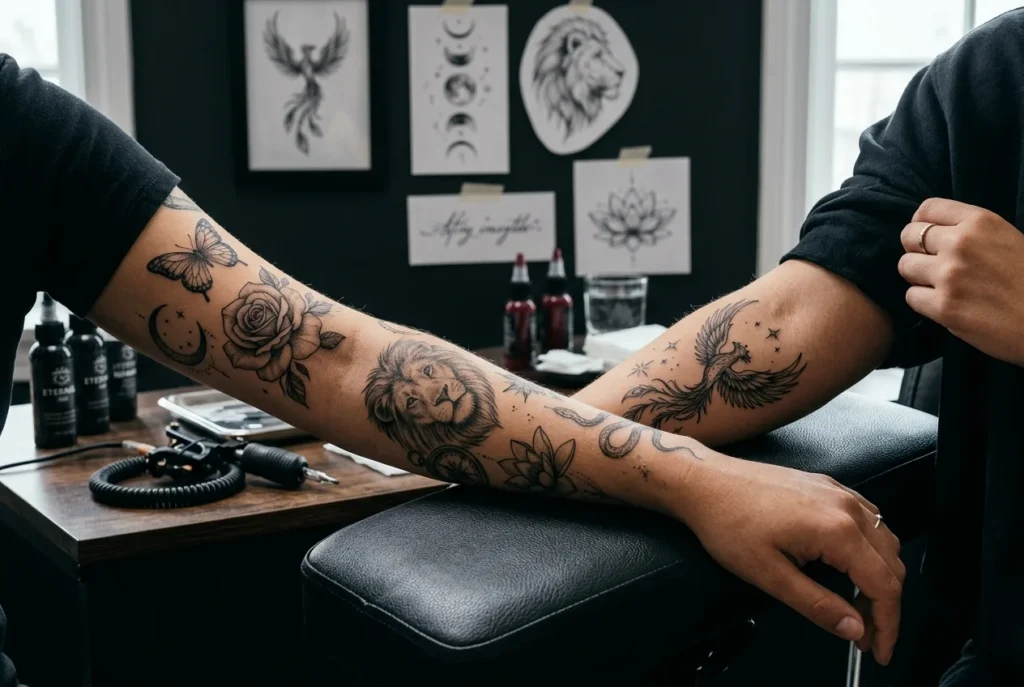
| 1 | 🦋 | Butterfly | Transformation and change | Marks growth or a new chapter |
| 2 | 🐍 | Snake | Renewal, healing, temptation, or danger | Represents shedding an old self |
| 3 | 🦁 | Lion | Courage, strength, leadership | Reflects confidence and resilience |
| 4 | 🐺 | Wolf | Loyalty, family, independence | Connects with family bonds and self-reliance |
| 5 | 🔥 | Phoenix | Rebirth and renewal | Represents rising after hardship |
| 6 | 🐟 | Koi Fish | Perseverance and determination | Suits difficult goals and long journeys |
The 🦋 Butterfly is often linked with transformation because its life cycle visibly changes from one form to another. The 🐍 Snake can suggest renewal through shedding, while its symbolism can also include danger or temptation in some traditions.
The 🦁 Lion is commonly associated with courage and leadership. The 🐺 Wolf can represent loyalty and family as well as independence. The 🔥 Phoenix is a classic image of rebirth, while the 🐟 Koi Fish is associated with perseverance in Japanese cultural storytelling.
Read More: Hyundai Dashboard Symbols and Meanings: Complete Guide
Floral Designs and Their Hidden Languages
Flowers can communicate emotion without words. Floral symbolism often depends on the flower, color, cultural tradition, and personal memory attached to the design.
These choices work well when you want beauty paired with a deeper personal message. Understanding the traditional associations can help you choose imagery that matches the feeling you want to carry.
| # | Symbol | Tattoo Name | Common Association | Design Consideration |
|---|---|---|---|---|
| 7 | 🌹 | Rose | Love, beauty, grief, remembrance | Color can change the traditional association |
| 8 | 🪷 | Lotus | Purity, growth, enlightenment | Strong spiritual associations in Asian traditions |
| 9 | 🌸 | Cherry Blossom | Impermanence and life’s beauty | Closely connected with Japanese culture |
| 10 | 🌺 | Peony | Prosperity, romance, bravery | Meanings vary between Chinese and Japanese traditions |
| 11 | 💜 | Lavender | Calm, serenity, grace | Often chosen for a peaceful visual style |
| 12 | 🌻 | Sunflower | Optimism, loyalty, light | Bright imagery often supports its positive symbolism |
The 🌹 Rose is especially flexible because color can alter its traditional symbolism. Red roses are commonly connected with romantic love, while white roses can suggest purity and remembrance. Black roses are often used to represent grief, loss, or endings.
The 🪷 Lotus is associated with spiritual growth and enlightenment because the plant rises from muddy water before flowering. 🌸 Cherry Blossoms can evoke impermanence, while 🌺 Peonies, 💜 Lavender, and 🌻 Sunflowers offer associations with prosperity, calmness, bravery, optimism, and light.
Geometric and Abstract Symbols
Geometric tattoos use recognizable shapes to express ideas such as balance, infinity, direction, and order. Their symbolism can be simple, mathematical, spiritual, cultural, or entirely personal.
Abstract symbols require extra research because their history may stretch across religions, philosophies, and ancient cultures. Understanding the background can help you avoid attaching an inaccurate meaning to a design.
| # | Symbol | Tattoo Name | Common Association | Key Context |
|---|---|---|---|---|
| 13 | 🔺 | Triangle | Balance, ambition, elements | Direction and tradition influence meaning |
| 14 | ⭕ | Circle | Wholeness and infinity | Often represents no beginning or ending |
| 15 | 🌀 | Mandala | Meditation, balance, wholeness | Connected with Buddhist and Hindu traditions |
| 16 | ✨ | Flower of Life | Sacred geometry and interconnectedness | Part of modern sacred-geometry imagery |
| 17 | 🐍 | Ouroboros | Cycles, renewal, beginning and ending | Serpent eating its own tail |
| 18 | 🏹 | Arrow | Direction, progress, movement | Design and orientation affect interpretation |
The 🔺 Triangle can carry different meanings depending on orientation and tradition. The ⭕ Circle commonly suggests wholeness or cycles. 🌀 Mandalas use circular patterns and have important roles in Buddhist and Hindu contexts, where they can support meditation and spiritual practice.
The 🐍 Ouroboros, a serpent consuming its tail, is associated with cycles and renewal. 🏹 Arrows commonly suggest direction or forward movement. Sacred-geometry designs can be visually striking, but historical and spiritual claims about them should be researched carefully.
Cultural and Spiritual Symbols to Approach Thoughtfully
Cultural and spiritual symbols deserve more research than ordinary decorative motifs. Designs connected with living traditions should be understood within the communities and practices where they originated.
Before choosing one, learn where it comes from, how it is traditionally used, and whether its meaning has been simplified online. This research can help you approach culturally significant designs with greater respect.
| # | Symbol | Tattoo Name | Common Association | Important Consideration |
|---|---|---|---|---|
| 19 | 🪬 | Hamsa Hand | Protection and blessing | Has Jewish and Islamic associations |
| 20 | 🕉️ | Om | Sacred sound and spiritual unity | Important within Hindu traditions |
| 21 | ☸️ | Unalome | A path toward enlightenment | Buddhist cultural and spiritual context matters |
| 22 | 👁️ | Evil Eye | Protection from jealousy or ill will | Found across several cultures |
| 23 | 🧿 | Nazar | Protection | A recognizable form of the evil-eye tradition |
| 24 | ☘️ | Celtic Knot | Eternity and interconnectedness | Different knot patterns have different histories |
| 25 | 🌀 | Maori Patterns | Lineage, identity, achievements | Traditional meanings are culturally specific |
| 26 | 🌊 | Polynesian Patterns | Ancestry, identity, spiritual beliefs | Designs should not be treated as generic decoration |
A symbol can have more than one historical context. The 🪬 Hamsa Hand, for example, appears in Jewish and Islamic traditions, while the 👁️ Evil Eye appears across Mediterranean, Middle Eastern, and South Asian cultures. Context can change how these symbols are understood.
Maori and Polynesian tattoo traditions deserve particularly careful research because traditional patterns can communicate lineage, identity, achievements, and other culturally specific information. Treating such designs as generic decoration can remove important meaning from the original visual language.
Symbols of Resilience and Personal Strength
Some designs are chosen to remember survival, growth, perseverance, or a difficult chapter that changed someone’s life. In these cases, symbolism often becomes a deeply personal reminder rather than a public definition.
These designs can serve as reminders of personal experiences, but the wearer decides what the image means in their own life. Personal interpretation can therefore matter more than a popular online definition.
| # | Symbol | Tattoo Name | Common Association | Personal Theme |
|---|---|---|---|---|
| 27 | ; | Semicolon | Continuation and mental-health awareness | A reminder that a story can continue |
| 28 | ⚓ | Anchor | Stability and groundedness | Connection, home, or steadiness |
| 29 | ⛰️ | Mountain | Obstacles and achievement | A difficult journey or goal |
| 30 | 🌊 | Wave | Change and life’s movement | Acceptance, adaptability, or connection to water |
| 31 | 🧭 | Compass | Guidance and direction | Finding or choosing a path |
| 32 | ⭐ | Star | Hope, guidance, aspiration | Looking toward a goal |
| 33 | 🌳 | Tree | Growth, roots, life | Family, stability, or personal development |
| 34 | ⌛ | Hourglass | Time and mortality | Awareness of change and limited time |
| 35 | 🌅 | Rising Sun | Renewal and new beginnings | A fresh chapter or renewed hope |
The ; Semicolon became associated with mental-health awareness through Project Semicolon and is commonly understood as a symbol of continuation. The ⚓ Anchor often represents stability, while ⛰️ Mountains can represent obstacles overcome and goals reached.
🌊 Waves can suggest life’s changing rhythm and adaptability. A 🧭 Compass often represents guidance. 🌳 Trees, ⌛ Hourglasses, ⭐ Stars, and 🌅 Rising Suns can be personalized around growth, time, hope, and new beginnings.
Read More: Number Meanings: Angel Numbers 000–999 Explained
Choosing Meaning That Will Last
A lasting design usually starts with a personal reason rather than a trend. The most meaningful choices often grow from memories, values, relationships, goals, or experiences that remain relevant over time.
Also consider permanence, placement, size, style, and future circumstances. A consultation with an experienced artist can help turn your idea into a design without making the symbolism feel forced.
| Question to Ask Yourself | Why It Matters |
|---|---|
| What do I want this design to represent? | Clarifies your personal intention |
| Is the symbol culturally specific? | Encourages respectful research |
| Will I still connect with it later? | Helps reduce trend-driven choices |
| Does the placement suit my life? | Considers work, comfort, and visibility |
| Does the artist understand my idea? | Improves communication and design development |
| Have I researched the symbol myself? | Helps avoid inaccurate online interpretations |
Remember that symbolism is not a contract. You can choose a design because it looks beautiful, reminds you of someone, or represents an experience only you understand.
Permanence is the practical issue that deserves equal attention. The FDA notes that tattoos can involve infections, allergic reactions, scarring, and difficulties with removal. Choosing a reputable professional and following appropriate aftercare are important parts of the process.
When You Are Ready to Move Forward
Once you understand the symbol, its cultural background, and your own reason for choosing it, the next step is a thoughtful consultation. A clear idea can also help an artist shape the design around your story.
Do not rush because a design is trending. A tattoo is intended to be permanent, and removal can be difficult, expensive, incomplete, or leave scarring. Give yourself enough time to feel comfortable with both the meaning and the practical commitment.
| Before Booking | What to Check |
|---|---|
| Meaning | Does it genuinely reflect your intention? |
| History | Have you checked reliable sources? |
| Culture | Is the design connected to a living tradition? |
| Artist | Does the artist understand the style you want? |
| Hygiene | Are needles, equipment, and work practices sanitary? |
| Placement | Will the location work for your lifestyle? |
| Aftercare | Do you understand the studio’s care instructions? |
Frequently Asked Questions About Tattoo Meanings in Toronto
People often search for symbolism before booking an appointment, especially when a design has cultural, spiritual, or emotional significance. The questions below focus on common interpretations while recognizing that personal and cultural context can change them.
What tattoo meanings can symbolize overcoming struggle?
🔥 A Phoenix can represent rebirth, ⛰️ mountains can symbolize overcoming challenges, and 🪷 a lotus can represent growth through hardship. A semicolon may symbolize continuation and mental-health awareness.
Do tattoo artists care about tattoo meanings?
Many artists ask about the meaning behind a design to understand your vision. Sharing the feeling or story behind it can make the consultation more helpful.
Can you get a tattoo without a specific meaning?
Yes. Tattoos can simply represent beauty, style, humor, memories, or personal taste. Not every tattoo needs a deep meaning.
How can I understand cultural tattoo meanings?
Research the symbol’s origin, traditional use, and cultural context. Avoid relying on a single online source, especially when using symbols from living traditions.
Can tattoo meanings change depending on the design?
Yes. Color, placement, surrounding elements, culture, and personal experiences can all change how a tattoo is interpreted.
Are tattoo meanings universal?
No. Symbolism varies across cultures and contexts. An image that represents protection in one tradition may have a different meaning elsewhere.
What should I consider besides tattoo meanings?
Consider the artist’s experience, hygiene, placement, size, style, aftercare, and permanence. Tattooing also carries risks such as infection, allergic reactions, scarring, and difficult removal.
Should I copy tattoo meanings or a design I saw online?
Reference images are useful for inspiration, but consider creating an original design that reflects your own story, style, or intention.
How long should I consider tattoo meanings before getting a tattoo?
Take enough time to research the design, understand its cultural context, consider permanence, and discuss your idea with an experienced tattoo artist.
What makes tattoo meanings personal?
A tattoo becomes meaningful through the connection between the image and the wearer. It can represent love, growth, family, survival, memories, beliefs, or personal interests.
Understanding tattoo meanings can help guide your choice, but the most important meaning is the one you personally give your tattoo.

MeaningShelf shares meaningful quotes, thoughtful messages, and helpful word meanings, managed by Lily Anderson, an SEO content writer with 2 years of experience, creating engaging content that inspires readers and helps them find the right words for every moment.
1 thought on “Tattoo Meanings: 35 Symbols Explained Before You Get Inked”